Randall G Kevin, Martin Peter, Macdonald Maurice, Margrett Jennifer, Bishop Alex J, Poon Leonard W
Department of Family and Consumer Sciences, Bradley University, Peoria, IL 61625, USA.
J Aging Res. 2011;2011:280727. doi: 10.4061/2011/280727. Epub 2011 Jul 17.
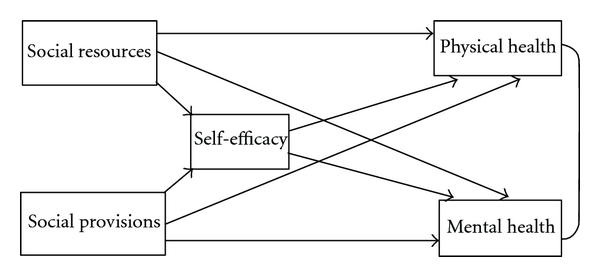
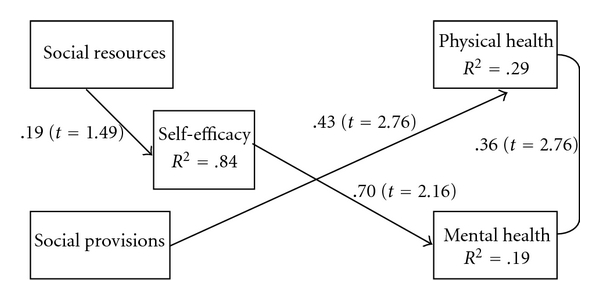
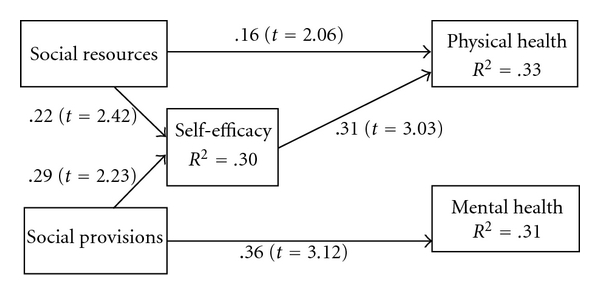
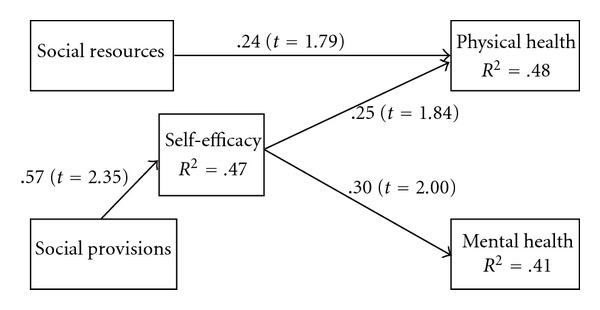
We investigated the influence of social relations on health outcomes in very late life by examining the support-efficacy convoy model among older adults who resided in three different residential environments (centenarians in private homes, n = 126; centenarians in assisted living facilities, n = 55; centenarians in nursing homes, n = 105). For each group, path analytic models were employed to test our hypotheses; analyses controlled for sex, mental status, education, perceived economic sufficiency, and activities of daily living. The hypothesized relationships among the models' variables were unique to each of the three groups; three different models fit the data depending upon residential environment. The direct and indirect effects of social relations assessments were positive for the mental and physical health of very old adults, suggesting that participants welcomed the support. However, residential status moderated the associations between the assessments of social relations, self-efficacy, and both outcomes, physical and mental health.
我们通过研究居住在三种不同居住环境中的老年人(私人住宅中的百岁老人,n = 126;辅助生活设施中的百岁老人,n = 55;养老院中的百岁老人,n = 105)的支持 - 效能护航模型,调查了社会关系对高龄老人健康状况的影响。对于每组,我们采用路径分析模型来检验我们的假设;分析控制了性别、精神状态、教育程度、感知经济充足性和日常生活活动。模型变量之间的假设关系在三组中各不相同;根据居住环境,三种不同的模型拟合了数据。社会关系评估对高龄老人的身心健康具有直接和间接的积极影响,这表明参与者欢迎这种支持。然而,居住状况调节了社会关系评估、自我效能与身心健康这两个结果之间的关联。