Wilson Elizabeth M
Laboratories for Reproductive Biology, Lineberger Comprehensive Cancer Center, Department of Pediatrics, University of North Carolina, Chapel Hill, NC 27599, USA.
Methods Mol Biol. 2011;776:113-29. doi: 10.1007/978-1-61779-243-4_8.
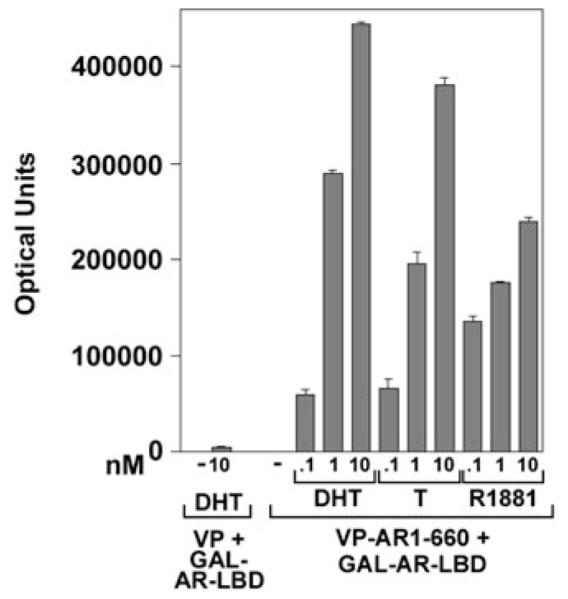
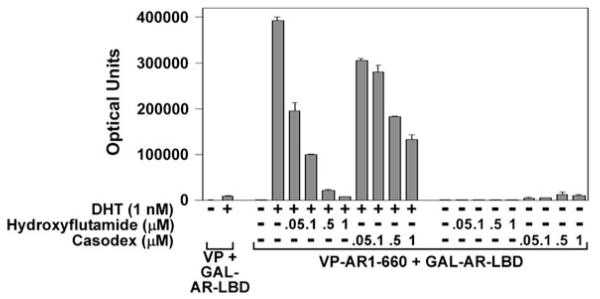
High-affinity binding of testosterone or dihydrotestosterone to the androgen receptor (AR) triggers the androgen-dependent AR NH2- and carboxyl-terminal (N/C) interaction between the AR NH2-terminal FXXLF motif and the activation function 2 (AF2) hydrophobic binding surface in the ligand-binding domain. The functional importance of the AR N/C interaction is supported by naturally occurring loss-of-function AR AF2 mutations where AR retains high-affinity androgen binding but is defective in AR FXXLF motif binding. Ligands with agonist activity in vivo such as testosterone, dihydrotestosterone, and the synthetic anabolic steroids induce the AR N/C interaction and increase AR transcriptional activity in part by slowing the dissociation rate of bound ligand and stabilizing AR against degradation. AR ligand-binding domain competitive antagonists inhibit the agonist-dependent AR N/C interaction. Although the human AR N/C interaction is important for transcriptional activity, it has an inhibitory effect on transcriptional activity from AF2 by competing for p160 coactivator LXXLL motif binding. The primate-specific AR coregulatory protein, melanoma antigen gene protein-A11 (MAGE-A11), modulates the AR N/C interaction through a direct interaction with the AR FXXLF motif. Inhibition of AF2 transcriptional activity by the AR N/C interaction is relieved by AR FXXLF motif binding to the F-box region of MAGE-11. Described here are methods to measure the androgen-dependent AR N/C interdomain interaction and the influence of transcriptional coregulators.
睾酮或双氢睾酮与雄激素受体(AR)的高亲和力结合会触发雄激素依赖性的AR氨基末端和羧基末端(N/C)相互作用,该相互作用发生在AR氨基末端的FXXLF基序与配体结合域中的激活功能2(AF2)疏水结合表面之间。AR N/C相互作用的功能重要性得到了自然发生的功能丧失型AR AF2突变的支持,在这些突变中,AR保留了高亲和力的雄激素结合能力,但在AR FXXLF基序结合方面存在缺陷。体内具有激动剂活性的配体,如睾酮、双氢睾酮和合成代谢类固醇,会诱导AR N/C相互作用,并部分通过减缓结合配体的解离速率和稳定AR以防止其降解来增加AR转录活性。AR配体结合域竞争性拮抗剂会抑制激动剂依赖性AR N/C相互作用。尽管人类AR N/C相互作用对转录活性很重要,但它通过竞争p160共激活因子LXXLL基序结合对AF2的转录活性具有抑制作用。灵长类动物特异性的AR共调节蛋白,黑色素瘤抗原基因蛋白-A11(MAGE-A11),通过与AR FXXLF基序直接相互作用来调节AR N/C相互作用。AR FXXLF基序与MAGE-11的F-box区域结合可缓解AR N/C相互作用对AF2转录活性的抑制作用。本文描述了测量雄激素依赖性AR N/C结构域间相互作用以及转录共调节因子影响的方法。