McKusick-Nathans Institute of Genetic Medicine, Johns Hopkins University School of Medicine, Baltimore, MD 21205, USA.
Skelet Muscle. 2011 May 4;1(1):19. doi: 10.1186/2044-5040-1-19.
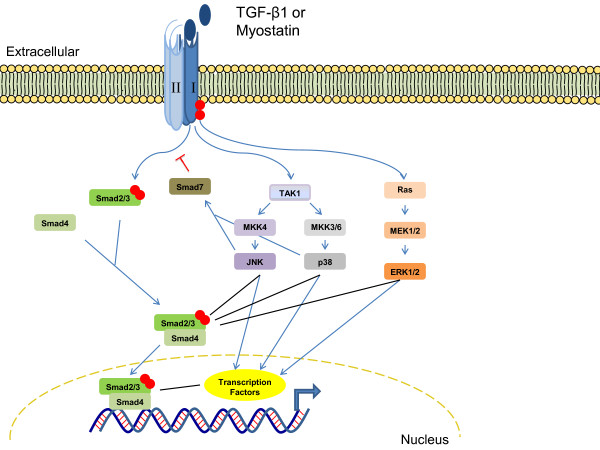
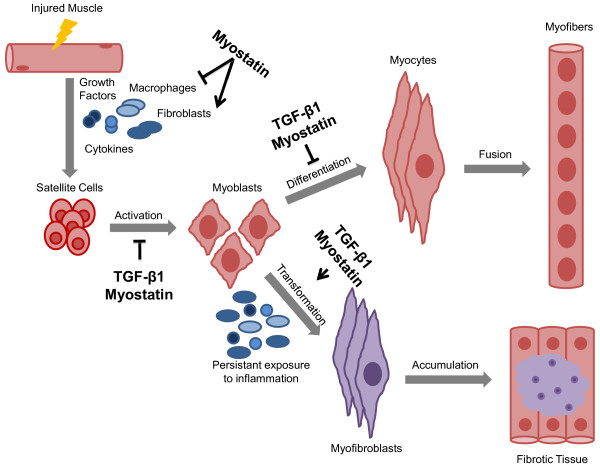
The transforming growth factor-beta (TGF-β) superfamily consists of a variety of cytokines expressed in many different cell types including skeletal muscle. Members of this superfamily that are of particular importance in skeletal muscle are TGF-β1, mitogen-activated protein kinases (MAPKs), and myostatin. These signaling molecules play important roles in skeletal muscle homeostasis and in a variety of inherited and acquired neuromuscular disorders. Expression of these molecules is linked to normal processes in skeletal muscle such as growth, differentiation, regeneration, and stress response. However, chronic elevation of TGF-β1, MAPKs, and myostatin is linked to various features of muscle pathology, including impaired regeneration and atrophy. In this review, we focus on the aberrant signaling of TGF-β in various disorders such as Marfan syndrome, muscular dystrophies, sarcopenia, and critical illness myopathy. We also discuss how the inhibition of several members of the TGF-β signaling pathway has been implicated in ameliorating disease phenotypes, opening up novel therapeutic avenues for a large group of neuromuscular disorders.
转化生长因子-β(TGF-β)超家族由多种细胞因子组成,这些细胞因子在许多不同的细胞类型中表达,包括骨骼肌。在骨骼肌中特别重要的该超家族成员有 TGF-β1、丝裂原活化蛋白激酶(MAPK)和肌肉生长抑制素。这些信号分子在骨骼肌的稳态和各种遗传性和获得性神经肌肉疾病中发挥重要作用。这些分子的表达与骨骼肌的正常过程有关,如生长、分化、再生和应激反应。然而,TGF-β1、MAPK 和肌肉生长抑制素的慢性升高与肌肉病理学的各种特征有关,包括再生受损和萎缩。在这篇综述中,我们重点讨论了 TGF-β 在马凡综合征、肌肉营养不良症、肌肉减少症和危重病性肌病等各种疾病中的异常信号转导。我们还讨论了抑制 TGF-β 信号通路的几个成员如何被牵连到改善疾病表型中,为一大组神经肌肉疾病开辟了新的治疗途径。