Department of Public Health, Erasmus MC, University Medical Centre Rotterdam, Rotterdam, The Netherlands.
PLoS One. 2011;6(7):e21919. doi: 10.1371/journal.pone.0021919. Epub 2011 Jul 20.
Since November 2009, WHO recommends that adults infected with HIV should initiate antiretroviral therapy (ART) at CD4+ cell counts of ≤350 cells/µl rather than ≤200 cells/µl. South Africa decided to adopt this strategy for pregnant and TB co-infected patients only. We estimated the impact of fully adopting the new WHO guidelines on HIV epidemic dynamics and associated costs.
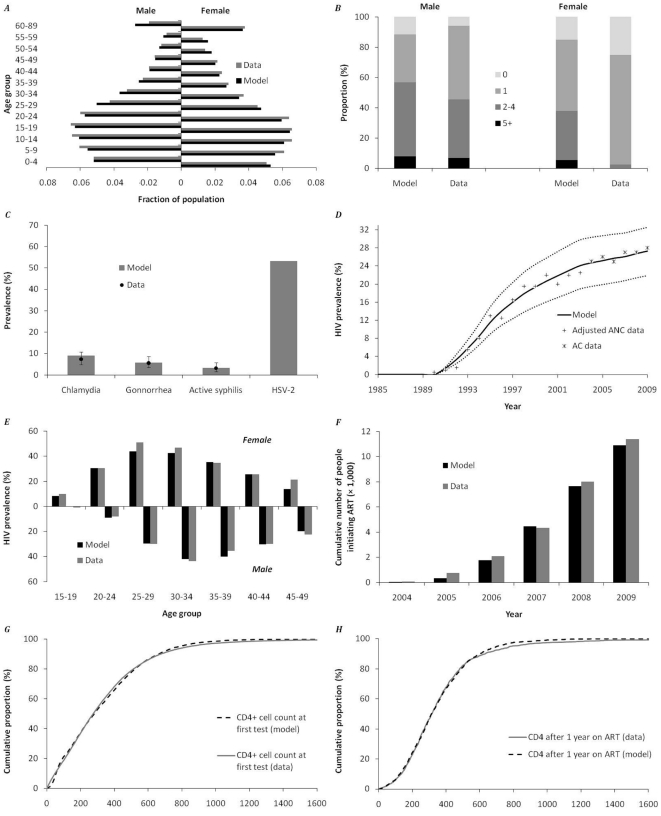
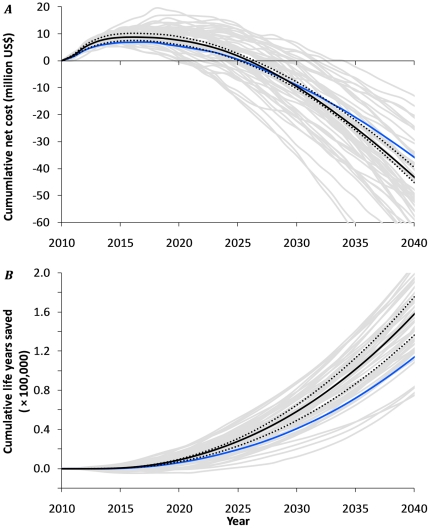
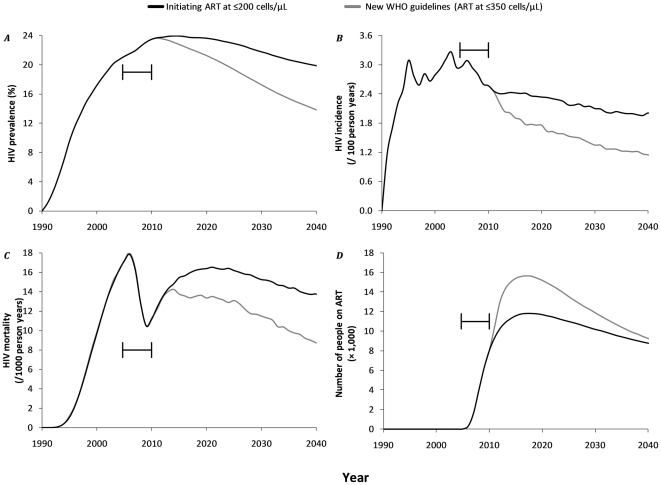
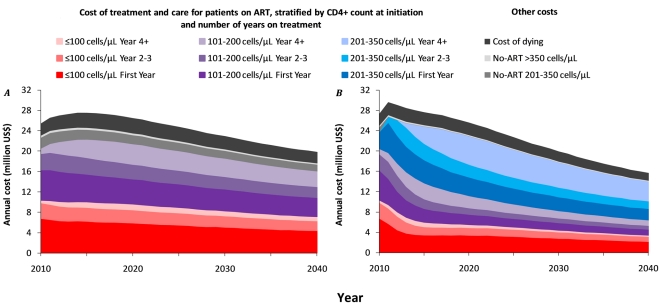
We used an established model of the transmission and control of HIV in specified sexual networks and healthcare settings. We quantified the model to represent Hlabisa subdistrict, KwaZulu-Natal, South Africa. We predicted the HIV epidemic dynamics, number on ART and program costs under the new guidelines relative to treating patients at ≤200 cells/µl for the next 30 years. During the first five years, the new WHO treatment guidelines require about 7% extra annual investments, whereas 28% more patients receive treatment. Furthermore, there will be a more profound impact on HIV incidence, leading to relatively less annual costs after seven years. The resulting cumulative net costs reach a break-even point after on average 16 years.
Our study strengthens the WHO recommendation of starting ART at ≤350 cells/µl for all HIV-infected patients. Apart from the benefits associated with many life-years saved, a modest frontloading appears to lead to net savings within a limited time-horizon. This finding is robust to alternative assumptions and foreseeable changes in ART prices and effectiveness. Therefore, South Africa should aim at rapidly expanding its healthcare infrastructure to fully embrace the new WHO guidelines.
自 2009 年 11 月以来,世界卫生组织(WHO)建议 CD4+细胞计数≤350 个/μl 的成人感染艾滋病毒后应开始接受抗逆转录病毒治疗(ART),而不是≤200 个/μl。南非仅决定为感染艾滋病毒和结核病的孕妇和患者采用这一策略。我们估计完全采用新的世卫组织指南对艾滋病毒流行动态和相关费用的影响。
我们使用了一个既定的模型来模拟特定性网络和医疗保健环境中艾滋病毒的传播和控制。我们对模型进行了量化,以代表夸祖鲁-纳塔尔省赫拉比萨次区域。我们预测了在未来 30 年内,新的世卫组织指南下艾滋病毒流行动态、接受 ART 的人数和方案成本,与治疗 CD4+细胞计数≤200 个/μl 的患者相比。在最初的五年中,新的世卫组织治疗指南需要额外投入约 7%的年度投资,而接受治疗的患者则增加了 28%。此外,这将对艾滋病毒发病率产生更深远的影响,导致七年之后年度费用相对减少。累计净成本平均在 16 年后达到收支平衡点。
我们的研究加强了世卫组织对所有感染艾滋病毒的患者均应在 CD4+细胞计数≤350 个/μl 时开始接受 ART 的建议。除了与挽救大量生命年相关的益处外,适度的前期投入似乎在有限的时间内带来了净节省。这一发现对 ART 价格和有效性的替代假设和可预见变化具有稳健性。因此,南非应致力于快速扩大其医疗保健基础设施,以全面采纳新的世卫组织指南。