Department of Plant Sciences, University of Oxford, South Parks Road, Oxford OX1 3RB, UK.
Curr Biol. 2011 Aug 23;21(16):1385-90. doi: 10.1016/j.cub.2011.07.002. Epub 2011 Jul 28.
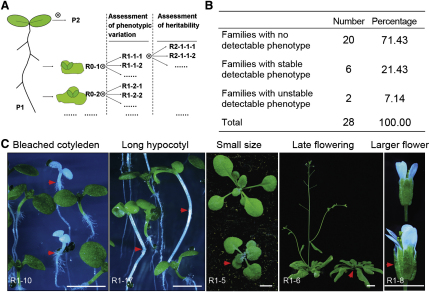
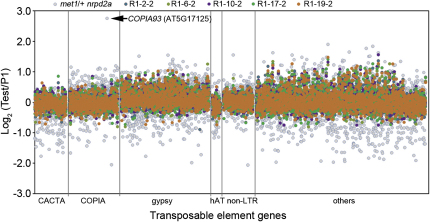
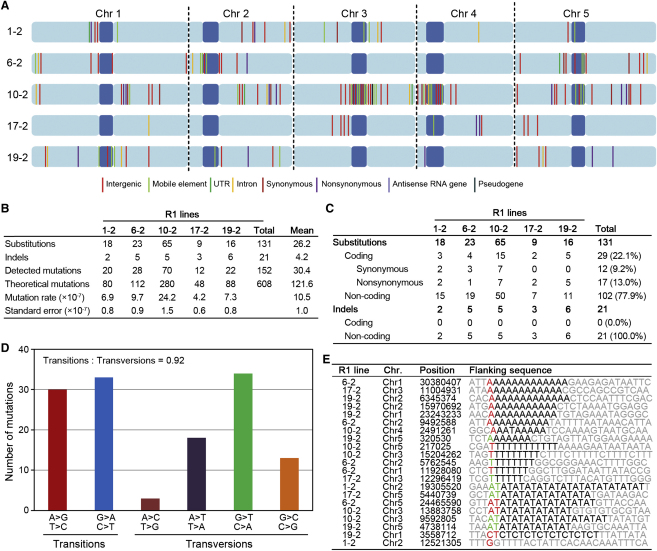
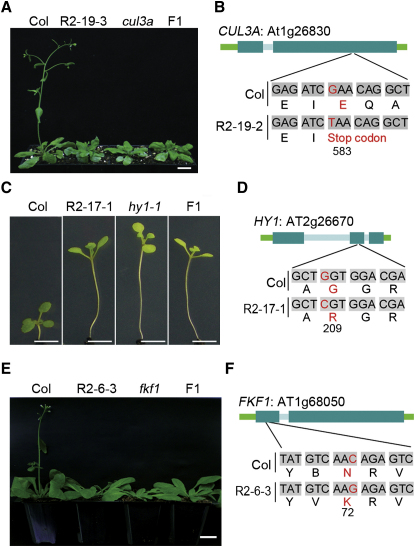
Multicellular organisms can be regenerated from totipotent differentiated somatic cell or nuclear founders [1-3]. Organisms regenerated from clonally related isogenic founders might a priori have been expected to be phenotypically invariant. However, clonal regenerant animals display variant phenotypes caused by defective epigenetic reprogramming of gene expression [2], and clonal regenerant plants exhibit poorly understood heritable phenotypic ("somaclonal") variation [4-7]. Here we show that somaclonal variation in regenerant Arabidopsis lineages is associated with genome-wide elevation in DNA sequence mutation rate. We also show that regenerant mutations comprise a distinctive molecular spectrum of base substitutions, insertions, and deletions that probably results from decreased DNA repair fidelity. Finally, we show that while regenerant base substitutions are a likely major genetic cause of the somaclonal variation of regenerant Arabidopsis lineages, transposon movement is unlikely to contribute substantially to that variation. We conclude that the phenotypic variation of regenerant plants, unlike that of regenerant animals, is substantially due to DNA sequence mutation.
多细胞生物可以从全能分化的体细胞或核供体中再生[1-3]。从克隆相关的同基因供体再生的生物在理论上应该具有表型不变性。然而,克隆再生动物表现出由基因表达的表观遗传重编程缺陷引起的变体表型[2],并且克隆再生植物表现出尚未完全理解的可遗传表型(“体细胞无性系”)变异[4-7]。在这里,我们表明再生拟南芥谱系中的体细胞无性系变异与全基因组 DNA 序列突变率升高有关。我们还表明,再生突变包含碱基替换、插入和缺失的独特分子谱,这可能是由于 DNA 修复保真度降低所致。最后,我们表明,虽然再生碱基替换可能是再生拟南芥谱系体细胞无性系变异的主要遗传原因,但转座子运动不太可能对该变异做出重大贡献。我们的结论是,与再生动物不同,再生植物的表型变异在很大程度上是由于 DNA 序列突变所致。