Maurya Indubala, Pawar Mridula, Garg Rakesh, Kaur Mohandeep, Sood Rajesh
Department of Anaesthesiology and Intensive Care, Postgraduate Institute of Medical Education and Research, Dr. Ram Manohar Lohia Hospital, New Delhi, India.
Saudi J Anaesth. 2011 Apr;5(2):195-201. doi: 10.4103/1658-354X.82800.
Measurement of respiratory quotient (RQ) and resting energy expenditure (REE) has been shown to be helpful in designing nutritional regimens. There is a paucity of the literature describing the impact of a feeding regimen on the energy expenditure patterns. Therefore, we studied the effect of continuous vs. intermittent feeding regimen in head-injured patients on mechanical ventilation on RQ and REE.
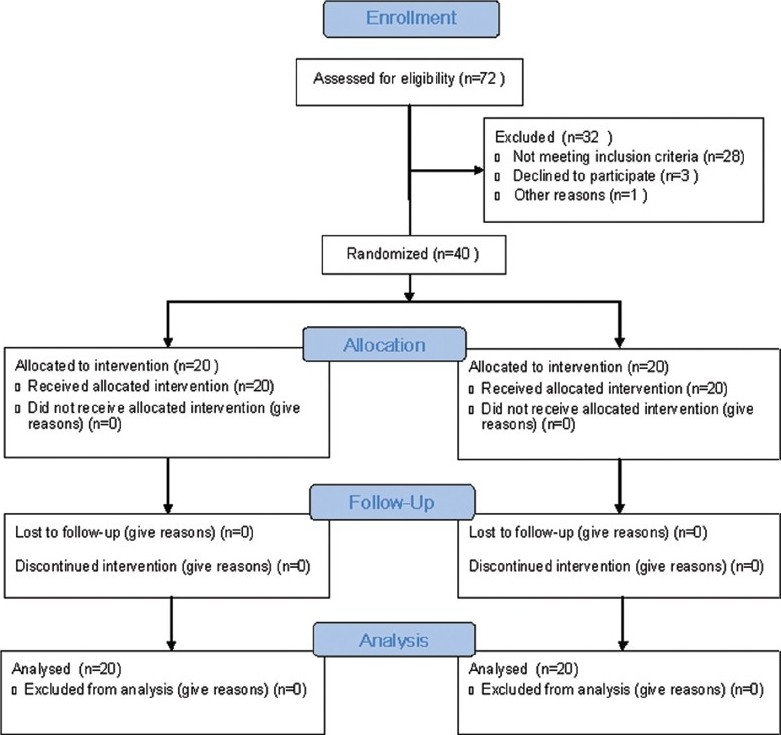
After institutional ethical approval, this randomized study was conducted in 40 adult male patients with head injury requiring controlled mode of ventilation. Patients were randomly allocated into two groups. Group C: Feeds (30 kcal/kg/day) were given for 18 h/day, with night rest for 6 h. Group I: Six bolus feeds (30 kcal/kg/day) were given three hourly for 18 h with night rest for 6 h. RQ and REE were recorded every 30 min for 24 h. Blood sugar was measured 4 hourly. Other adverse effects such as feed intolerance, aspiration were noted.
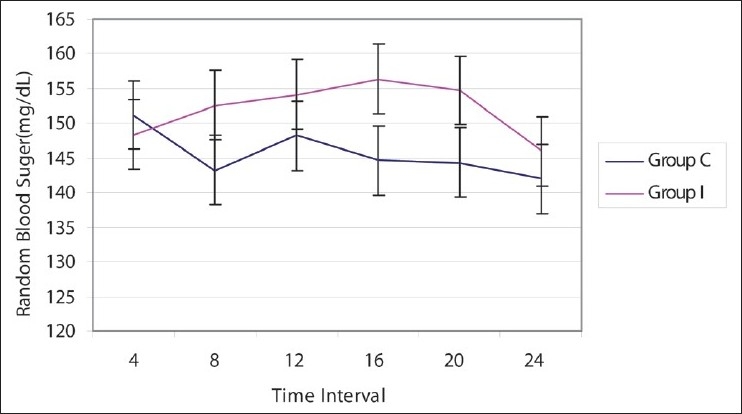
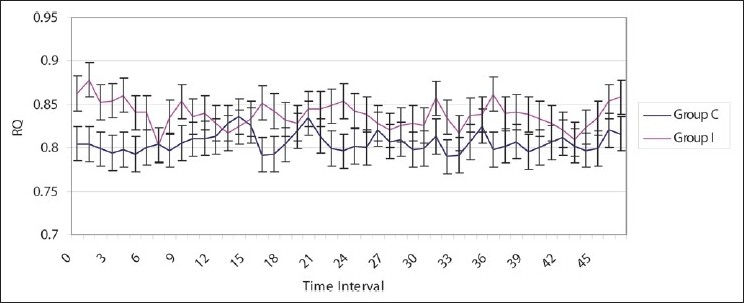
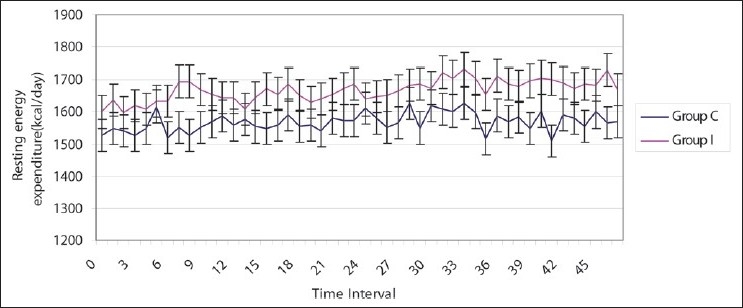
Demographic profile and SOFA score were comparable in the two groups. Base line RQ (0.8 vs. 0.86) and REE (1527 vs. 1599 kcal/day) were comparable in both the groups (P>0.05). RQ was comparable in both groups during the study period at any time of the day (P>0.05). Base line RQ was compared with all other RQ values measured every half hour and fluctuation from the base line value was insignificant in both groups (P>0.05). REE was comparable in both the groups throughout the study period (P>0.5). Adequacy of feeding as assessed by EI/MREE was 105.7% and 105.3% in group C and group I, respectively. There was no significant difference in the blood sugar levels between the two groups (P>0.05).
We found from our study that RQ, REE, and blood sugar remain comparable with two regimens of enteral feeding - continuous vs. intermittent in neurosurgical patients on ventilator support in a ICU setup.
呼吸商(RQ)和静息能量消耗(REE)的测量已被证明有助于设计营养方案。关于喂养方案对能量消耗模式影响的文献较少。因此,我们研究了持续喂养与间歇喂养方案对机械通气的颅脑损伤患者的RQ和REE的影响。
经机构伦理批准后,对40例需要控制通气模式的成年男性颅脑损伤患者进行了这项随机研究。患者被随机分为两组。C组:每天给予18小时的喂养(30千卡/千克/天),夜间休息6小时。I组:每三小时给予六次推注喂养(30千卡/千克/天),持续18小时,夜间休息6小时。每30分钟记录一次RQ和REE,持续24小时。每4小时测量一次血糖。记录其他不良反应,如喂养不耐受、误吸。
两组的人口统计学特征和序贯器官衰竭评估(SOFA)评分相当。两组的基线RQ(0.8对0.86)和REE(1527对1599千卡/天)相当(P>0.05)。在研究期间的任何时间,两组的RQ相当(P>0.05)。将基线RQ与每半小时测量的所有其他RQ值进行比较,两组与基线值的波动均无显著差异(P>0.05)。在整个研究期间,两组的REE相当(P>0.5)。以能量摄入(EI)与静息能量消耗(MREE)评估的喂养充足率在C组和I组分别为105.7%和105.3%。两组之间的血糖水平无显著差异(P>0.05)。
我们从研究中发现,在重症监护病房(ICU)中接受呼吸机支持的神经外科患者中,肠内喂养的两种方案——持续喂养与间歇喂养,其RQ、REE和血糖水平相当。