Department of Microbiology and Molecular Genetics, University of Pittsburgh School of Medicine, Pittsburgh, Pennsylvania, United States of America.
PLoS One. 2011;6(7):e22053. doi: 10.1371/journal.pone.0022053. Epub 2011 Jul 11.
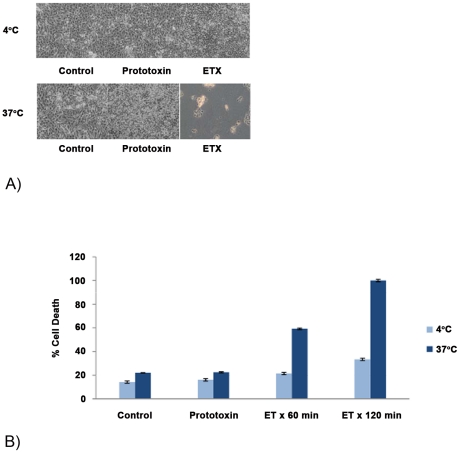
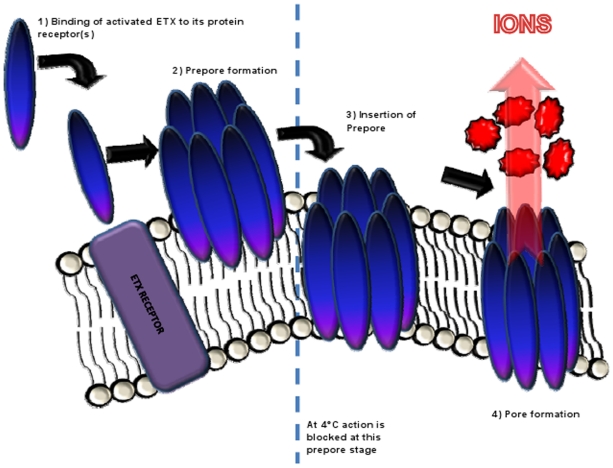
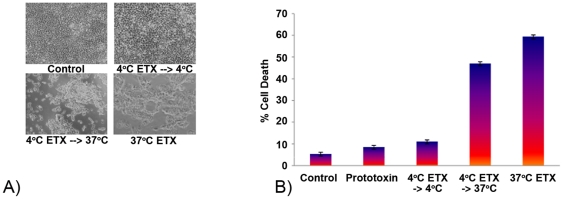
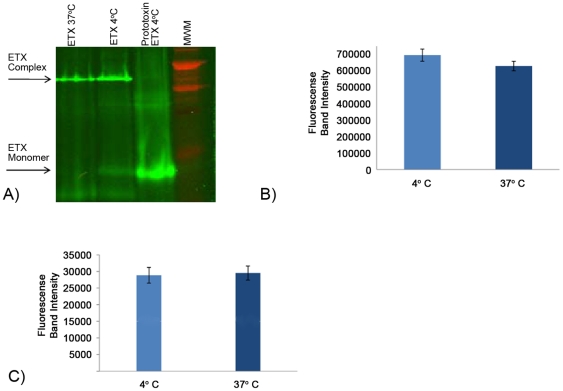
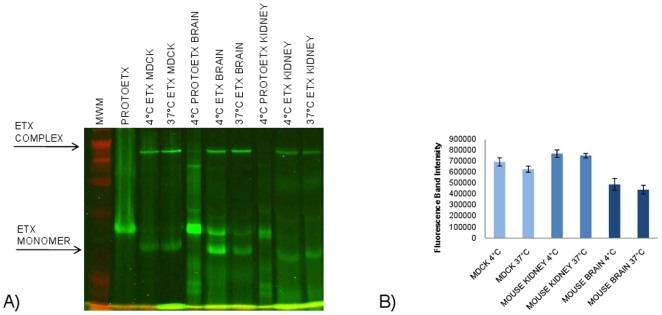
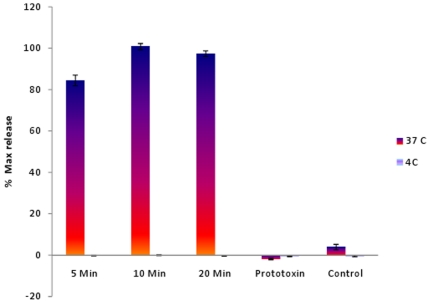
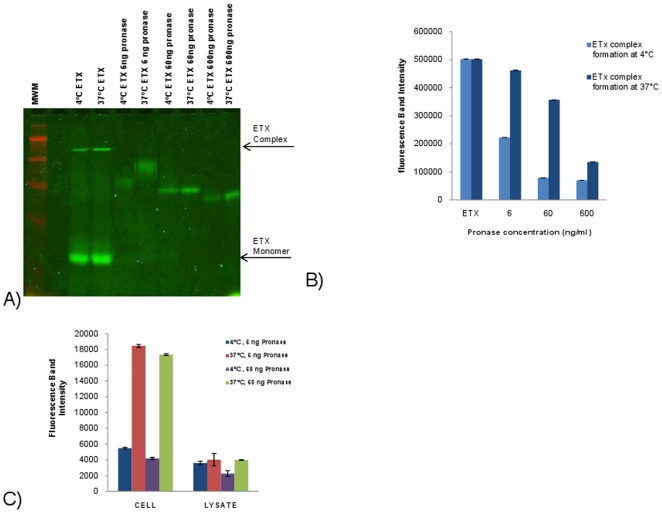
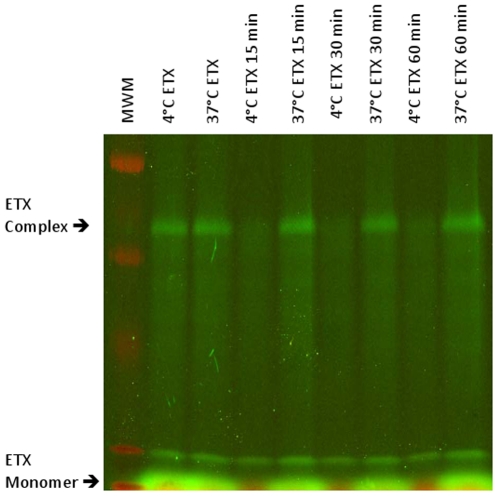
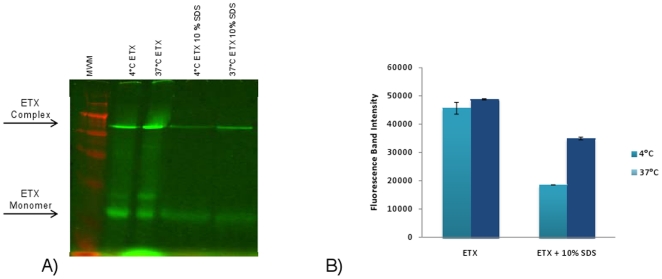
Clostridium perfringens epsilon toxin (ETX) rapidly kills MDCK II cells at 37°C, but not 4°C. The current study shows that, in MDCK II cells, ETX binds and forms an oligomeric complex equally well at 37°C and 4°C but only forms a pore at 37°C. However, the complex formed in MDCK cells treated with ETX at 4°C has the potential to form an active pore, since shifting those cells to 37°C results in rapid cytotoxicity. Those results suggested that the block in pore formation at 4°C involves temperature-related trapping of ETX in a prepore intermediate on the MDCK II cell plasma membrane surface. Evidence supporting this hypothesis was obtained when the ETX complex in MDCK II cells was shown to be more susceptible to pronase degradation when formed at 4°C vs. 37°C; this result is consistent with ETX complex formed at 4°C remaining present in an exposed prepore on the membrane surface, while the ETX prepore complex formed at 37°C is unaccessible to pronase because it has inserted into the plasma membrane to form an active pore. In addition, the ETX complex rapidly dissociated from MDCK II cells at 4°C, but not 37°C; this result is consistent with the ETX complex being resistant to dissociation at 37°C because it has inserted into membranes, while the ETX prepore readily dissociates from cells at 4°C because it remains on the membrane surface. These results support the identification of a prepore stage in ETX action and suggest a revised model for ETX cytotoxicity, i) ETX binds to an unidentified receptor, ii) ETX oligomerizes into a prepore on the membrane surface, and iii) the prepore inserts into membranes, in a temperature-sensitive manner, to form an active pore.
产气荚膜梭菌 ε 毒素(ETX)在 37°C 时迅速杀死 MDCK II 细胞,但在 4°C 时则不然。本研究表明,在 MDCK II 细胞中,ETX 在 37°C 和 4°C 时同样良好地结合并形成寡聚复合物,但仅在 37°C 时形成孔。然而,在 4°C 下用 ETX 处理的 MDCK 细胞中形成的复合物具有形成活性孔的潜力,因为将这些细胞转移到 37°C 会导致快速细胞毒性。这些结果表明,在 4°C 时孔形成受阻是由于 ETX 在 MDCK II 细胞膜表面的前孔中间体中与温度相关的捕获。当在 4°C 下形成的 ETX 复合物比在 37°C 下更容易被蛋白酶降解时,获得了支持该假说的证据;这一结果与在 4°C 下形成的 ETX 复合物仍然存在于膜表面的暴露前孔中一致,而在 37°C 下形成的 ETX 前孔复合物无法被蛋白酶降解,因为它已插入质膜形成活性孔。此外,ETX 复合物在 4°C 下从 MDCK II 细胞中迅速解离,但在 37°C 下则不然;这一结果与 ETX 复合物在 37°C 下不易解离的结果一致,因为它已插入膜中,而 ETX 前孔在 4°C 下容易从细胞中解离,因为它仍留在膜表面。这些结果支持 ETX 作用中存在前孔阶段的鉴定,并提出了 ETX 细胞毒性的修订模型,即 i)ETX 结合到未鉴定的受体上,ii)ETX 在膜表面上寡聚化成前孔,iii)前孔以温度敏感的方式插入膜中,形成活性孔。