Department of Pharmacology, Emory University School of Medicine, Atlanta, GA, USA.
Mol Brain. 2011 Aug 10;4:32. doi: 10.1186/1756-6606-4-32.
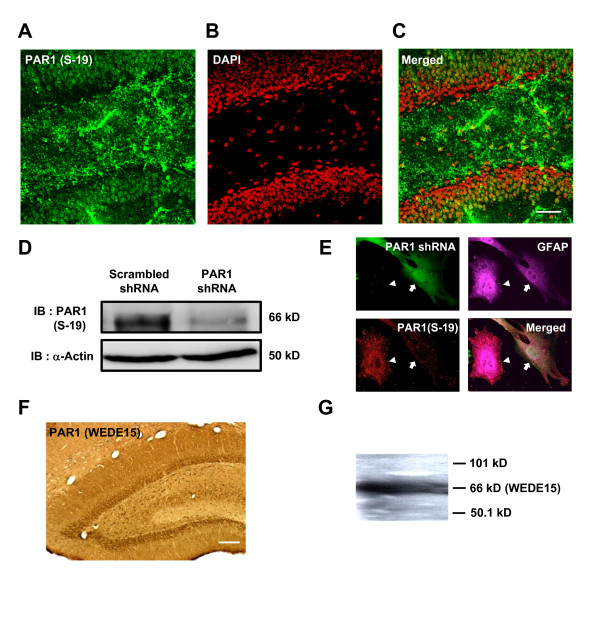
Protease activated receptor-1 (PAR1) is expressed in multiple cell types in the CNS, with the most prominent expression in glial cells. PAR1 activation enhances excitatory synaptic transmission secondary to the release of glutamate from astrocytes following activation of astrocytically-expressed PAR1. In addition, PAR1 activation exacerbates neuronal damage in multiple in vivo models of brain injury in a manner that is dependent on NMDA receptors. In the hippocampal formation, PAR1 mRNA appears to be expressed by a subset of neurons, including granule cells in the dentate gyrus. In this study we investigate the role of PAR activation in controlling neuronal excitability of dentate granule cells. We confirm that PAR1 protein is expressed in neurons of the dentate cell body layer as well as in astrocytes throughout the dentate. Activation of PAR1 receptors by the selective peptide agonist TFLLR increased the intracellular Ca2+ concentration in a subset of acutely dissociated dentate neurons as well as non-neuronal cells. Bath application of TFLLR in acute hippocampal slices depolarized the dentate gyrus, including the hilar region in wild type but not in the PAR1-/- mice. PAR1 activation increased the frequency of action potential generation in a subset of dentate granule neurons; cells in which PAR1 activation triggered action potentials showed a significant depolarization. The activation of PAR1 by thrombin increased the amplitude of NMDA receptor-mediated component of EPSPs. These data suggest that activation of PAR1 during normal function or pathological conditions, such as during ischemia or hemorrhage, can increase the excitability of dentate granule cells.
蛋白酶激活受体-1(PAR1)在中枢神经系统的多种细胞类型中表达,在神经胶质细胞中表达最为突出。PAR1 的激活增强了兴奋性突触传递,这是由于星形胶质细胞表达的 PAR1 激活后谷氨酸从星形胶质细胞中释放。此外,PAR1 的激活以依赖 NMDA 受体的方式加剧了多种脑损伤的体内模型中的神经元损伤。在海马结构中,PAR1 mRNA 似乎由包括齿状回颗粒细胞在内的一部分神经元表达。在这项研究中,我们研究了 PAR 激活在控制齿状回颗粒细胞神经元兴奋性中的作用。我们证实 PAR1 蛋白在齿状体细胞层的神经元以及整个齿状回的星形胶质细胞中表达。选择性肽激动剂 TFLLR 激活 PAR1 受体增加了急性分离的齿状回神经元以及非神经元细胞中的细胞内 Ca2+浓度。在急性海马切片中,TFLLR 的浴应用使野生型的齿状回去极化,包括 hilar 区,但在 PAR1-/- 小鼠中则没有。PAR1 的激活增加了一部分齿状回颗粒神经元中动作电位产生的频率;PAR1 激活引发动作电位的细胞表现出明显的去极化。凝血酶激活 PAR1 增加了 NMDA 受体介导的 EPSP 的幅度。这些数据表明,PAR1 的激活在正常功能或病理条件下,例如在缺血或出血期间,可增加齿状回颗粒细胞的兴奋性。