Department of Neuroscience, Novartis Institutes for BioMedical Research, Novartis Pharma AG, CH-4002 Basel, Switzerland.
Hum Mol Genet. 2011 Nov 1;20(21):4209-23. doi: 10.1093/hmg/ddr348. Epub 2011 Aug 9.
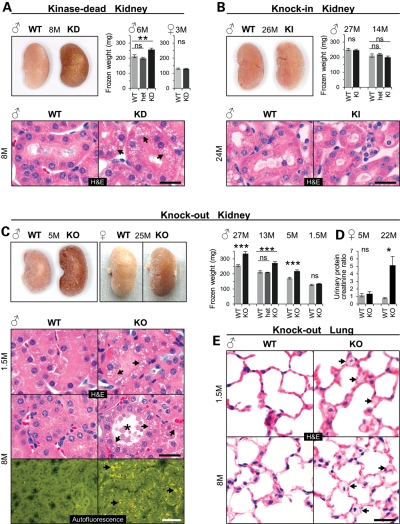
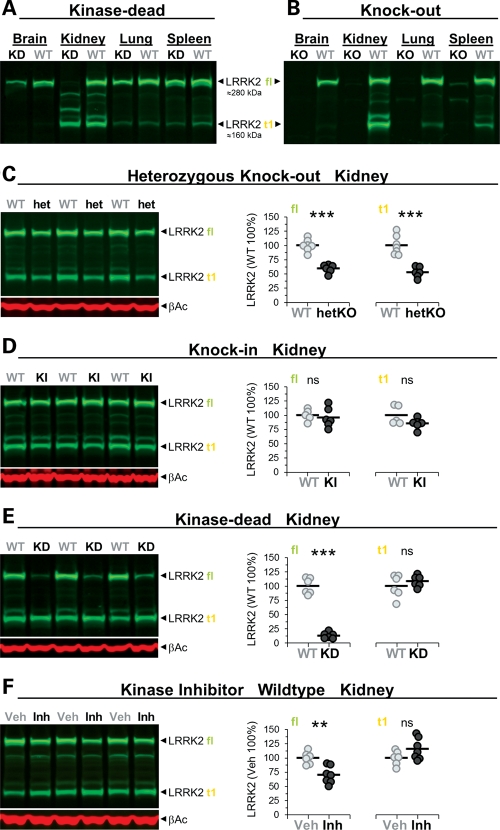
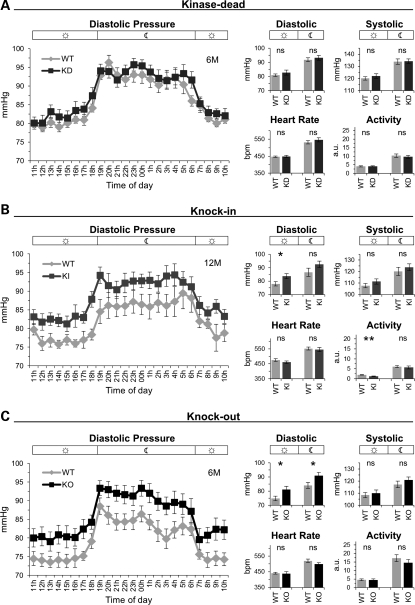
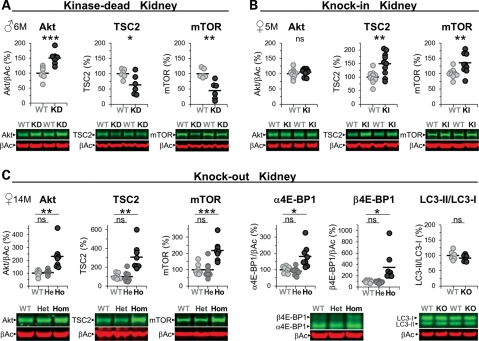
Mutations in leucine-rich repeat kinase 2 (LRRK2) cause late-onset Parkinson's disease (PD), but the underlying pathophysiological mechanisms and the normal function of this large multidomain protein remain speculative. To address the role of this protein in vivo, we generated three different LRRK2 mutant mouse lines. Mice completely lacking the LRRK2 protein (knock-out, KO) showed an early-onset (age 6 weeks) marked increase in number and size of secondary lysosomes in kidney proximal tubule cells and lamellar bodies in lung type II cells. Mice expressing a LRRK2 kinase-dead (KD) mutant from the endogenous locus displayed similar early-onset pathophysiological changes in kidney but not lung. KD mutants had dramatically reduced full-length LRRK2 protein levels in the kidney and this genetic effect was mimicked pharmacologically in wild-type mice treated with a LRRK2-selective kinase inhibitor. Knock-in (KI) mice expressing the G2019S PD-associated mutation that increases LRRK2 kinase activity showed none of the LRRK2 protein level and histopathological changes observed in KD and KO mice. The autophagy marker LC3 remained unchanged but kidney mTOR and TCS2 protein levels decreased in KD and increased in KO and KI mice. Unexpectedly, KO and KI mice suffered from diastolic hypertension opposed to normal blood pressure in KD mice. Our findings demonstrate a role for LRRK2 in kidney and lung physiology and further show that LRRK2 kinase function affects LRRK2 protein steady-state levels thereby altering putative scaffold/GTPase activity. These novel aspects of peripheral LRRK2 biology critically impact ongoing attempts to develop LRRK2 selective kinase inhibitors as therapeutics for PD.
LRRK2(富含亮氨酸重复激酶 2)突变可导致迟发性帕金森病(PD),但这种大型多功能蛋白的潜在病理生理机制和正常功能仍存在推测。为了研究该蛋白在体内的作用,我们构建了三种不同的 LRRK2 突变小鼠品系。完全缺乏 LRRK2 蛋白的小鼠(敲除,KO)表现出肾近端小管细胞次级溶酶体数量和大小的早期(6 周龄)显著增加,以及肺 II 型细胞板层体的增加。表达内源性基因座 LRRK2 激酶失活(KD)突变的小鼠在肾中表现出类似的早期发病的病理生理变化,但在肺中没有。KD 突变体的肾中全长 LRRK2 蛋白水平显著降低,这种遗传效应在野生型小鼠中用 LRRK2 选择性激酶抑制剂处理时得到模拟。表达增加 LRRK2 激酶活性的 PD 相关 G2019S 突变的 LRRK2 敲入(KI)小鼠没有观察到 KD 和 KO 小鼠中观察到的 LRRK2 蛋白水平和组织病理学变化。自噬标记物 LC3 保持不变,但 KD 和 KO 小鼠的肾 mTOR 和 TCS2 蛋白水平降低,而 KI 小鼠的则增加。出乎意料的是,KO 和 KI 小鼠发生舒张期高血压,而 KD 小鼠的血压正常。我们的研究结果表明 LRRK2 在肾和肺生理中起作用,进一步表明 LRRK2 激酶功能影响 LRRK2 蛋白的稳态水平,从而改变假定的支架/GTP 酶活性。这些外周 LRRK2 生物学的新方面对正在进行的开发 LRRK2 选择性激酶抑制剂作为 PD 治疗方法的尝试具有重要影响。