Blood Systems Research Institute, San Francisco, California, United States of America.
PLoS One. 2011;6(8):e22948. doi: 10.1371/journal.pone.0022948. Epub 2011 Aug 1.
West Nile virus (WNV) infection is asymptomatic in most individuals, with a minority developing symptoms ranging from WNV fever to serious neuroinvasive disease. This study investigated the impact of host HLA on the outcome of WNV disease.
A cohort of 210 non-Hispanic mostly white WNV(+) subjects from Canada and the U.S. were typed for HLA-A, B, C, DP, DQ, and DR. The study subjects were divided into three WNV infection outcome groups: asymptomatic (AS), symptomatic (S), and neuroinvasive disease (ND). Allele frequency distribution was compared pair-wise between the AS, S, and ND groups using χ2 and Fisher's exact tests and P values were corrected for multiple comparisons (Pc). Allele frequencies were compared between the groups and the North American population (NA) used as a control group. Logistic regression analysis was used to evaluate the potential synergistic effect of age and HLA allele phenotype on disease outcome.
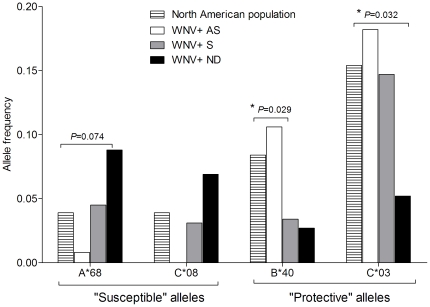
The alleles HLA-A68, C08 and DQB05 were more frequently associated with severe outcomes (ND vs. AS, P(A68) = 0.013/Pc = 0.26, P(C08) = 0.0075/Pc = 0.064, and P(DQB105) = 0.029/Pc = 0.68), However the apparent DQB105 association was driven by age. The alleles HLA-B40 and C03 were more frequently associated with asymptomatic outcome (AS vs. S, P(B40) = 0.021/Pc = 0.58 and AS vs. ND P(C03) = 0.039/Pc = 0.64) and their frequencies were lower within WNV(+) subjects with neuroinvasive disease than within the North American population (NA vs. S, P(B40) = 0.029 and NA vs. ND, P(C*03) = 0.032).
Host HLA may be associated with the outcome of WNV disease; HLA-A68 and C08 might function as "susceptible" alleles, whereas HLA-B40 and C03 might function as "protective" alleles.
西尼罗河病毒(WNV)感染在大多数个体中无症状,少数个体出现症状范围从 WNV 发热到严重的神经侵袭性疾病。本研究调查了宿主 HLA 对 WNV 疾病结局的影响。
本研究纳入了来自加拿大和美国的 210 名非西班牙裔白人为主的 WNV(+)受试者,对 HLA-A、B、C、DP、DQ 和 DR 进行分型。研究对象分为三组:无症状(AS)、有症状(S)和神经侵袭性疾病(ND)。使用卡方检验和 Fisher 精确检验比较 AS、S 和 ND 组之间的等位基因频率分布,并对多重比较进行校正(Pc)。比较各组之间的等位基因频率,并将北美人作为对照组进行比较。使用 logistic 回归分析评估年龄和 HLA 等位基因表型对疾病结局的潜在协同作用。
等位基因 HLA-A68、C08 和 DQB05 与严重结局(ND 与 AS,P(A68)=0.013/Pc=0.26,P(C08)=0.0075/Pc=0.064 和 P(DQB105)=0.029/Pc=0.68)更为相关。然而,DQB105 等位基因的明显关联是由年龄驱动的。等位基因 HLA-B40 和 C03 与无症状结局(AS 与 S,P(B40)=0.021/Pc=0.58 和 AS 与 ND,P(C03)=0.039/Pc=0.64)更为相关,且在神经侵袭性疾病的 WNV(+)患者中频率低于北美人(NA 与 S,P(B40)=0.029 和 NA 与 ND,P(C*03)=0.032)。
宿主 HLA 可能与 WNV 疾病的结局相关;HLA-A68 和 C08 可能作为“易感”等位基因,而 HLA-B40 和 C03 可能作为“保护”等位基因。