Department of Urology, Josephine Nefkens Institute, Rotterdam, The Netherlands.
PLoS One. 2011;6(8):e23144. doi: 10.1371/journal.pone.0023144. Epub 2011 Aug 4.
Prostate epithelial cells depend on androgens for survival and function. In (early) prostate cancer (PCa) androgens also regulate tumor growth, which is exploited by hormonal therapies in metastatic disease. The aim of the present study was to characterize the androgen receptor (AR) response in hormonal therapy-resistant PC346 cells and identify potential disease markers.
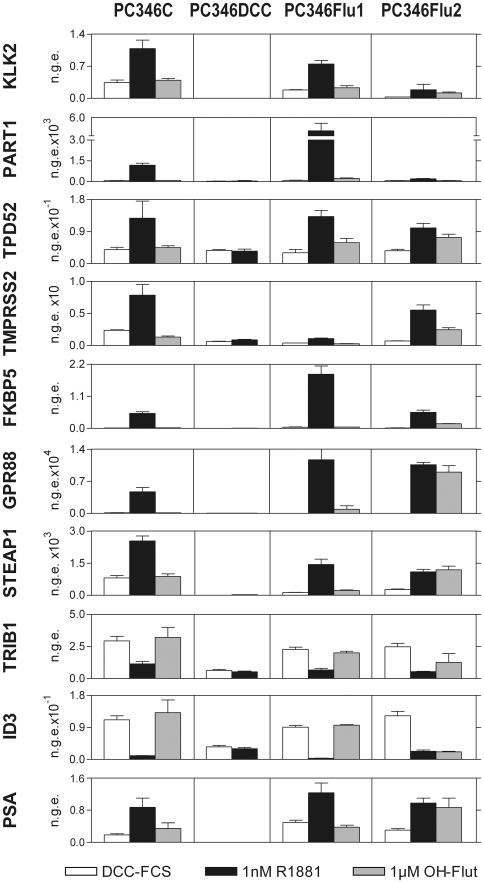
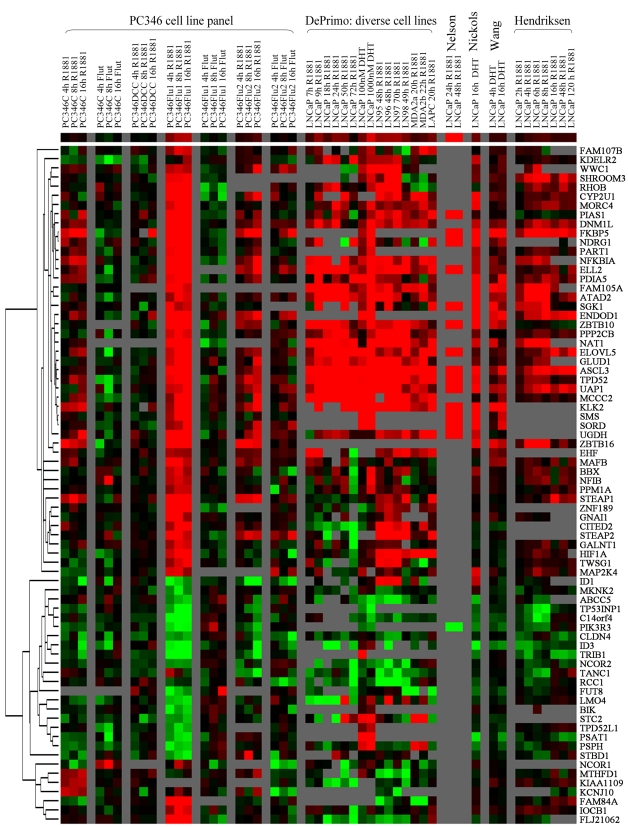
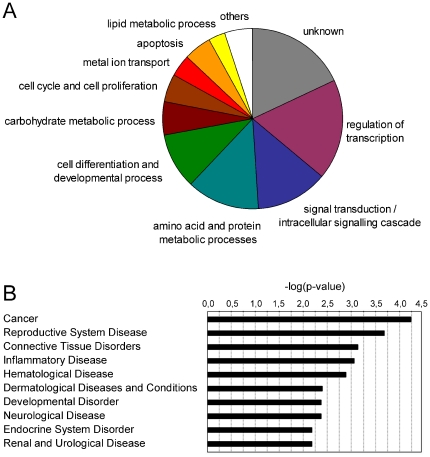
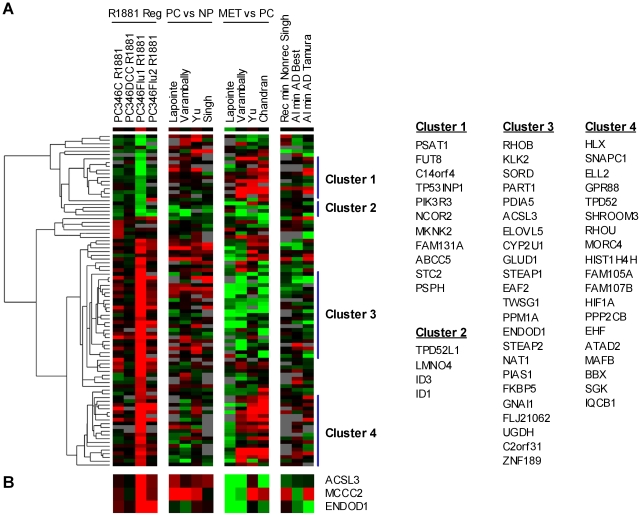
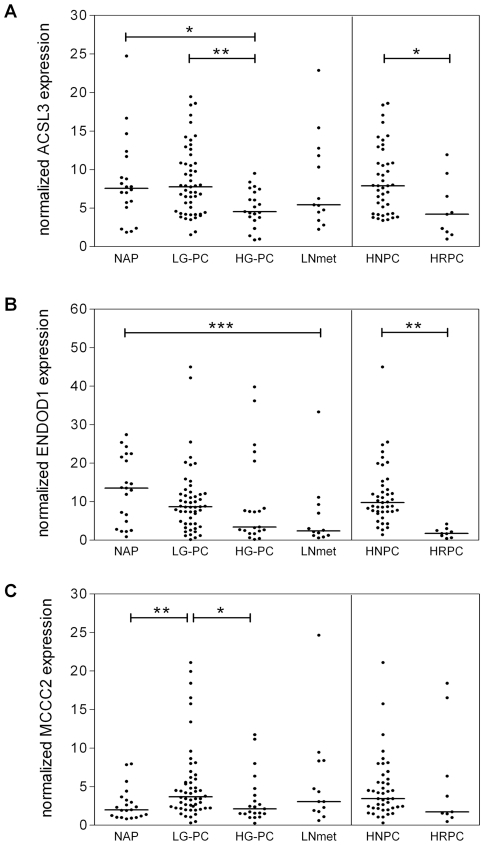
METHODOLOGY/PRINCIPAL FINDINGS: Human 19K oligoarrays were used to establish the androgen-regulated expression profile of androgen-responsive PC346C cells and its derivative therapy-resistant sublines: PC346DCC (vestigial AR levels), PC346Flu1 (AR overexpression) and PC346Flu2 (T877A AR mutation). In total, 107 transcripts were differentially-expressed in PC346C and derivatives after R1881 or hydroxyflutamide stimulations. The AR-regulated expression profiles reflected the AR modifications of respective therapy-resistant sublines: AR overexpression resulted in stronger and broader transcriptional response to R1881 stimulation, AR down-regulation correlated with deficient response of AR-target genes and the T877A mutation resulted in transcriptional response to both R1881 and hydroxyflutamide. This AR-target signature was linked to multiple publicly available cell line and tumor derived PCa databases, revealing that distinct functional clusters were differentially modulated during PCa progression. Differentiation and secretory functions were up-regulated in primary PCa but repressed in metastasis, whereas proliferation, cytoskeletal remodeling and adhesion were overexpressed in metastasis. Finally, the androgen-regulated genes ENDOD1, MCCC2 and ACSL3 were selected as potential disease markers for RT-PCR quantification in a distinct set of human prostate specimens. ENDOD1 and ACSL3 showed down-regulation in high-grade and metastatic PCa, while MCCC2 was overexpressed in low-grade PCa.
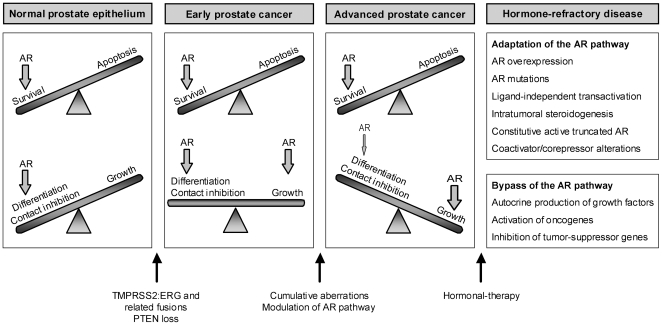
CONCLUSIONS/SIGNIFICANCE: AR modifications altered the transcriptional response to (anti)androgens in therapy-resistant cells. Furthermore, selective down-regulation of genes involved in differentiation and up-regulation of genes promoting proliferation and invasion suggest a disturbed balance between the growth and differentiation functions of the AR pathway during PCa progression. These findings may have implications in the current treatment and development of novel therapeutical approaches for metastatic PCa.
前列腺上皮细胞的存活和功能依赖于雄激素。在(早期)前列腺癌(PCa)中,雄激素也调节肿瘤生长,这在转移性疾病的激素治疗中得到了利用。本研究的目的是描述激素治疗耐药的 PC346 细胞中雄激素受体(AR)的反应,并确定潜在的疾病标志物。
方法/主要发现:使用人类 19K 寡核苷酸芯片建立了雄激素反应性 PC346C 细胞及其衍生的耐药亚系(AR 水平降低的 PC346DCC、AR 过表达的 PC346Flu1 和 AR T877A 突变的 PC346Flu2)的雄激素调节表达谱。在 R1881 或羟基氟他胺刺激后,PC346C 及其衍生物中有 107 个转录本差异表达。AR 调节的表达谱反映了各自耐药亚系的 AR 修饰:AR 过表达导致对 R1881 刺激的转录反应更强更广泛,AR 下调与 AR 靶基因反应缺陷相关,而 T877A 突变导致对 R1881 和羟基氟他胺的转录反应。该 AR 靶基因特征与多个公开的细胞系和肿瘤衍生的 PCa 数据库相关联,揭示了在 PCa 进展过程中,不同的功能簇存在差异调节。分化和分泌功能在原发性 PCa 中上调,但在转移中受到抑制,而增殖、细胞骨架重塑和黏附在转移中过度表达。最后,选择雄激素调节基因 ENDOD1、MCCC2 和 ACSL3 作为特定的人前列腺标本 RT-PCR 定量的潜在疾病标志物。ENDOD1 和 ACSL3 在高级别和转移性 PCa 中下调,而 MCCC2 在低级别 PCa 中过表达。
结论/意义:AR 修饰改变了耐药细胞对(抗)雄激素的转录反应。此外,参与分化的基因选择性下调和促进增殖和侵袭的基因上调表明,在 PCa 进展过程中,AR 通路的生长和分化功能之间的平衡被打破。这些发现可能对转移性 PCa 的当前治疗和新型治疗方法的发展有影响。