Juvenile Diabetes Research Foundation/Wellcome Trust Diabetesand Inflammation Laboratory, Cambridge Institute for Medical Research, Departmentof Medical Genetics, University of Cambridge, Cambridge, U.K.
Diabetes. 2011 Oct;60(10):2635-44. doi: 10.2337/db11-0131. Epub 2011 Aug 10.
A major feature of type 1 diabetes is the appearance of islet autoantibodies before diagnosis. However, although the genetics of type 1 diabetes is advanced, the genetics of islet autoantibodies needs further investigation. The primary susceptibility loci in type 1 diabetes, the HLA class I and II genes, are believed to determine the specificity and magnitude of the autoimmune response to islet antigens. We investigated the association of glutamic acid decarboxylase autoantibodies (GADA) and insulinoma-associated antigen-2 autoantibodies (IA-2A) with the HLA region.
Associations of GADA and IA-2A with HLA-DRB1, HLA-DQB1, HLA-B, HLA-C, HLA-A, MICA, and 3,779 single nucleotide polymorphisms (SNPs) were analyzed in 2,531 childhood-onset case subjects (median time since diagnosis 5 years). All analyses were adjusted for age-at-diagnosis and duration of diabetes.
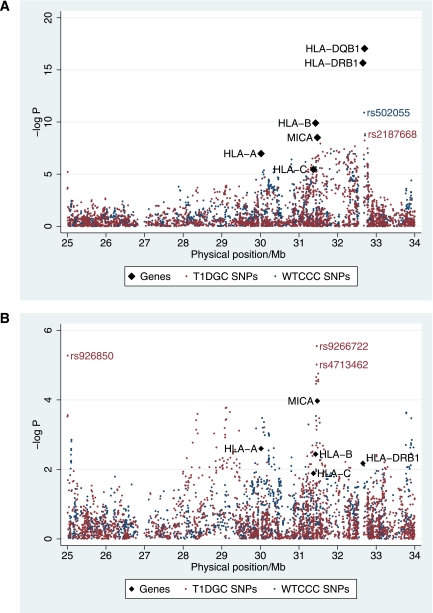
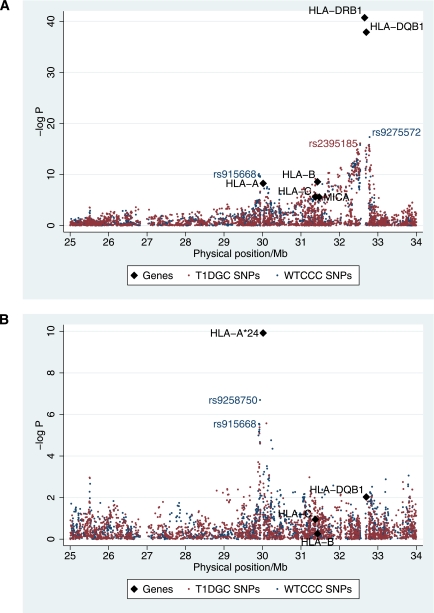
GADA and IA-2A were associated with an older age-at-diagnosis (P < 10(-19)). For GADA, the primary association was with HLA-DQB1 (P = 9.00 × 10(-18)), with evidence of a second independent effect in the HLA class I region with SNP, rs9266722 (P = 2.84 × 10(-6)). HLA-DRB1 had the strongest association with IA-2A (P = 1.94 × 10(-41)), with HLA-A24 adding to the association, albeit negatively (P = 1.21 × 10(-10)). There was no evidence of association of either IA-2A or GADA with the highly type 1 diabetes predisposing genotype, HLA-DRB103/04.
Despite genetic association of type 1 diabetes and the islet autoantibodies localizing to the same HLA class II genes, HLA-DRB1 and HLA-DQB1, the effects of the class II alleles and genotypes involved are quite different. Therefore, the presence of autoantibodies is unlikely to be causal, and their role in pathogenesis remains to be established.
1 型糖尿病的一个主要特征是在诊断前出现胰岛自身抗体。然而,尽管 1 型糖尿病的遗传学已经很先进,但胰岛自身抗体的遗传学仍需要进一步研究。1 型糖尿病的主要易感基因座是 HLA Ⅰ类和Ⅱ类基因,这些基因被认为决定了对胰岛抗原的自身免疫反应的特异性和强度。我们研究了谷氨酸脱羧酶自身抗体(GADA)和胰岛素瘤相关抗原-2 自身抗体(IA-2A)与 HLA 区域的关联。
在 2531 例儿童起病的病例中(诊断后中位时间 5 年),分析了 GADA 和 IA-2A 与 HLA-DRB1、HLA-DQB1、HLA-B、HLA-C、HLA-A、MICA 和 3779 个单核苷酸多态性(SNP)的关联。所有分析均调整了诊断时的年龄和糖尿病的持续时间。
GADA 和 IA-2A 与较晚的诊断年龄相关(P < 10(-19))。对于 GADA,主要关联是与 HLA-DQB1(P = 9.00 × 10(-18)),在 HLA Ⅰ类区域存在 SNP rs9266722 的第二个独立效应的证据(P = 2.84 × 10(-6))。HLA-DRB1 与 IA-2A 的关联最强(P = 1.94 × 10(-41)),HLA-A24 虽然为负性(P = 1.21 × 10(-10)),但也增加了关联。IA-2A 或 GADA 与高度易患 1 型糖尿病的基因型 HLA-DRB103/04 均无关联的证据。
尽管 1 型糖尿病和胰岛自身抗体的遗传关联定位于相同的 HLA Ⅱ类基因,但 HLA-DRB1 和 HLA-DQB1 所涉及的Ⅱ类等位基因和基因型的影响却大不相同。因此,自身抗体的存在不太可能是因果关系,其在发病机制中的作用仍有待确定。