Lefrançois Marilou, Lefebvre Marie-Reine, Saint-Onge Geneviève, Boulais Philip E, Lamothe Simon, Leduc Richard, Lavigne Pierre, Heveker Nikolaus, Escher Emanuel
ACS Med Chem Lett. 2011 Aug 11;2(8):597-602. doi: 10.1021/ml200084n. Epub 2011 Jun 6.
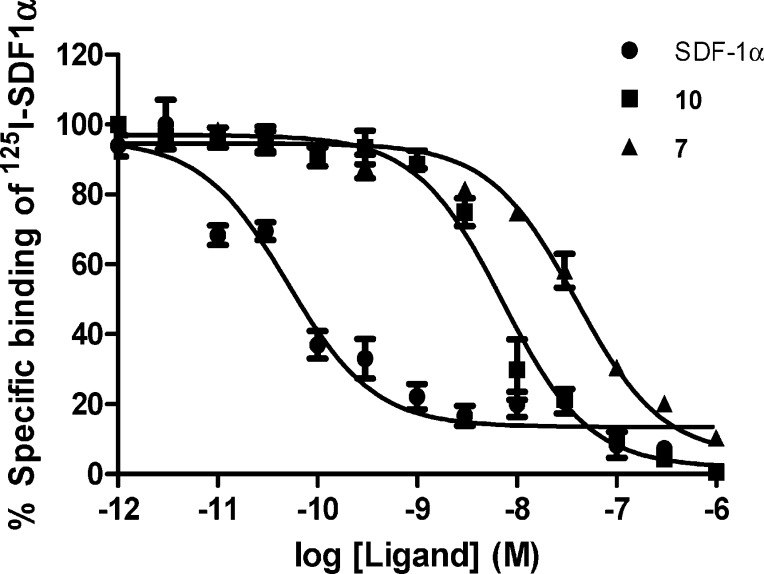
The development of agonists for the chemokine receptor CXCR4 could provide promising therapeutic candidates. On the basis of previously forwarded two site model of chemokine-receptor interactions, we hypothesized that linking the agonistic N-terminus of SDF-1 to the T140 backbone would yield new high-affinity agonists of CXCR4. We developed chimeras with the agonistic SDF-1 N-terminus grafted to a T140 side chain and tested their binding affinity and chemotactic agonist activity. While chimeras with the peptide grafted onto position 12 of T140 remained high-affinity antagonists, those bearing the peptide on position 14 were in part agonists. One chimera was a full CXCR4 agonist with 25 nM affinity, and several chimeras showed low nanomolar affinities with partial agonist activity. Our results confirmed that we have developed high-affinity agonists of CXCR4.
趋化因子受体CXCR4激动剂的研发有望提供有前景的治疗候选药物。基于先前提出的趋化因子-受体相互作用双位点模型,我们推测将SDF-1的激动性N端与T140主链相连会产生新的CXCR4高亲和力激动剂。我们构建了将激动性SDF-1 N端嫁接到T140侧链的嵌合体,并测试了它们的结合亲和力和趋化激动剂活性。虽然将肽嫁接到T140第12位的嵌合体仍然是高亲和力拮抗剂,但肽位于第14位的那些嵌合体部分表现为激动剂。一种嵌合体是具有25 nM亲和力的完全CXCR4激动剂,还有几种嵌合体表现出低纳摩尔亲和力并具有部分激动剂活性。我们的结果证实已研发出CXCR4的高亲和力激动剂。