• 文献检索
  • 文档翻译
  • 深度研究
  • 学术资讯
  • Suppr Zotero 插件Zotero 插件
  • 邀请有礼
  • 套餐&价格
  • 历史记录
应用&插件
Suppr Zotero 插件Zotero 插件浏览器插件Mac 客户端Windows 客户端微信小程序
定价
高级版会员购买积分包购买API积分包
服务
文献检索文档翻译深度研究API 文档MCP 服务
关于我们
关于 Suppr公司介绍联系我们用户协议隐私条款
关注我们

Suppr 超能文献

核心技术专利:CN118964589B侵权必究
粤ICP备2023148730 号-1Suppr @ 2026

文献检索

告别复杂PubMed语法,用中文像聊天一样搜索,搜遍4000万医学文献。AI智能推荐,让科研检索更轻松。

立即免费搜索

文件翻译

保留排版,准确专业,支持PDF/Word/PPT等文件格式,支持 12+语言互译。

免费翻译文档

深度研究

AI帮你快速写综述,25分钟生成高质量综述,智能提取关键信息,辅助科研写作。

立即免费体验

关于 CCN6 如何抑制乳腺癌生长和侵袭。

On how CCN6 suppresses breast cancer growth and invasion.

机构信息

Department of Pathology and 4217 Comprehensive Cancer Center, University of Michigan Medical School, 1500 E. Medical Center Drive, Ann Arbor, MI, 48109, USA.

出版信息

J Cell Commun Signal. 2012 Mar;6(1):5-10. doi: 10.1007/s12079-011-0148-9. Epub 2011 Aug 13.

DOI:10.1007/s12079-011-0148-9
PMID:21842227
原文链接:https://pmc.ncbi.nlm.nih.gov/articles/PMC3271195/
Abstract

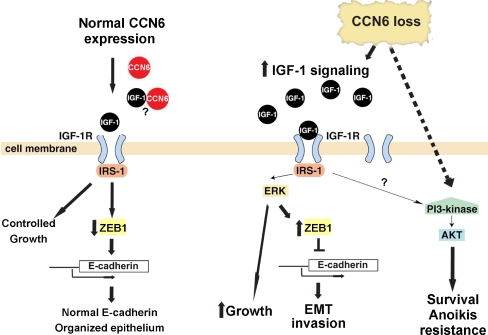
Living cells communicate with their microenvironment and exchange information through signaling pathways in order to carry out most biological processes. The CCN family of proteins has the ability to coordinate the extracellular and intracellular signaling pathways and epithelial-stromal cross-talks. CCN proteins have been shown to play roles in multiple processes including cancer, either as tumor suppressors or oncogenes. Particularly, loss of CCN6 expression has been reported in highly aggressive breast cancer types, especially in inflammatory breast cancer and breast cancer with axillary lymph node metastasis. Recent findings can better explain the biological relevance of CCN6 as a tumor suppressor protein in breast tumorigenesis. CCN6 loss triggers the process of epithelial to mesenchymal transition (EMT), which converts epithelial cells into migratory and invasive mesenchymal-like cells at least in part through modulation of IGF-1 receptor signaling pathway. Emerging data support the hypothesis that CCN6 also exerts growth factor independent functions, especially related to cell survival and anoikis resistance. Thus, our work provides new insights into the functions and mechanisms of tumor suppression exerted by CCN6 in the breast.

摘要

活细胞通过信号通路与其微环境进行交流并交换信息,以进行大多数生物过程。CCN 蛋白家族具有协调细胞外和细胞内信号通路以及上皮-间质相互作用的能力。已经表明 CCN 蛋白在多种过程中发挥作用,包括癌症,作为肿瘤抑制因子或癌基因。特别是,已经报道在高度侵袭性的乳腺癌类型中,尤其是在炎症性乳腺癌和腋窝淋巴结转移的乳腺癌中,CCN6 的表达缺失。最近的发现可以更好地解释 CCN6 作为乳腺癌发生中肿瘤抑制蛋白的生物学相关性。CCN6 的缺失触发上皮细胞向间充质转化(EMT)的过程,该过程至少部分通过调节 IGF-1 受体信号通路将上皮细胞转化为迁移和侵袭性的间充质样细胞。新出现的数据支持这样的假设,即 CCN6 还发挥独立于生长因子的功能,特别是与细胞存活和抗凋亡有关。因此,我们的工作为 CCN6 在乳腺中发挥的肿瘤抑制作用的功能和机制提供了新的见解。
https://cdn.ncbi.nlm.nih.gov/pmc/blobs/9312/3271195/07659b00a0b8/12079_2011_148_Fig1_HTML.jpg

相似文献

1
On how CCN6 suppresses breast cancer growth and invasion.关于 CCN6 如何抑制乳腺癌生长和侵袭。
J Cell Commun Signal. 2012 Mar;6(1):5-10. doi: 10.1007/s12079-011-0148-9. Epub 2011 Aug 13.
2
The emerging role of CCN6 in breast cancer invasion.CCN6在乳腺癌侵袭中的新作用。
Cellscience. 2009 Oct;6(2):146-157.
3
The matricellular protein CCN6 (WISP3) decreases Notch1 and suppresses breast cancer initiating cells.基质细胞蛋白CCN6(WISP3)可降低Notch1水平并抑制乳腺癌起始细胞。
Oncotarget. 2016 May 3;7(18):25180-93. doi: 10.18632/oncotarget.7734.
4
Blockade of CCN6 (WISP3) activates growth factor-independent survival and resistance to anoikis in human mammary epithelial cells.阻断 CCN6(WISP3)可激活人乳腺上皮细胞中生长因子非依赖性存活和抗失巢凋亡。
Cancer Res. 2010 Apr 15;70(8):3340-50. doi: 10.1158/0008-5472.CAN-09-4225.
5
CCN6 (WISP3) decreases ZEB1-mediated EMT and invasion by attenuation of IGF-1 receptor signaling in breast cancer.CCN6(WISP3)通过衰减 IGF-1 受体信号转导降低乳腺癌中的 ZEB1 介导的 EMT 和侵袭。
J Cell Sci. 2011 May 15;124(Pt 10):1752-8. doi: 10.1242/jcs.084194. Epub 2011 Apr 26.
6
Inhibition of CCN6 (WISP3) expression promotes neoplastic progression and enhances the effects of insulin-like growth factor-1 on breast epithelial cells.抑制CCN6(WISP3)表达可促进肿瘤进展,并增强胰岛素样生长因子-1对乳腺上皮细胞的作用。
Breast Cancer Res. 2005;7(6):R1080-9. doi: 10.1186/bcr1351. Epub 2005 Nov 8.
7
Matricellular CCN6 (WISP3) protein: a tumor suppressor for mammary metaplastic carcinomas.基质细胞蛋白CCN6(WISP3):乳腺化生癌的肿瘤抑制因子。
J Cell Commun Signal. 2018 Mar;12(1):13-19. doi: 10.1007/s12079-018-0451-9. Epub 2018 Jan 22.
8
CCN6 (WISP3) as a new regulator of the epithelial phenotype in breast cancer.CCN6(WISP3)作为乳腺癌上皮表型的一种新调节因子。
Cells Tissues Organs. 2007;185(1-3):95-9. doi: 10.1159/000101308.
9
CCN6 modulates BMP signaling via the Smad-independent TAK1/p38 pathway, acting to suppress metastasis of breast cancer.CCN6 通过 Smad 非依赖的 TAK1/p38 通路调节 BMP 信号通路,从而抑制乳腺癌的转移。
Cancer Res. 2012 Sep 15;72(18):4818-28. doi: 10.1158/0008-5472.CAN-12-0154. Epub 2012 Jul 17.
10
Inhibition of CCN6 (Wnt-1-induced signaling protein 3) down-regulates E-cadherin in the breast epithelium through induction of snail and ZEB1.CCN6(Wnt-1诱导信号蛋白3)的抑制通过诱导蜗牛蛋白和锌指E盒结合蛋白1(ZEB1)下调乳腺上皮中的E-钙黏蛋白。
Am J Pathol. 2008 Apr;172(4):893-904. doi: 10.2353/ajpath.2008.070899. Epub 2008 Mar 5.

引用本文的文献

1
Noninvasive Mapping of Extracellular Potassium in Breast Tumors via Multi-Wavelength Photoacoustic Imaging.通过多波长光声成像对乳腺肿瘤细胞外钾进行无创映射
Sensors (Basel). 2025 Jul 31;25(15):4724. doi: 10.3390/s25154724.
2
Circulating CCN6/WISP3 in type 2 diabetes mellitus patients and its correlation with insulin resistance and inflammation: statistical and machine learning analyses.2型糖尿病患者循环CCN6/WISP3及其与胰岛素抵抗和炎症的相关性:统计分析与机器学习分析
BMC Med Inform Decis Mak. 2025 Mar 6;25(1):114. doi: 10.1186/s12911-025-02957-1.
3
CTGF (CCN2): a multifaceted mediator in breast cancer progression and therapeutic targeting.

本文引用的文献

1
CCN6 (WISP3) decreases ZEB1-mediated EMT and invasion by attenuation of IGF-1 receptor signaling in breast cancer.CCN6(WISP3)通过衰减 IGF-1 受体信号转导降低乳腺癌中的 ZEB1 介导的 EMT 和侵袭。
J Cell Sci. 2011 May 15;124(Pt 10):1752-8. doi: 10.1242/jcs.084194. Epub 2011 Apr 26.
2
Blockade of CCN6 (WISP3) activates growth factor-independent survival and resistance to anoikis in human mammary epithelial cells.阻断 CCN6(WISP3)可激活人乳腺上皮细胞中生长因子非依赖性存活和抗失巢凋亡。
Cancer Res. 2010 Apr 15;70(8):3340-50. doi: 10.1158/0008-5472.CAN-09-4225.
3
E-cadherin, beta-catenin, and ZEB1 in malignant progression of cancer.
结缔组织生长因子(CCN2):乳腺癌进展及治疗靶点中的多面调节因子
Cancer Metastasis Rev. 2025 Feb 13;44(1):32. doi: 10.1007/s10555-025-10248-4.
4
Anoikis resistance--protagonists of breast cancer cells survive and metastasize after ECM detachment.失巢凋亡抵抗——细胞外基质解离后乳腺癌细胞存活和转移的主角。
Cell Commun Signal. 2023 Aug 3;21(1):190. doi: 10.1186/s12964-023-01183-4.
5
CCN proteins: opportunities for clinical studies-a personal perspective.CCN蛋白:临床研究的机遇——个人观点
J Cell Commun Signal. 2023 Jun;17(2):333-352. doi: 10.1007/s12079-023-00761-y. Epub 2023 May 17.
6
Potential Role of CCN Proteins in Breast Cancer: Therapeutic Advances and Perspectives.CCN 蛋白在乳腺癌中的潜在作用:治疗进展与展望。
Curr Oncol. 2021 Nov 26;28(6):4972-4985. doi: 10.3390/curroncol28060417.
7
The Molecular Mechanism of Epithelial-Mesenchymal Transition for Breast Carcinogenesis.上皮-间质转化在乳腺癌发生中的分子机制。
Biomolecules. 2019 Sep 11;9(9):476. doi: 10.3390/biom9090476.
8
Association of Wnt signaling pathway genetic variants in gallbladder cancer susceptibility and survival.Wnt信号通路基因变异与胆囊癌易感性及生存率的关联
Tumour Biol. 2016 Jun;37(6):8083-95. doi: 10.1007/s13277-015-4728-9. Epub 2015 Dec 29.
9
Markers of breast cancer stromal fibroblasts in the primary tumour site associated with lymph node metastasis: a systematic review including our case series.原发肿瘤部位乳腺癌基质成纤维细胞标志物与淋巴结转移相关:一项系统评价包括我们的病例系列。
Biosci Rep. 2013 Dec 12;33(6):e00085. doi: 10.1042/BSR20130060.
10
Tissue-based identification of stem cells and epithelial-to-mesenchymal transition in breast cancer.基于组织的乳腺癌干细胞鉴定及上皮-间充质转化。
Hum Pathol. 2013 Aug;44(8):1457-64. doi: 10.1016/j.humpath.2013.01.005. Epub 2013 Apr 8.
E-钙黏蛋白、β-连环蛋白和锌指E盒结合蛋白1在癌症恶性进展中的作用
Cancer Metastasis Rev. 2009 Jun;28(1-2):151-66. doi: 10.1007/s10555-008-9179-y.
4
Mitochondrial DNA depletion in prostate epithelial cells promotes anoikis resistance and invasion through activation of PI3K/Akt2.前列腺上皮细胞中的线粒体DNA耗竭通过激活PI3K/Akt2促进失巢凋亡抗性和侵袭。
Cell Death Differ. 2009 Apr;16(4):571-83. doi: 10.1038/cdd.2008.178. Epub 2008 Dec 12.
5
A double-negative feedback loop between ZEB1-SIP1 and the microRNA-200 family regulates epithelial-mesenchymal transition.ZEB1-SIP1与微小RNA-200家族之间的双负反馈回路调节上皮-间质转化。
Cancer Res. 2008 Oct 1;68(19):7846-54. doi: 10.1158/0008-5472.CAN-08-1942.
6
A reciprocal repression between ZEB1 and members of the miR-200 family promotes EMT and invasion in cancer cells.ZEB1与miR-200家族成员之间的相互抑制促进癌细胞的上皮-间质转化和侵袭。
EMBO Rep. 2008 Jun;9(6):582-9. doi: 10.1038/embor.2008.74. Epub 2008 May 16.
7
The miR-200 family inhibits epithelial-mesenchymal transition and cancer cell migration by direct targeting of E-cadherin transcriptional repressors ZEB1 and ZEB2.miR-200家族通过直接靶向E-钙黏蛋白转录抑制因子ZEB1和ZEB2来抑制上皮-间质转化和癌细胞迁移。
J Biol Chem. 2008 May 30;283(22):14910-4. doi: 10.1074/jbc.C800074200. Epub 2008 Apr 14.
8
The miR-200 family determines the epithelial phenotype of cancer cells by targeting the E-cadherin repressors ZEB1 and ZEB2.微小RNA-200家族通过靶向E-钙黏蛋白抑制因子锌指E盒结合蛋白1(ZEB1)和锌指E盒结合蛋白2(ZEB2)来决定癌细胞的上皮表型。
Genes Dev. 2008 Apr 1;22(7):894-907. doi: 10.1101/gad.1640608.
9
Insulin-like growth factor-I-dependent up-regulation of ZEB1 drives epithelial-to-mesenchymal transition in human prostate cancer cells.胰岛素样生长因子-I依赖的ZEB1上调驱动人前列腺癌细胞的上皮-间质转化。
Cancer Res. 2008 Apr 1;68(7):2479-88. doi: 10.1158/0008-5472.CAN-07-2559.
10
Inhibition of CCN6 (Wnt-1-induced signaling protein 3) down-regulates E-cadherin in the breast epithelium through induction of snail and ZEB1.CCN6(Wnt-1诱导信号蛋白3)的抑制通过诱导蜗牛蛋白和锌指E盒结合蛋白1(ZEB1)下调乳腺上皮中的E-钙黏蛋白。
Am J Pathol. 2008 Apr;172(4):893-904. doi: 10.2353/ajpath.2008.070899. Epub 2008 Mar 5.