Department of Radiation Oncology, New York University Langone Medical Center, New York, NY 10016, USA.
J Appl Clin Med Phys. 2011 Mar 2;12(3):3405. doi: 10.1120/jacmp.v12i3.3405.
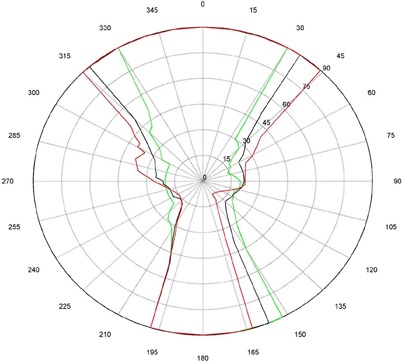
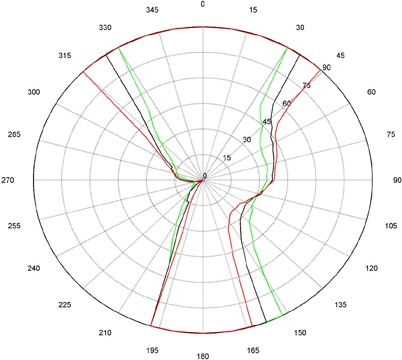
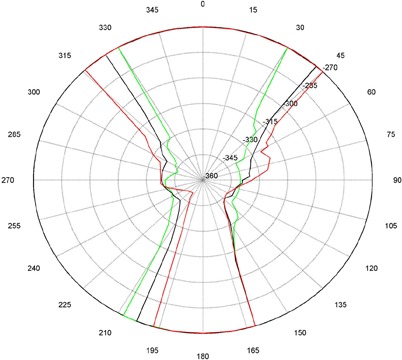
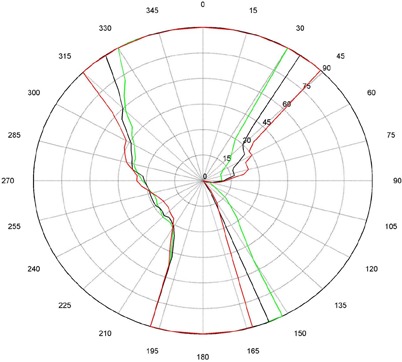
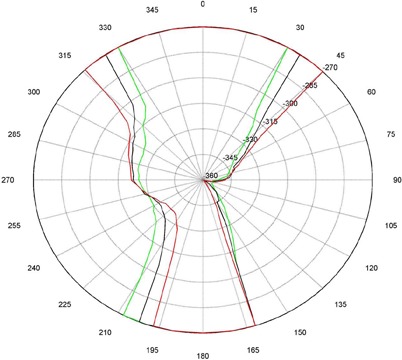
The use of non-coplanar radiation fields can potentially lead to collisions between the gantry and the couch or patient. The collisions are often not realized until the plan is finished and the fields are checked on the machine, or even later when the patient is already on the table. This paper presents an easy method of gauging if a collision is likely between the gantry and couch or patient during treatment planning. The method involves creating a chart of allowable gantry and couch combinations. The charts contain curves on a polar graph of the gantry and couch angle "plane". The curves display the limits of collisions for each gantry and couch combination for vertical couch positions 10, 15 and 20 cm below isocenter and for couch lateral positions of -10, 0, +10 cm, covering the majority of couch positions encountered in patient treatments. All combinations in the region within the curves (containing the origin) are valid, while all combinations outside the curves will result in a collision. The data for the charts are collected from measurements of the gantry angle that just clears each couch angle. The patient presence was modeled by placing a stereotactic body frame on the top of the couch. Separate charts were created for couch angles between 0° and 90° and between 360° and 270° over all gantry angles. The graphs are easy to create, implement, and use in the clinic and help reduce the time, complications, and uncertainties of planning with non-coplanar fields.
使用非共面射束可能会导致机架与治疗床或患者发生碰撞。通常只有在计划完成后并在机器上检查射束时,甚至在患者已经在治疗台上时,才会发现这些碰撞。本文提出了一种简单的方法来判断在治疗计划期间机架与治疗床或患者之间是否可能发生碰撞。该方法涉及创建一个允许的机架和治疗床组合图表。图表包含在机架和治疗床角度“平面”极坐标图上的曲线。这些曲线显示了每个机架和治疗床组合在垂直治疗床位置为 10、15 和 20cm 低于等中心以及治疗床横向位置为-10、0、+10cm 时的碰撞限制,涵盖了患者治疗中遇到的大多数治疗床位置。曲线内(包含原点)的所有组合都是有效的,而所有组合都在曲线外则会导致碰撞。图表数据是从测量刚好清除每个治疗床角度的机架角度收集而来。通过在治疗床顶部放置立体定向体架来模拟患者的存在。为所有机架角度创建了治疗床角度在 0°至 90°之间以及在 360°至 270°之间的单独图表。这些图表易于在临床中创建、实施和使用,并有助于减少非共面射束规划的时间、复杂性和不确定性。