Xiao Xueshan, Li Wei, Wang Panfeng, Li Lin, Li Shiqiang, Jia Xiaoyun, Sun Wenmin, Guo Xiangming, Zhang Qingjiong
State Key Laboratory of Ophthalmology, Zhongshan Ophthalmic Center, Sun Yat-sen University, Guangzhou, China.
Mol Vis. 2011;17:2049-55. Epub 2011 Jul 26.
To identify the genetic defect in a large Chinese family with autosomal dominant cerulean cataract.
Genomic DNA and clinical data were collected from the family. Candidate gene sequencing and genome-wide linkage analysis were used to disclose the molecular basis responsible for cerulean cataract in the family.
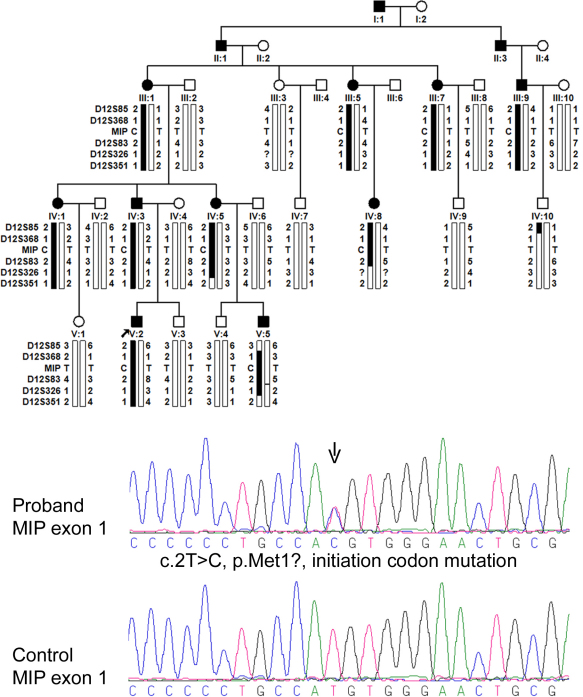
Initially, sequencing analysis of the three genes (beta-B2-crystallin [CRYBB2], gamma-D-crystallin [CRYGD], and V-MAF avian musculoaponeurotic fibrosarcoma oncogene homolog [MAF]) known to cause cerulean cataract failed to find any mutation. Then, genome-wide linkage analysis mapped the disease to chromosome 12q13-q22 between D12S85 and D12S351, with a maximum lod score of 4.10 at θ=0. Sequence analysis of the major intrinsic protein of lens fiber gene (MIP), a gene known to cause other types of cataract in the linkage interval, detected a novel heterozygous initiation codon mutation, c.2T>C (p.Met1?). This mutation was present in all patients with cerulean cataract but was not present in any of the 13 unaffected family members nor in 96 control individuals.
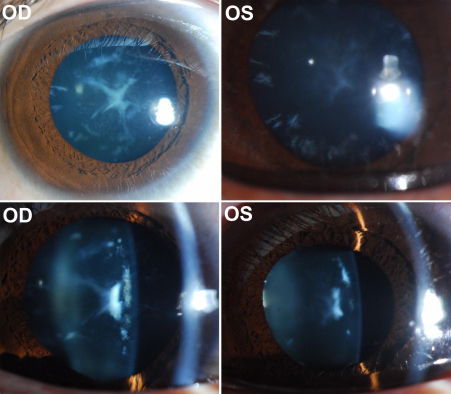
Cerulean cataract was found in a large family and is caused by a novel initiation codon mutation in MIP. This study adds a new member in the existing list of genes causing cerulean cataract and expands the mutation spectrum and phenotypic association of MIP mutations.
确定一个患有常染色体显性遗传性天蓝色白内障的中国大家庭中的基因缺陷。
收集该家族的基因组DNA和临床数据。采用候选基因测序和全基因组连锁分析来揭示该家族中天蓝色白内障的分子基础。
最初,对已知可导致天蓝色白内障的三个基因(β-B2-晶状体蛋白[CRYBB2]、γ-D-晶状体蛋白[CRYGD]和V-MAF禽肌动蛋白纤维肉瘤癌基因同源物[MAF])进行测序分析,未发现任何突变。随后,全基因组连锁分析将该疾病定位到12号染色体q13-q22区域,位于D12S85和D12S351之间,在θ=0时最大对数优势得分为4.10。对晶状体纤维主要内在蛋白基因(MIP)进行序列分析,该基因在连锁区间内已知可导致其他类型的白内障,检测到一个新的杂合起始密码子突变,c.2T>C(p.Met1?)。该突变存在于所有天蓝色白内障患者中,但在13名未受影响的家庭成员和96名对照个体中均未出现。
在一个大家庭中发现了天蓝色白内障,其由MIP基因中的一个新的起始密码子突变引起。本研究在导致天蓝色白内障的现有基因列表中增加了一个新成员,并扩展了MIP突变的突变谱和表型关联。