Department of Psychiatry and Behavioral Sciences, Duke University Medical Center, Durham, NC 27710, United States.
Behav Brain Res. 2011 Dec 1;225(2):473-81. doi: 10.1016/j.bbr.2011.08.005. Epub 2011 Aug 11.
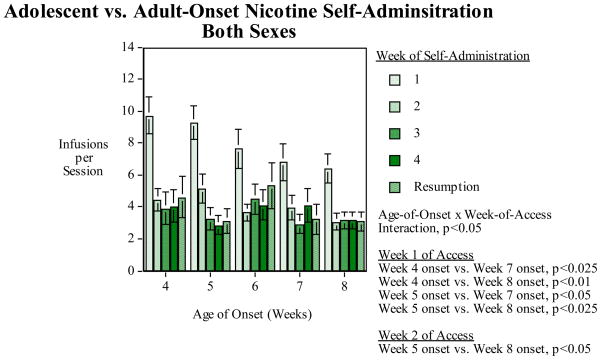
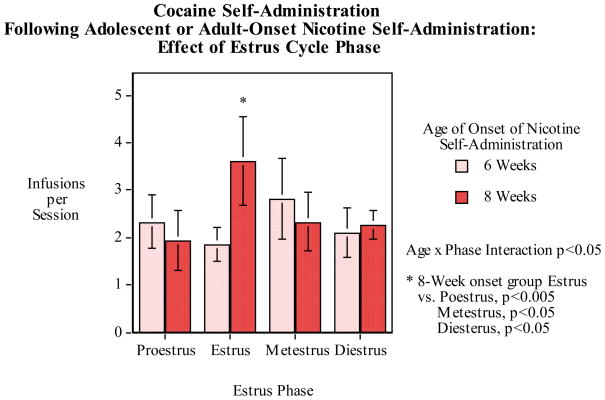
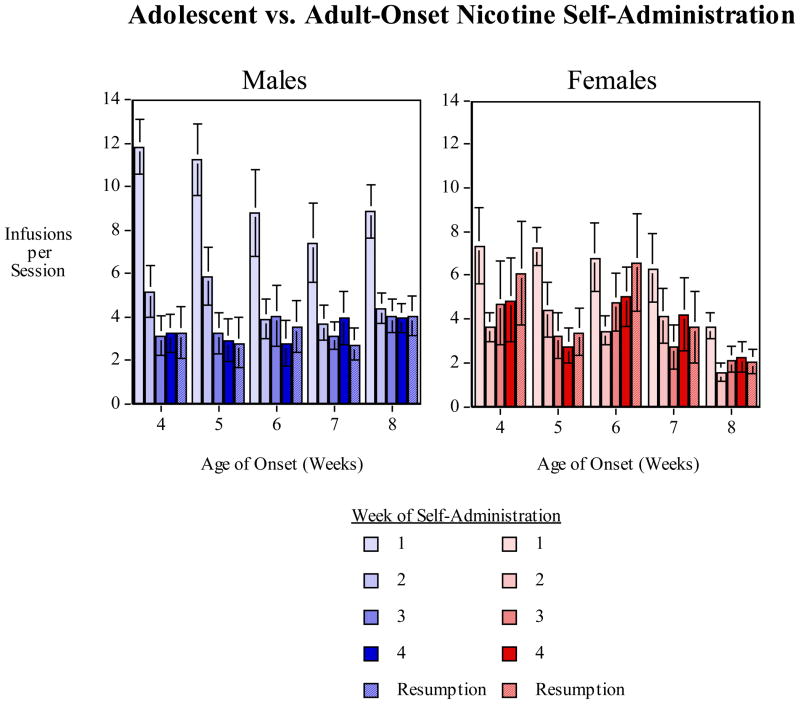
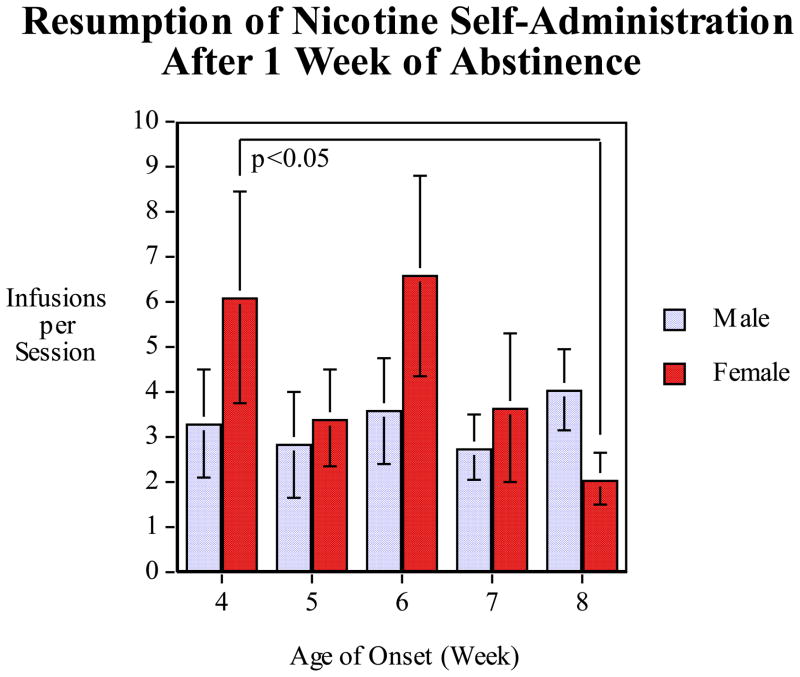
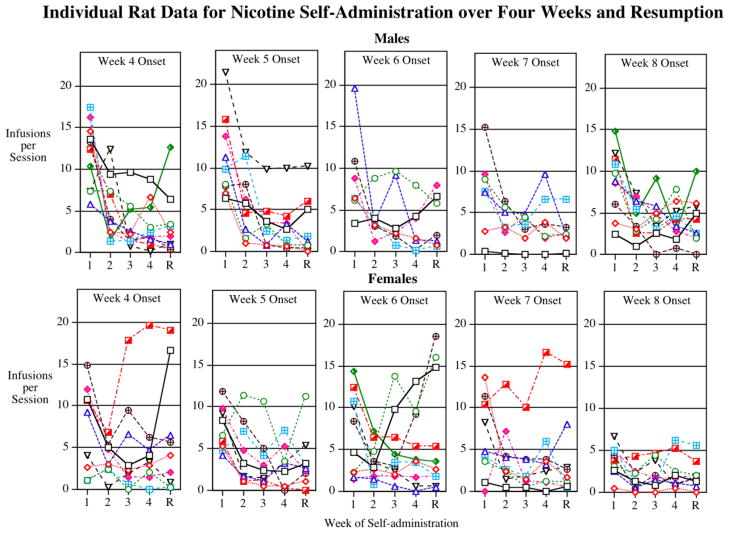
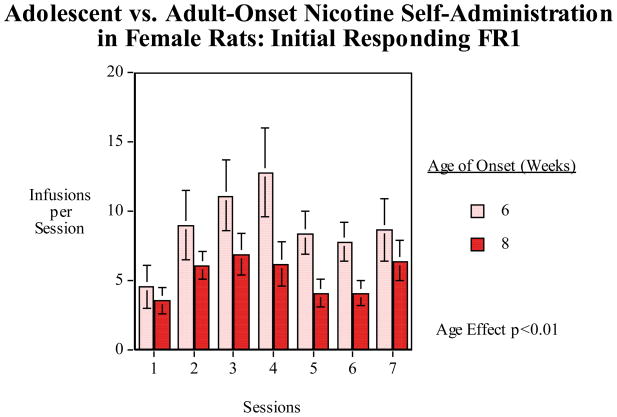
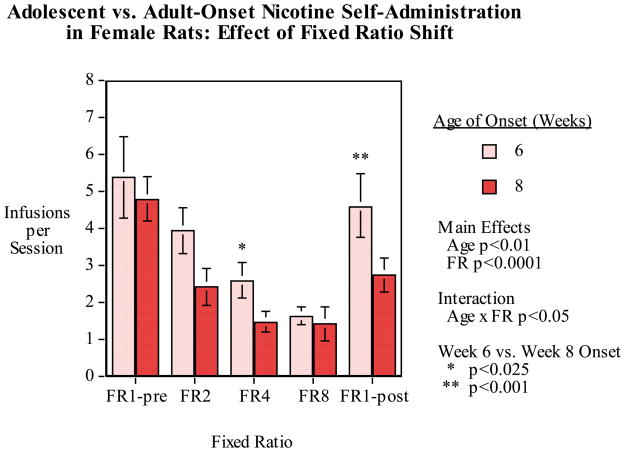
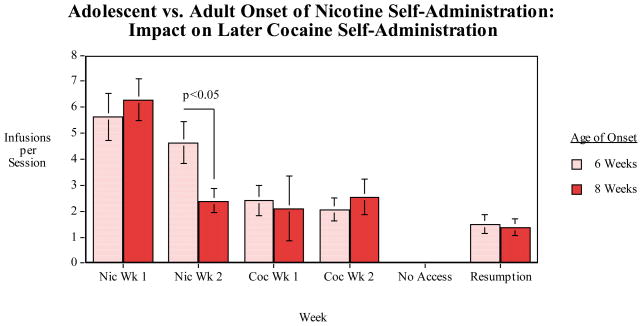
The great majority of tobacco addiction begins during adolescence. More heavily addicted smokers begin smoking earlier, but differentiating the neurobehavioral impact of nicotine self-administration during adolescence from self-selection bias (whereby people more prone to heavy addiction also begin earlier) cannot be ethically unconfounded in humans. The goals of this research were to determine the age threshold for the adult-like nicotine self-administration and determine sex differences. Male and female Sprague-Dawley rats were tested for nicotine self-administration starting at 4, 5, 6, 7, and 8 weeks of age in an operant FR1 schedule for IV nicotine (0.03 mg/kg/infusion) in 45-min sessions for 2 weeks, with 1 week of enforced abstinence and 1 week of resumed access. This study replicated our earlier work that nicotine self-administration was increased in adolescent vs. adult rats and that the effect was more pronounced in adolescent males, but the increased nicotine self-administration was more persistent in adolescent-onset females. The age threshold for adult-like behavior was 6-7 weeks of age. Adolescent-onset nicotine self-administration had persisting effects of eggaurated increases of nicotine self-administration when fixed-ratio requirements for self-administration were lowered. Female rats that had begun nicotine self-administration during adolescence showed exaggerated increases in nicotine self-administration after a switch back to FR1 from FR8, indicating a lessened control over their self-administration. Adolescent-onset nicotine self-administration was not found to potentiate cocaine self-administration. Adolescent-onset nicotine self-administration causes persistent increases in nicotine self-administration in female rats even after they reach adulthood and disrupts control over self-administration behavior.
绝大多数的烟草成瘾始于青少年时期。成瘾程度较高的吸烟者开始吸烟的时间更早,但在人类中,无法从伦理上区分青少年时期尼古丁自我给药的神经行为影响和自我选择偏差(即更容易上瘾的人也开始得更早)。本研究的目的是确定类似于成人的尼古丁自我给药的年龄阈值,并确定性别差异。雄性和雌性 Sprague-Dawley 大鼠从 4 周、5 周、6 周、7 周和 8 周龄开始,在 IV 尼古丁(0.03mg/kg/ 注射)的操作性 FR1 方案中进行测试,45 分钟/次,为期 2 周,1 周强制戒断,1 周恢复接触。这项研究复制了我们之前的工作,即尼古丁自我给药在青少年与成年大鼠中增加,且在青少年雄性大鼠中更为明显,但在青少年开始的女性中,尼古丁自我给药的增加更为持久。类似于成人的行为的年龄阈值为 6-7 周龄。当自我给药的固定比率要求降低时,青少年开始的尼古丁自我给药具有持续增加的作用,导致尼古丁自我给药的增加更为明显。在青少年时期开始尼古丁自我给药的雌性大鼠在从 FR8 切换回 FR1 后,尼古丁自我给药的增加更为明显,表明对自我给药的控制能力减弱。青少年开始的尼古丁自我给药并未增强可卡因自我给药。青少年开始的尼古丁自我给药导致雌性大鼠的尼古丁自我给药持续增加,即使它们成年后也会持续增加,并破坏了对自我给药行为的控制。