Key Laboratory of Experimental Teratology, Ministry of Education, and Institute of Molecular Medicine and Genetics, Shandong University School of Medicine, Jinan, Shandong, China.
PLoS One. 2011;6(8):e23427. doi: 10.1371/journal.pone.0023427. Epub 2011 Aug 8.
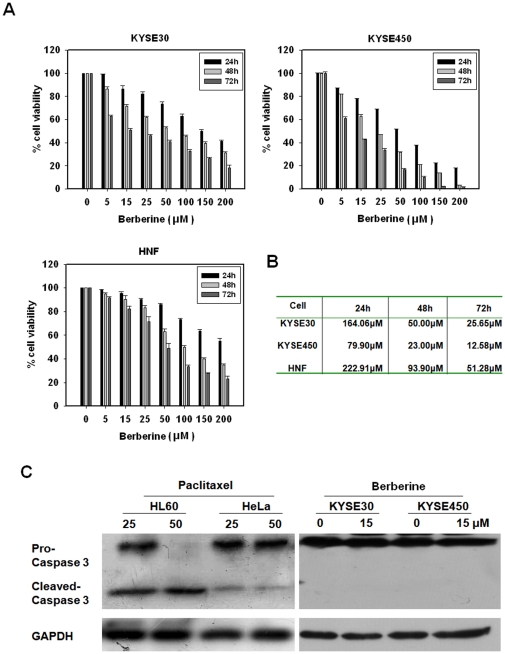
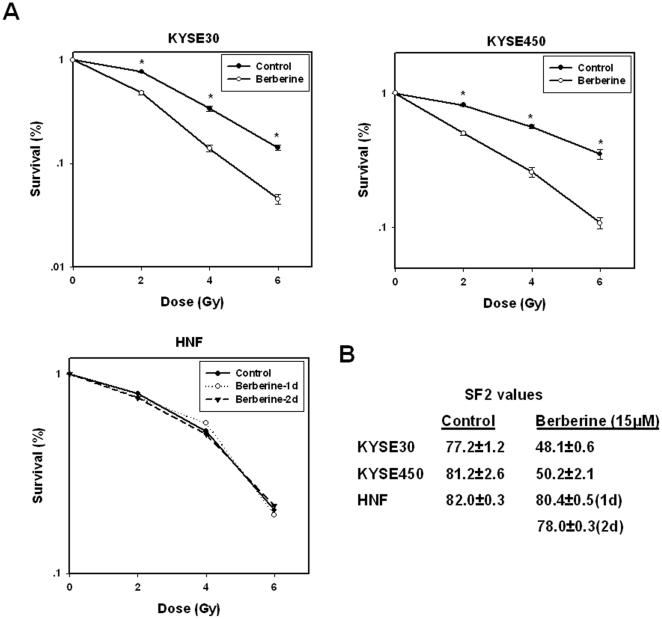
Esophageal squamous cell carcinomas (ESCC) have poor prognosis. While combined modality of chemotherapy and radiotherapy increases survival, most patients die within five years. Development of agents that confer cancer cell-specific chemo- and radiosensitivity may improve the therapy of ESCC. We here reported the discovery of berberine as a potent radiosensitizing agent on ESCC cells.
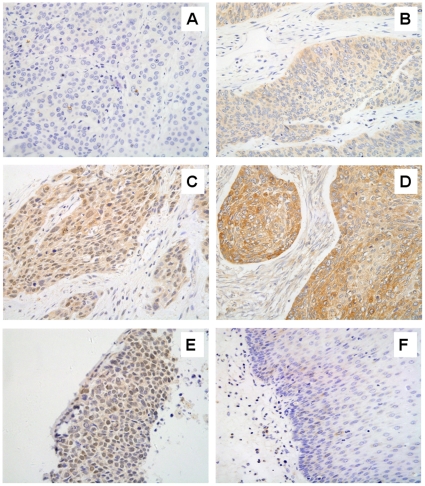
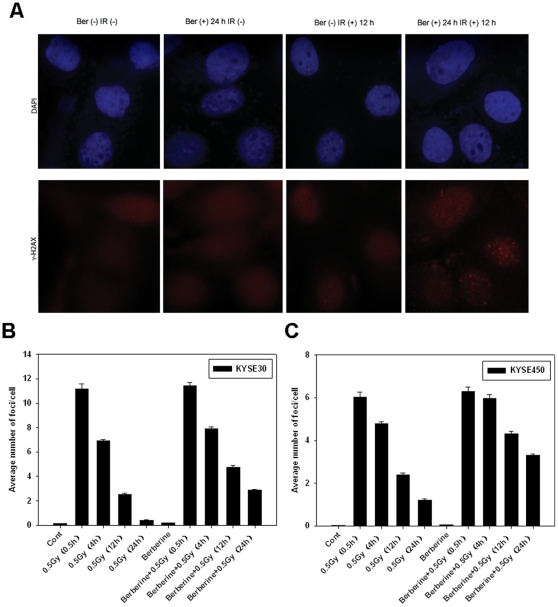
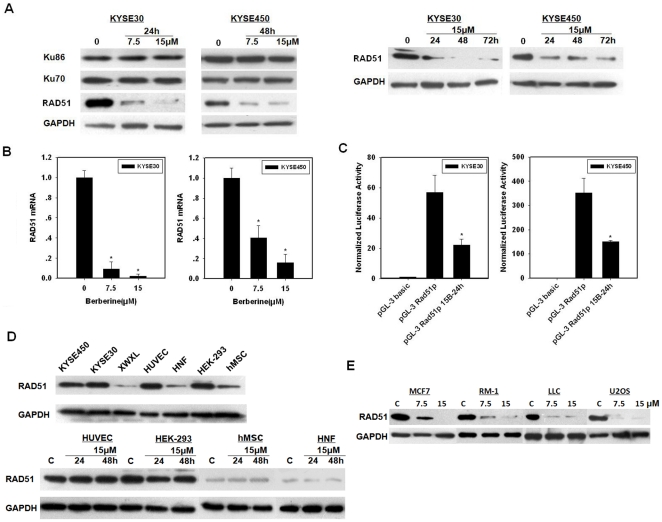
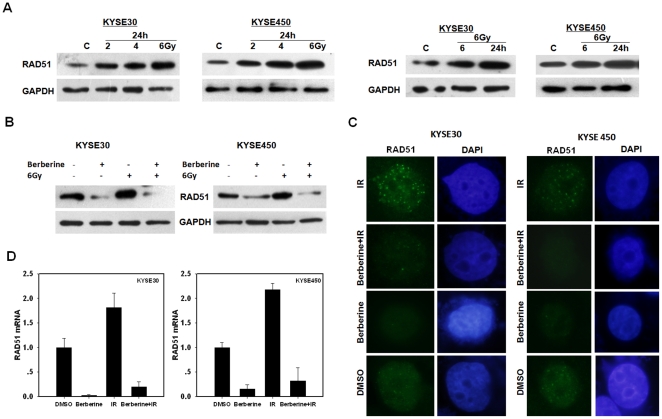
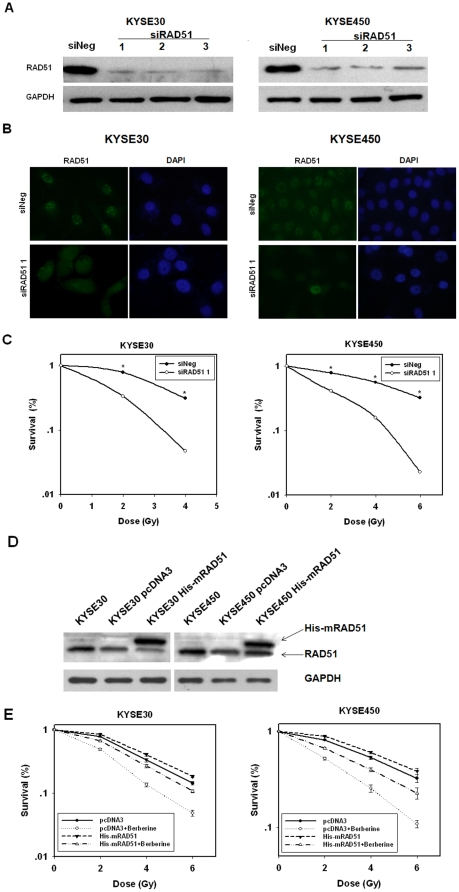
Berberine at low concentrations (<15 µM) substantially radiosensitized ESCC cells. X-ray induced DNA double-strand breaks (DSBs) persist longer in ESCC cells pretreated with berberine. Berberine pretreatment led to a significant downregulation of RAD51, a key player in homologous recombination repair, in ESCC cells, but not in non-malignant human cells. Downregulation of RAD51 by RNA interference similarly radiosensitized the cancer cells, and, conversely, introduction of exogenous RAD51 was able to significantly counteract the radiosensitizing effect of berberine, thus establishing RAD51 as a key determinant in radiation sensitivity. We also observed that RAD51 was commonly overexpressed in human ESCC tissues, suggesting that it is necessary to downregulate RAD51 to achieve high radio- or chemotherapeutic efficacy of ESCC in clinic, because overexpression of RAD51 is known to confer radio- and chemoresistance.
CONCLUSIONS/SIGNIFICANCE: Berberine can effectively downregulate RAD51 in conferring radiosensitivity on esophageal cancer cells. Its clinical application as an adjuvant in chemotherapy and radiotherapy of esophageal cancers should be explored.
食管鳞状细胞癌(ESCC)预后较差。虽然化疗和放疗的联合治疗可以提高生存率,但大多数患者在五年内死亡。开发能够赋予癌细胞特异性化疗和放射敏感性的药物可能会改善 ESCC 的治疗效果。我们在此报告发现小檗碱可作为 ESCC 细胞的一种有效的放射增敏剂。
小檗碱在低浓度(<15µM)下可显著放射增敏 ESCC 细胞。X 射线诱导的 DNA 双链断裂(DSBs)在小檗碱预处理的 ESCC 细胞中持续时间更长。小檗碱预处理导致 ESCC 细胞中同源重组修复的关键因子 RAD51 显著下调,但在非恶性人细胞中则没有。RAD51 的 RNA 干扰下调同样使癌细胞放射增敏,相反,外源性 RAD51 的引入能够显著抵消小檗碱的放射增敏作用,从而确立 RAD51 是辐射敏感性的关键决定因素。我们还观察到 RAD51 在人 ESCC 组织中普遍过表达,这表明在临床上要实现 ESCC 的高放射或化学治疗效果,有必要下调 RAD51,因为 RAD51 的过表达已知可赋予放射和化学抗性。
结论/意义:小檗碱可以有效地下调 RAD51,从而赋予食管癌放射敏感性。应探索其作为食管癌化疗和放疗辅助药物的临床应用。