Instituto de Investigaciones Biomédicas Alberto Sols, Consejo Superior de Investigaciones Científicas-Universidad Autónoma de Madrid, Madrid, Spain.
PLoS One. 2011;6(8):e23524. doi: 10.1371/journal.pone.0023524. Epub 2011 Aug 15.
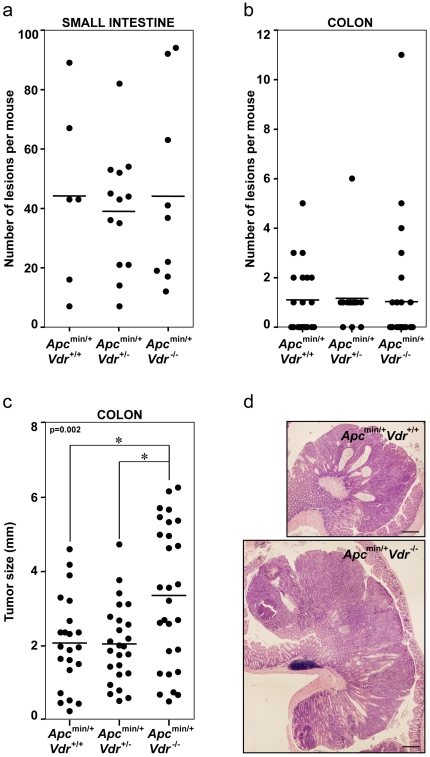
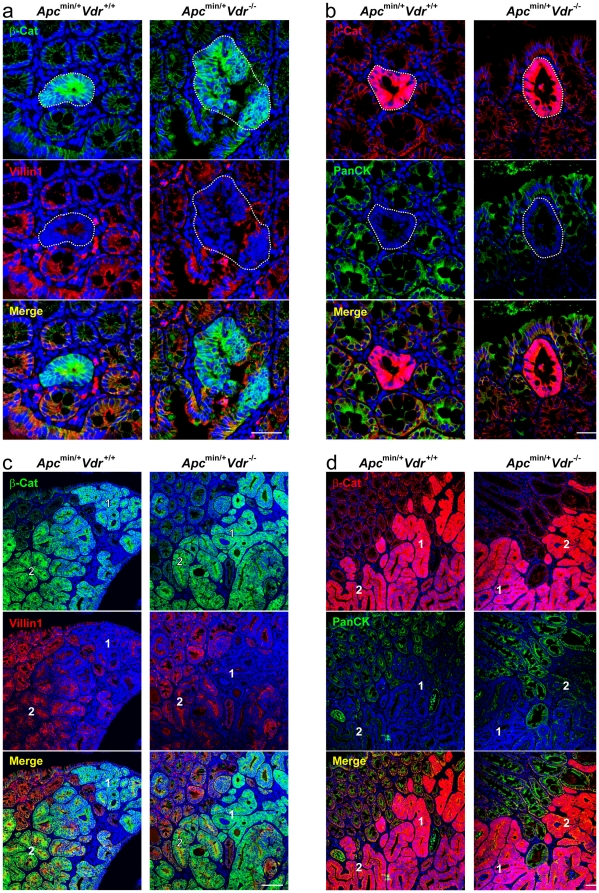
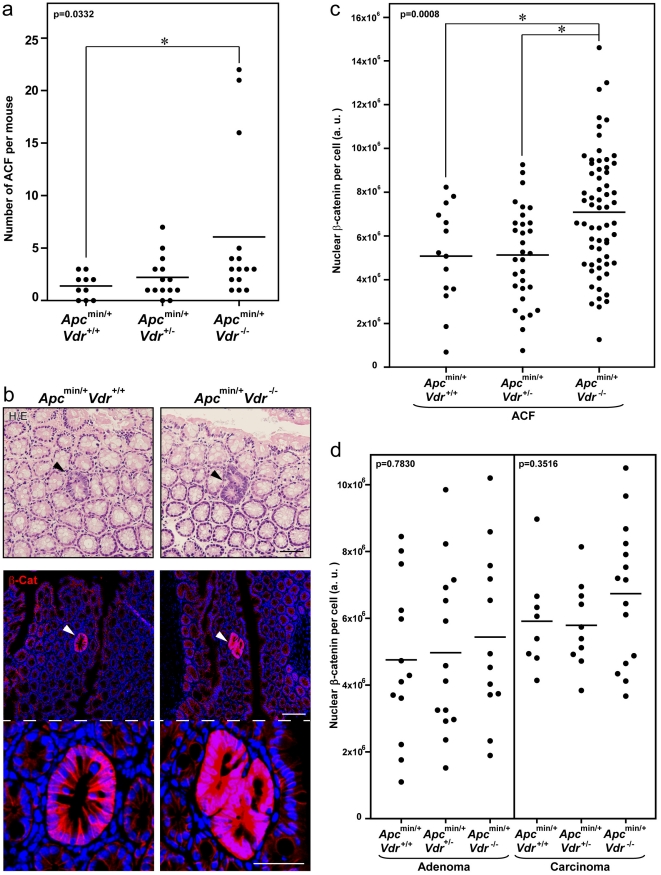
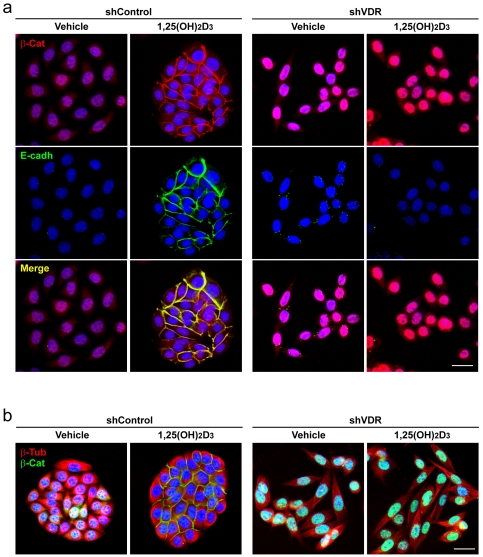
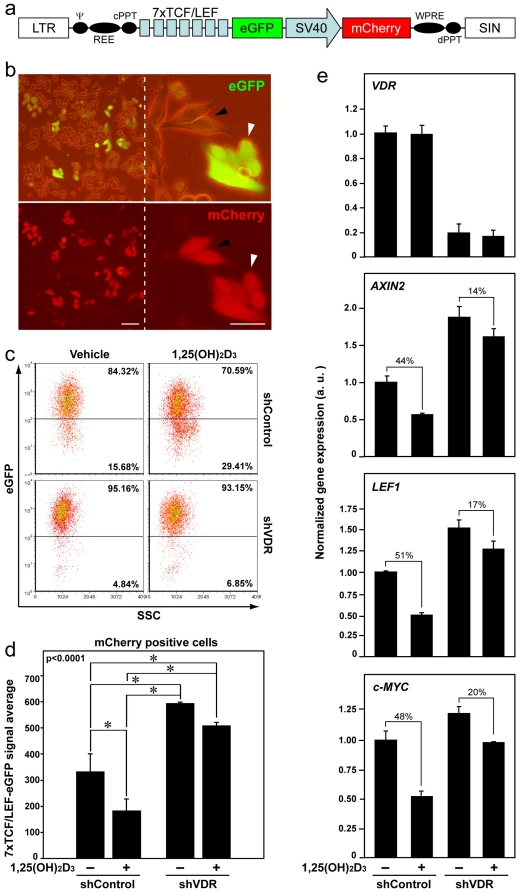
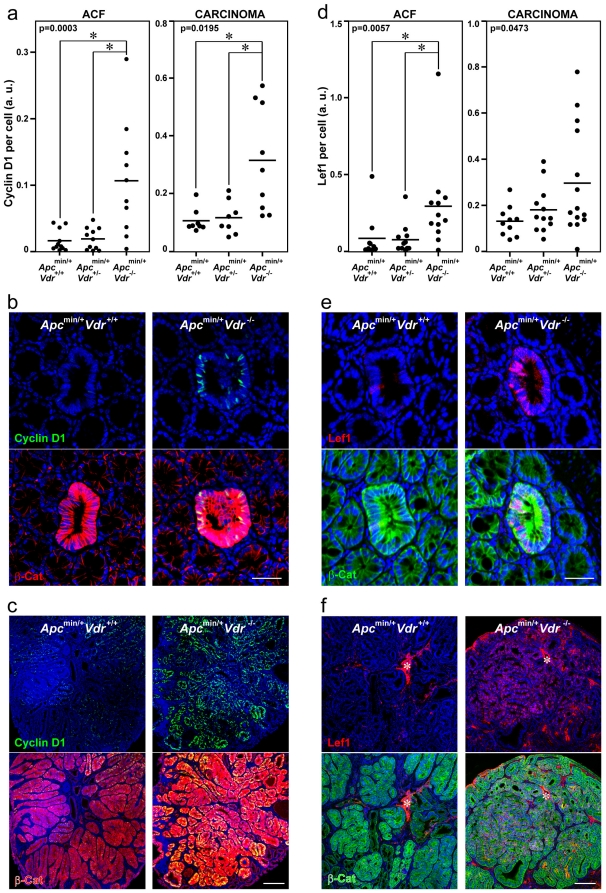
Aberrant activation of the Wnt/β-catenin pathway is critical for the initiation and progression of most colon cancers. This activation provokes the accumulation of nuclear β-catenin and the induction of its target genes. Apc(min/+) mice are the most commonly used model for colon cancer. They harbor a mutated Apc allele and develop intestinal adenomas and carcinomas during the first months of life. This phenotype is caused by the mutation of the second Apc allele and the consequent accumulation of nuclear β-catenin in the affected cells. Here we describe that vitamin D receptor (VDR) is a crucial modulator of nuclear β-catenin levels in colon cancer in vivo. By appropriate breeding of Apc(min/+) mice and Vdr(+/-) mice we have generated animals expressing a mutated Apc allele and two, one, or none Vdr wild type alleles. Lack of Vdr increased the number of colonic Aberrant Crypt Foci (ACF) but not that of adenomas or carcinomas in either small intestine or colon. Importantly, colon ACF and tumors of Apc(min/+)Vdr(-/-) mice had increased nuclear β-catenin and the tumors reached a larger size than those of Apc(min/+)Vdr(+/+). Both ACF and carcinomas in Apc(min/+)Vdr(-/-) mice showed higher expression of β-catenin/TCF target genes. In line with this, VDR knock-down in cultured human colon cancer cells enhanced β-catenin nuclear content and target gene expression. Consistently, VDR depletion abrogated the capacity of 1,25(OH)(2)D(3) to promote the relocation of β-catenin from the nucleus to the plasma membrane and to inhibit β-catenin/TCF target genes. In conclusion, VDR controls the level of nuclear β-catenin in colon cancer cells and can therefore attenuate the impact of oncogenic mutations that activate the Wnt/β-catenin pathway.
Wnt/β-catenin 信号通路的异常激活对于大多数结肠癌的发生和发展至关重要。这种激活促使核 β-catenin 的积累,并诱导其靶基因的表达。Apc(min/+) 小鼠是最常用于结肠癌的模型。它们携带突变的 Apc 等位基因,并在生命的头几个月内发展为肠道腺瘤和癌。这种表型是由第二个 Apc 等位基因的突变以及受影响细胞中核 β-catenin 的积累引起的。在这里,我们描述维生素 D 受体 (VDR) 是体内结肠癌中核 β-catenin 水平的关键调节剂。通过适当的 Apc(min/+) 小鼠和 Vdr(+/-) 小鼠的繁殖,我们生成了表达突变型 Apc 等位基因和两个、一个或没有野生型 Vdr 等位基因的动物。缺乏 Vdr 增加了结肠异常隐窝病灶 (ACF) 的数量,但无论是在小肠还是结肠,腺瘤或癌的数量都没有增加。重要的是,Apc(min/+)Vdr(-/-) 小鼠的结肠 ACF 和肿瘤的核 β-catenin 增加,并且肿瘤的大小大于 Apc(min/+)Vdr(+/+) 的肿瘤。Apc(min/+)Vdr(-/-) 小鼠的 ACF 和癌都表现出更高的 β-catenin/TCF 靶基因表达。与此一致,在培养的人结肠癌细胞中敲低 VDR 增强了核 β-catenin 含量和靶基因表达。一致地,VDR 耗竭消除了 1,25(OH)2D3 促进 β-catenin 从核到质膜重新定位以及抑制 β-catenin/TCF 靶基因的能力。总之,VDR 控制结肠癌细胞中核 β-catenin 的水平,因此可以减弱激活 Wnt/β-catenin 通路的致癌突变的影响。