Marras Francesco, Bozzano Federica, De Maria Andrea
Centro di Eccellenza per la Ricerca Biomedica (CEBR), Università di Genova, Genova, Italy.
J Biomed Biotechnol. 2011;2011:152430. doi: 10.1155/2011/152430. Epub 2011 Aug 11.
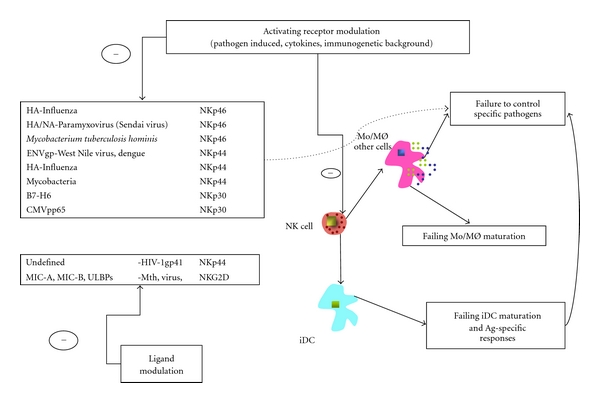
Natural Killer (NK) cells are endowed with cell-structure-sensing receptors providing inhibitory protection from self-destruction (inhibitory NK receptors, iNKRs, including killer inhibitory receptors and other molecules) and rapid triggering potential leading to functional cell activation by Toll-like receptors (TLRs), cytokine receptors, and activating NK cell receptors including natural cytotoxicity receptors (NCRs, i.e., NKp46, NKp46, and NKp44). NCR and NKG2D recognize ligands on infected cells which may be endogenous or may directly bind to some structures derived from invading pathogens. In this paper, we address the known direct or indirect interactions between activating receptors and pathogens and their expression during chronic HIV and HCV infections.
自然杀伤(NK)细胞具有细胞结构传感受体,这些受体提供抑制性保护以防止自身破坏(抑制性NK受体,iNKRs,包括杀伤细胞抑制受体和其他分子),以及通过Toll样受体(TLRs)、细胞因子受体和包括自然细胞毒性受体(NCRs,即NKp46、NKp46和NKp44)在内的激活NK细胞受体导致功能性细胞激活的快速触发潜能。NCR和NKG2D识别感染细胞上的配体,这些配体可能是内源性的,也可能直接结合某些源自入侵病原体的结构。在本文中,我们探讨了激活受体与病原体之间已知的直接或间接相互作用及其在慢性HIV和HCV感染期间的表达。