
病毒 Tat 蛋白激活 HIV 转录需要赖氨酸特异性去甲基化酶 1(LSD1/KDM1)介导的去甲基化步骤。
Activation of HIV transcription by the viral Tat protein requires a demethylation step mediated by lysine-specific demethylase 1 (LSD1/KDM1).
机构信息
Gladstone Institute of Virology and Immunology, University of California, San Francisco, California, United States of America.
出版信息
PLoS Pathog. 2011 Aug;7(8):e1002184. doi: 10.1371/journal.ppat.1002184. Epub 2011 Aug 18.
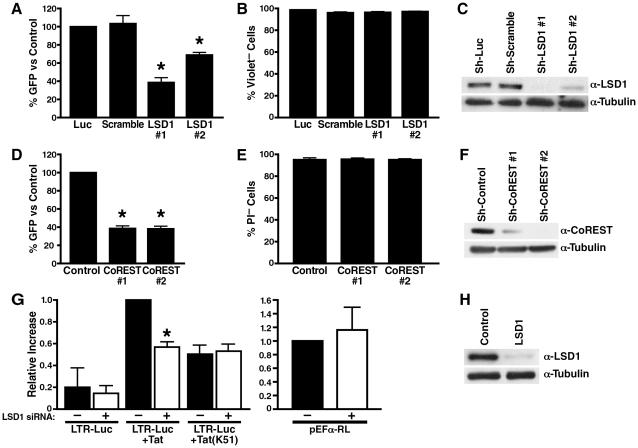
The essential transactivator function of the HIV Tat protein is regulated by multiple posttranslational modifications. Although individual modifications are well characterized, their crosstalk and dynamics of occurrence during the HIV transcription cycle remain unclear.We examine interactions between two critical modifications within the RNA-binding domain of Tat: monomethylation of lysine 51 (K51) mediated by Set7/9/KMT7, an early event in the Tat transactivation cycle that strengthens the interaction of Tat with TAR RNA, and acetylation of lysine 50 (K50) mediated by p300/KAT3B, a later process that dissociates the complex formed by Tat, TAR RNA and the cyclin T1 subunit of the positive transcription elongation factor b (P-TEFb). We find K51 monomethylation inhibited in synthetic Tat peptides carrying an acetyl group at K50 while acetylation can occur in methylated peptides, albeit at a reduced rate. To examine whether Tat is subject to sequential monomethylation and acetylation in cells, we performed mass spectrometry on immunoprecipitated Tat proteins and generated new modification-specific Tat antibodies against monomethylated/acetylated Tat. No bimodified Tat protein was detected in cells pointing to a demethylation step during the Tat transactivation cycle. We identify lysine-specific demethylase 1 (LSD1/KDM1) as a Tat K51-specific demethylase, which is required for the activation of HIV transcription in latently infected T cells. LSD1/KDM1 and its cofactor CoREST associates with the HIV promoter in vivo and activate Tat transcriptional activity in a K51-dependent manner. In addition, small hairpin RNAs directed against LSD1/KDM1 or inhibition of its activity with the monoamine oxidase inhibitor phenelzine suppresses the activation of HIV transcription in latently infected T cells.Our data support the model that a LSD1/KDM1/CoREST complex, normally known as a transcriptional suppressor, acts as a novel activator of HIV transcription through demethylation of K51 in Tat. Small molecule inhibitors of LSD1/KDM1 show therapeutic promise by enforcing HIV latency in infected T cells.
HIV Tat 蛋白的基本转录激活功能受多种翻译后修饰调控。虽然各个修饰都已得到很好的描述,但它们在 HIV 转录周期中的相互作用和发生动态仍不清楚。我们研究了 Tat 蛋白 RNA 结合域内两个关键修饰之间的相互作用:Set7/9/KMT7 介导的赖氨酸 51 单甲基化(K51),这是 Tat 转录激活循环中的早期事件,可增强 Tat 与 TAR RNA 的相互作用;p300/KAT3B 介导的赖氨酸 50 乙酰化(K50),这是稍后的过程,可使 Tat、TAR RNA 和正转录延伸因子 b(P-TEFb)的 cyclin T1 亚基形成的复合物解离。我们发现,在携带 K50 乙酰基的合成 Tat 肽中,K51 单甲基化受到抑制,而在甲基化肽中可以发生乙酰化,但速度较慢。为了研究 Tat 在细胞中是否经历顺序的单甲基化和乙酰化,我们对免疫沉淀的 Tat 蛋白进行了质谱分析,并针对单甲基化/乙酰化 Tat 生成了新的修饰特异性 Tat 抗体。在细胞中未检测到双修饰 Tat 蛋白,这表明在 Tat 转录激活循环中有去甲基化步骤。我们鉴定出赖氨酸特异性去甲基酶 1(LSD1/KDM1)为 Tat K51 特异性去甲基酶,它是潜伏感染 T 细胞中 HIV 转录激活所必需的。LSD1/KDM1 及其共因子 CoREST 在体内与 HIV 启动子结合,并以 K51 依赖的方式激活 Tat 转录活性。此外,针对 LSD1/KDM1 的短发夹 RNA 或用单胺氧化酶抑制剂苯佐卡因抑制其活性可抑制潜伏感染 T 细胞中 HIV 转录的激活。我们的数据支持这样的模型,即 LSD1/KDM1/CoREST 复合物通常作为转录抑制剂,通过 Tat 中 K51 的去甲基化作用,作为 HIV 转录的新型激活剂。LSD1/KDM1 的小分子抑制剂通过在感染的 T 细胞中强制建立 HIV 潜伏期显示出治疗潜力。



 Zotero 插件