Service of Medical Genetics, Centre Hospitalier Universitaire Vaudois, 1011 Lausanne, Switzerland.
Nature. 2011 Aug 31;478(7367):97-102. doi: 10.1038/nature10406.
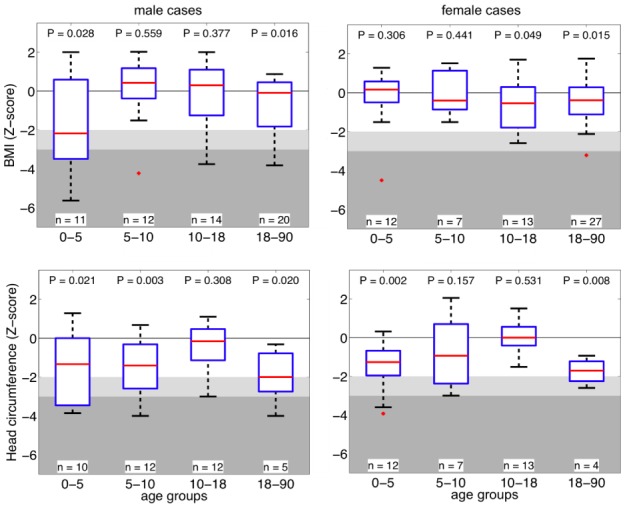
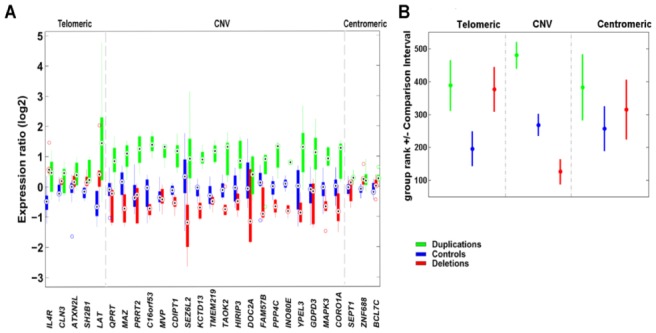
Both obesity and being underweight have been associated with increased mortality. Underweight, defined as a body mass index (BMI) ≤ 18.5 kg per m(2) in adults and ≤ -2 standard deviations from the mean in children, is the main sign of a series of heterogeneous clinical conditions including failure to thrive, feeding and eating disorder and/or anorexia nervosa. In contrast to obesity, few genetic variants underlying these clinical conditions have been reported. We previously showed that hemizygosity of a ∼600-kilobase (kb) region on the short arm of chromosome 16 causes a highly penetrant form of obesity that is often associated with hyperphagia and intellectual disabilities. Here we show that the corresponding reciprocal duplication is associated with being underweight. We identified 138 duplication carriers (including 132 novel cases and 108 unrelated carriers) from individuals clinically referred for developmental or intellectual disabilities (DD/ID) or psychiatric disorders, or recruited from population-based cohorts. These carriers show significantly reduced postnatal weight and BMI. Half of the boys younger than five years are underweight with a probable diagnosis of failure to thrive, whereas adult duplication carriers have an 8.3-fold increased risk of being clinically underweight. We observe a trend towards increased severity in males, as well as a depletion of male carriers among non-medically ascertained cases. These features are associated with an unusually high frequency of selective and restrictive eating behaviours and a significant reduction in head circumference. Each of the observed phenotypes is the converse of one reported in carriers of deletions at this locus. The phenotypes correlate with changes in transcript levels for genes mapping within the duplication but not in flanking regions. The reciprocal impact of these 16p11.2 copy-number variants indicates that severe obesity and being underweight could have mirror aetiologies, possibly through contrasting effects on energy balance.
肥胖和体重过轻都与死亡率增加有关。体重过轻是指成年人的身体质量指数(BMI)≤18.5kg/m(2),儿童则低于平均值的-2 个标准差,是一系列异质临床情况的主要表现,包括发育不良、喂养和饮食障碍和/或神经性厌食症。与肥胖相反,这些临床情况的遗传变异很少被报道。我们之前表明,16 号染色体短臂上一个约 600 千碱基(kb)的区域的半合子缺失会导致一种高度外显的肥胖形式,这种肥胖通常与食欲过盛和智力障碍有关。在这里,我们表明相应的相互重复与体重过轻有关。我们从临床上因发育或智力障碍(DD/ID)或精神障碍而就诊的个体或从基于人群的队列中确定了 138 个重复携带者(包括 132 个新病例和 108 个无关携带者)。这些携带者的出生后体重和 BMI 明显降低。五岁以下的男孩有一半体重过轻,可能被诊断为发育不良,而成年重复携带者临床体重过轻的风险增加了 8.3 倍。我们观察到男性的严重程度有上升趋势,非医学确定病例中的男性携带者也有所减少。这些特征与选择性和限制性进食行为的发生率增加以及头围显著缩小有关。所观察到的表型中的每一种都与该位点缺失携带者报告的表型相反。这些表型与映射到重复内的基因的转录水平变化相关,但与侧翼区域无关。这些 16p11.2 拷贝数变异的相互影响表明,严重肥胖和体重过轻可能有镜像病因,可能通过对能量平衡的相反影响。