Development of Language, Learning, and Action, Department of Psychology, Saarland University Saarbruecken, Saarland, Germany.
Front Psychol. 2011 Aug 11;2:171. doi: 10.3389/fpsyg.2011.00171. eCollection 2011.
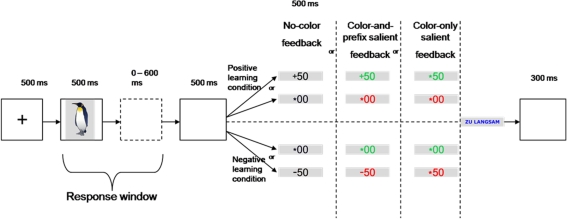
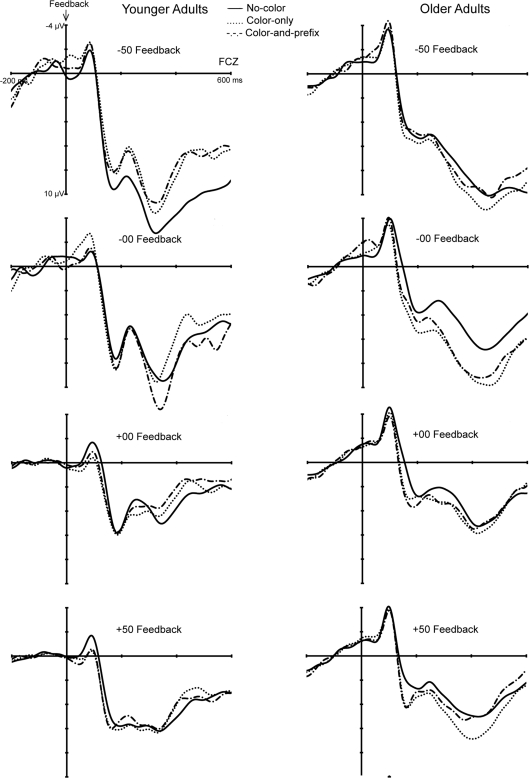
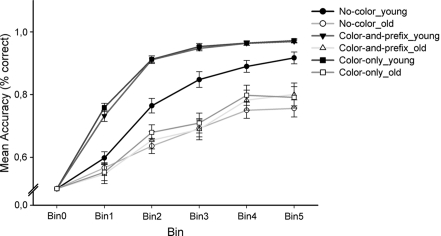
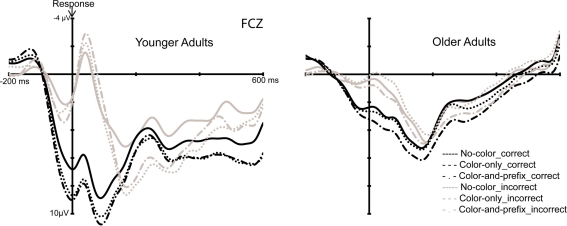
Older adults are impaired in reinforcement learning (RL) when feedback is partially ambiguous (e.g., Eppinger and Kray, 2011). In this study we examined whether older adults benefit from salient feedback information during learning. We used an electrophysiological approach and investigated 15 younger and 15 older adults with a RL task in which they had to learn stimulus-response associations under two learning conditions. In the positive learning conditions, participants could gain 50 Cents for a correct response but did not gain or lose money (*00 Cent) for an incorrect response. In negative learning conditions, they could lose 50 Cents for an incorrect response but did not gain or lose money (*00 Cent) for a correct response. As the identical outcome "00 Cent" is either better or worse than the alternative outcome depending on the learning condition, this feedback type is ambiguous. To examine the influence of feedback salience we compared this condition with a condition in which positive and negative outcomes were color-coded and thereby clearly separable. The behavioral results indicated that younger adults reached higher accuracy levels under salient feedback conditions. Moreover, the error-related negativity and the feedback-related negativity for losses were larger if the good-bad dimension of feedback was salient. Hence, in younger adults salient feedback facilitates the rapid evaluation of outcomes on a good-bad dimension and by this supports learning. In contrast, for older adults we obtained neither behavioral nor electrophysiological effects of feedback salience. The older adults' performance monitoring system therefore appears less flexible in integrating additional information in this evaluation process.
老年人在反馈部分模糊(例如,Eppinger 和 Kray,2011)时,在强化学习(RL)中受到损害。在这项研究中,我们研究了老年人在学习过程中是否受益于明显的反馈信息。我们使用了一种电生理方法,调查了 15 名年轻成年人和 15 名老年人,他们在 RL 任务中,在两种学习条件下学习刺激 - 反应关联。在积极的学习条件下,参与者可以正确回答获得 50 美分,但不正确回答不赚钱(* 00 美分)。在消极的学习条件下,他们可以不正确回答损失 50 美分,但正确回答不赚钱(* 00 美分)。由于相同的结果“00 美分”根据学习条件,要么比替代结果好,要么比替代结果差,因此这种反馈类型是模糊的。为了检查反馈显着性的影响,我们将这种情况与一种情况进行了比较,在这种情况下,积极和消极的结果都用颜色编码,因此可以清楚地区分。行为结果表明,在显着反馈条件下,年轻成年人达到了更高的准确性水平。此外,如果反馈的好坏维度显着,则错误相关负性和损失相关负性更大。因此,在年轻成年人中,显着反馈有助于快速评估好坏维度上的结果,并通过这种方式支持学习。相比之下,我们没有获得老年人反馈显着性的行为或电生理效应。因此,老年人的绩效监测系统在这个评估过程中整合额外信息的灵活性较低。