Mental Health Service, VA Boston Healthcare System, Boston, Massachusetts, United States of America.
PLoS One. 2011;6(8):e23574. doi: 10.1371/journal.pone.0023574. Epub 2011 Aug 23.
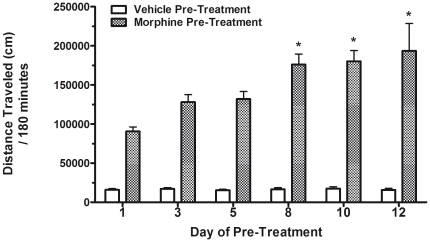
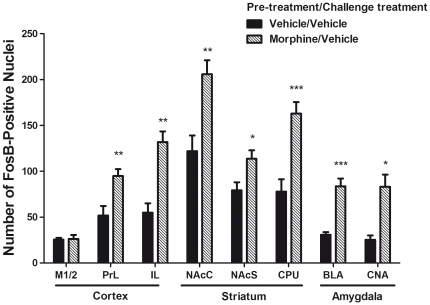
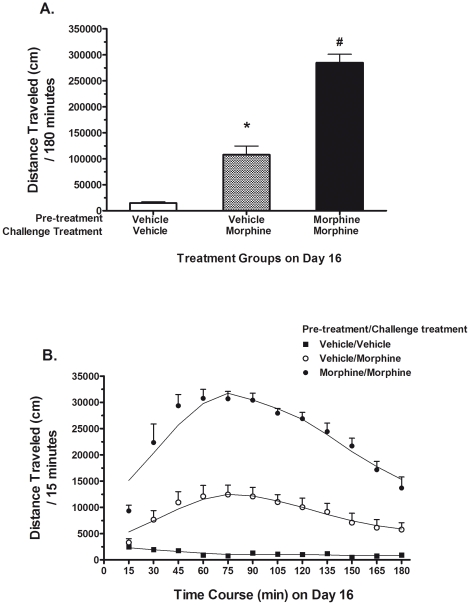
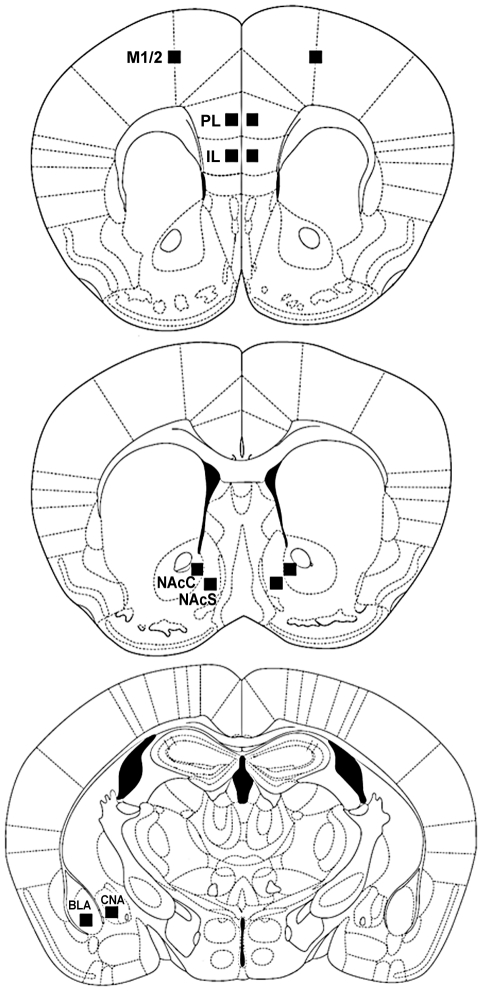
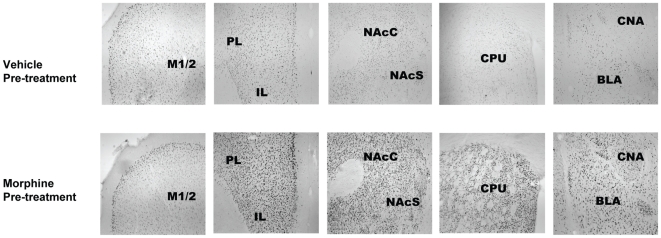
Sensitization to the effects of drugs of abuse and associated stimuli contributes to drug craving, compulsive drug use, and relapse in addiction. Repeated opiate exposure produces behavioral sensitization that is hypothesized to result from neural plasticity in specific limbic, striatal and cortical systems. ΔFosB and FosB are members of the Fos family of transcription factors that are implicated in neural plasticity in addiction. This study examined the effects of intermittent morphine treatment, associated with motor sensitization, on FosB/ΔFosB levels using quantitative immunohistochemistry. Motor sensitization was tested in C57BL/6 mice that received six intermittent pre-treatments (on days 1, 3, 5, 8, 10, 12) with either subcutaneous morphine (10 mg/kg) or saline followed by a challenge injection of morphine or saline on day 16. Mice receiving repeated morphine injections demonstrated significant increases in locomotor activity on days 8, 10, and 12 of treatment (vs. day 1), consistent with development of locomotor sensitization. A morphine challenge on day 16 significantly increased locomotor activity of saline pre-treated mice and produced even larger increases in motor activity in the morphine pre-treated mice, consistent with the expression of opiate sensitization. Intermittent morphine pre-treatment on these six pre-treatment days produced a significant induction of FosB/ΔFosB, measured on day 16, in multiple brain regions including prelimbic (PL) and infralimbic (IL) cortex, nucleus accumbens (NAc) core, dorsomedial caudate-putamen (CPU), basolateral amygdala (BLA) and central nucleus of the amygdala (CNA) but not in a motor cortex control region. Opiate induced sensitization may develop via Fos/ΔFosB plasticity in motivational pathways (NAc), motor outputs (CPU), and associative learning (PL, IL, BLA) and stress pathways (CNA).
对滥用药物及其相关刺激物的作用的敏化作用导致了药物渴望、强迫性药物使用和成瘾的复发。反复接触阿片类药物会产生行为敏化,据推测这种敏化是由于特定边缘系统、纹状体和皮质系统的神经可塑性所致。ΔFosB 和 FosB 是 Fos 家族转录因子的成员,它们与成瘾中的神经可塑性有关。本研究使用定量免疫组织化学方法研究了与运动敏化相关的间歇性吗啡治疗对 FosB/ΔFosB 水平的影响。在接受六次间歇性预处理(第 1、3、5、8、10 和 12 天)的 C57BL/6 小鼠中测试了运动敏化,预处理包括皮下吗啡(10mg/kg)或生理盐水,然后在第 16 天给予吗啡或生理盐水挑战注射。接受重复吗啡注射的小鼠在治疗的第 8、10 和 12 天(与第 1 天相比)表现出明显的运动活动增加,这与运动敏化的发展一致。第 16 天的吗啡挑战显著增加了生理盐水预处理小鼠的运动活动,并使吗啡预处理小鼠的运动活动增加更大,这与阿片类药物敏化的表达一致。在这六个预处理日中,间歇性吗啡预处理产生了 FosB/ΔFosB 的显著诱导,在多个脑区(包括前扣带回皮层(PL)和下边缘皮层(IL)、伏隔核(NAc)核心、背侧尾状壳(CPU)、基底外侧杏仁核(BLA)和杏仁中央核(CNA)),但在运动皮层对照区没有。阿片类药物诱导的敏化可能通过动机途径(NAc)、运动输出(CPU)、联想学习(PL、IL、BLA)和应激途径(CNA)中的 Fos/ΔFosB 可塑性发展。