Laboratoire de Sommeil et de Neurophysiologie, Hôpitaux Universitaires de Genève, Belle Idée, Geneva, Switzerland.
PLoS One. 2011;6(8):e23593. doi: 10.1371/journal.pone.0023593. Epub 2011 Aug 19.
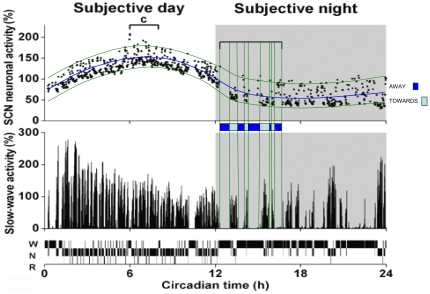
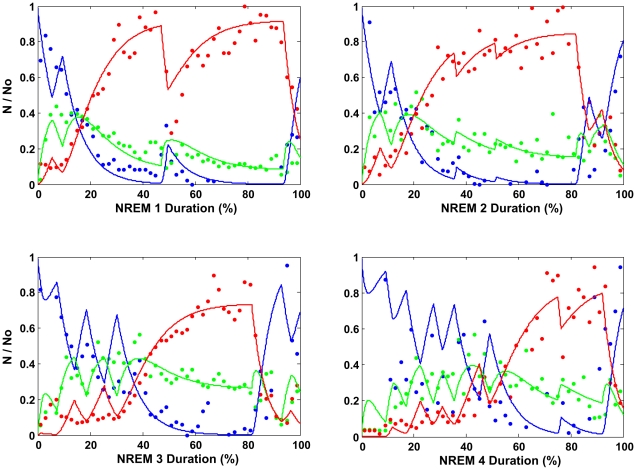
Little attention has gone into linking to its neuronal substrates the dynamic structure of non-rapid-eye-movement (NREM) sleep, defined as the pattern of time-course power in all frequency bands across an entire episode. Using the spectral power time-courses in the sleep electroencephalogram (EEG), we showed in the typical first episode, several moves towards-and-away from deep sleep, each having an identical pattern linking the major frequency bands beta, sigma and delta. The neuronal transition probability model (NTP)--in fitting the data well--successfully explained the pattern as resulting from stochastic transitions of the firing-rates of the thalamically-projecting brainstem-activating neurons, alternating between two steady dynamic-states (towards-and-away from deep sleep) each initiated by a so-far unidentified flip-flop. The aims here are to identify this flip-flop and to demonstrate that the model fits well all NREM episodes, not just the first. Using published data on suprachiasmatic nucleus (SCN) activity we show that the SCN has the information required to provide a threshold-triggered flip-flop for TIMING the towards-and-away alternations, information provided by sleep-relevant feedback to the SCN. NTP then determines the PATTERN of spectral power within each dynamic-state. NTP was fitted to individual NREM episodes 1-4, using data from 30 healthy subjects aged 20-30 years, and the quality of fit for each NREM measured. We show that the model fits well all NREM episodes and the best-fit probability-set is found to be effectively the same in fitting all subject data. The significant model-data agreement, the constant probability parameter and the proposed role of the SCN add considerable strength to the model. With it we link for the first time findings at cellular level and detailed time-course data at EEG level, to give a coherent picture of NREM dynamics over the entire night and over hierarchic brain levels all the way from the SCN to the EEG.
人们很少关注将非快速眼动 (NREM) 睡眠的动态结构与其神经元基质联系起来,NREM 睡眠被定义为整个发作过程中所有频段的时程功率模式。我们使用睡眠脑电图 (EEG) 中的频谱功率时程,在典型的第一个发作中,展示了几次向深度睡眠和远离深度睡眠的移动,每个移动都具有将主要频段β、σ和δ联系起来的相同模式。神经元转移概率模型 (NTP)——在很好地拟合数据方面——成功地将该模式解释为丘脑投射脑干激活神经元的发射率随机转移的结果,这些神经元在两个稳定的动态状态(向深度睡眠和远离深度睡眠)之间交替,每个状态都是由迄今为止尚未确定的触发器启动的。这里的目的是确定这个触发器,并证明该模型很好地适用于所有 NREM 发作,而不仅仅是第一个。使用关于视交叉上核 (SCN) 活动的已发表数据,我们表明 SCN 具有提供定时向-远离交替所需的触发触发器的信息,这些信息由与睡眠相关的反馈提供给 SCN。然后,NTP 确定每个动态状态内的光谱功率模式。使用来自 30 名年龄在 20-30 岁之间的健康受试者的数据,将 NTP 拟合到个体 NREM 发作 1-4 中,并测量每个 NREM 的拟合质量。我们表明,该模型很好地适用于所有 NREM 发作,并且发现最佳拟合概率集在拟合所有受试者数据时实际上是相同的。模型与数据的显著一致性、恒定的概率参数以及 SCN 的提议作用为该模型增添了相当大的力量。通过该模型,我们首次将细胞水平的发现和 EEG 水平的详细时程数据联系起来,为整个夜间和从 SCN 到 EEG 的层次化大脑水平的 NREM 动力学提供了一个连贯的画面。