Université Paris Descartes, EA 3620, CHU Necker-Enfants Malades, Paris, France.
PLoS One. 2011;6(8):e23301. doi: 10.1371/journal.pone.0023301. Epub 2011 Aug 24.
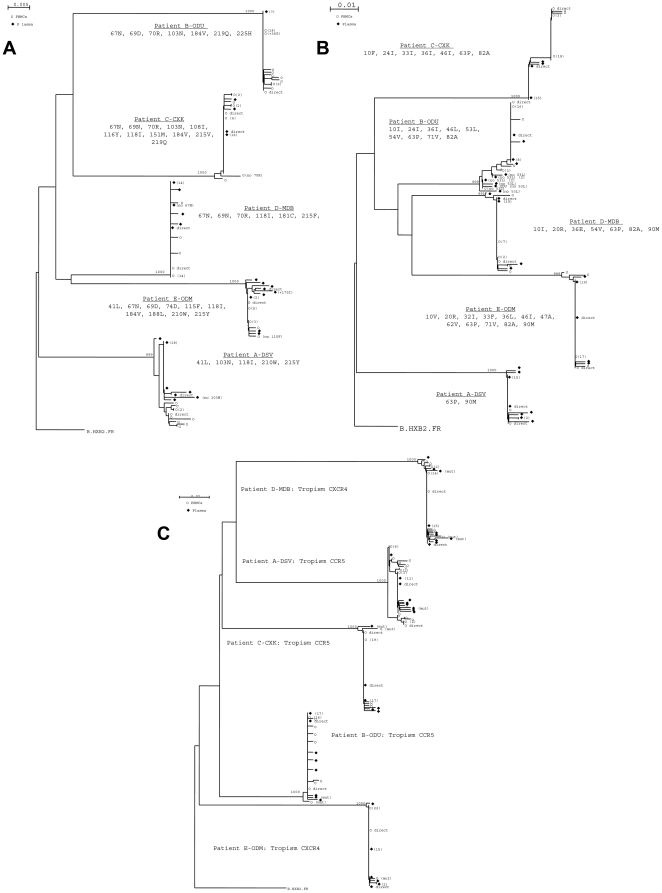
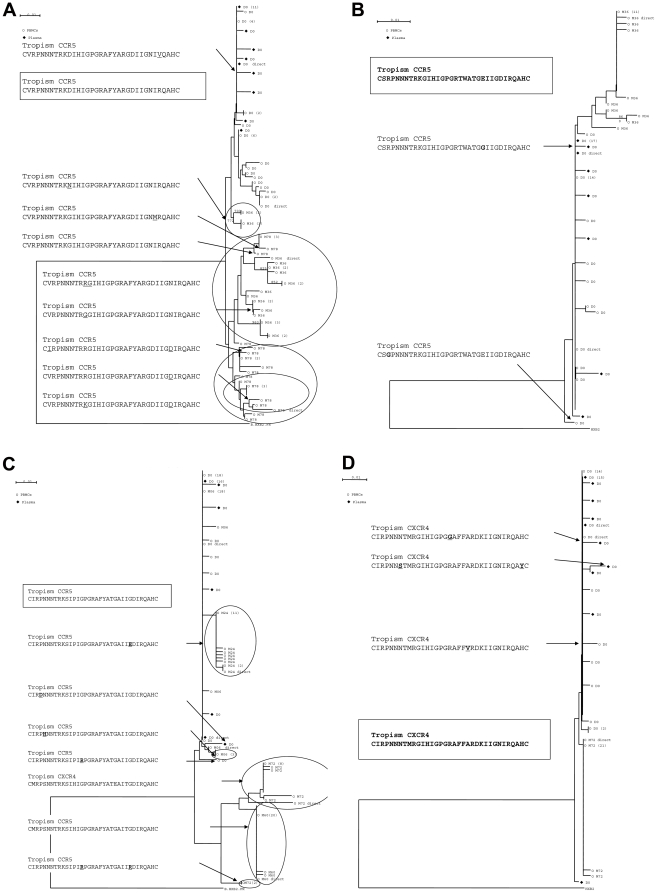
Our objective was to analyze the evolution of resistance mutations (RM) and viral tropism of multi-drug-resistant (MDR) strains detected at primary HIV-1 infection (PHI). MDR HIV strain was defined as the presence of genotypic resistance to at least 1 antiretroviral of the 3 classes. Tropism determinations (CCR5 or CXCR4) were performed on baseline plasma HIV-RNA and/or PBMC-HIV-DNA samples, then during follow-up using population-based sequencing of V3 loop and phenotypic tests. Clonal analysis was performed at baseline for env, RT and protease genes, and for HIV-DNA env gene during follow-up. Five patients were eligible. At baseline, RT, protease and env clones from HIV-RNA and HIV-DNA were highly homogenous for each patient; genotypic tropism was R5 in 3 (A,B,C) and X4 in 2 patients (D,E). MDR strains persisted in HIV-DNA throughout follow-up in all patients. For patient A, tropism remained R5 with concordance between phenotypic and genotypic tests. Clonal analysis on Month (M) 78 HIV-DNA evidenced exclusively R5 (21/21) variants. In patient B, clonal analysis at M36 showed exclusively R5 variants (19/19) using both genotypic and phenotypic tests. In patient C, baseline tropism was R5 by genotypic test and R5/X4 by phenotypic test. An expansion of these X4 clones was evidenced by clonal analysis on M72 HIV-DNA (12/14 X4 and 2/14 R5 variants). In patient D, baseline tropism was X4 with concordance between both techniques and HIV-RNA and HIV-DNA remained X4-tropic up to M72, confirmed by the clonal analysis. Patient E harboured highly homogenous X4-using population at baseline; tropism was unchanged at M1 and M18. In all patients, the initial MDR population was highly homogenous initially, supporting the early expansion of a monoclonal population and its long-term persistence. X4-tropic variants present at baseline were still exclusive (patients D and E) or dominant (at least one time point, patient C) far from PHI.
我们的目的是分析在原发性 HIV-1 感染(PHI)时检测到的多药耐药(MDR)株的耐药突变(RM)和病毒嗜性的演变。MDR HIV 株定义为至少对 3 类抗逆转录病毒药物中的 1 种存在基因型耐药。在基线血浆 HIV-RNA 和/或 PBMC-HIV-DNA 样本上进行嗜性测定(CCR5 或 CXCR4),然后在随访期间使用基于人群的 V3 环序列分析和表型检测进行。在基线时对 env、RT 和蛋白酶基因进行克隆分析,并在随访期间对 HIV-DNA env 基因进行分析。符合条件的患者有 5 名。基线时,每位患者的 HIV-RNA 和 HIV-DNA 的 RT、蛋白酶和 env 克隆高度同源;3 名患者(A、B、C)的基因型嗜性为 R5,2 名患者(D、E)为 X4。在所有患者中,MDR 株在整个随访过程中均存在于 HIV-DNA 中。对于患者 A,表型和基因型检测均显示嗜性仍为 R5,且两者一致。在第 78 个月时,HIV-DNA 的克隆分析仅显示 R5(21/21)变异。在患者 B,第 36 个月时的克隆分析显示,使用基因型和表型检测,均仅为 R5 变异(19/19)。在患者 C,基线时的基因型检测嗜性为 R5,表型检测为 R5/X4。在第 72 个月时,HIV-DNA 的克隆分析显示这些 X4 克隆的扩增(12/14 X4 和 2/14 R5 变异)。在患者 D,基线时的嗜性为 X4,两种技术均一致,HIV-RNA 和 HIV-DNA 一直为 X4 嗜性,直至第 72 个月,这一结果得到了克隆分析的证实。患者 E 基线时携带高度同源的 X4-使用人群;在第 1 个月和第 18 个月时,嗜性未发生改变。在所有患者中,初始 MDR 人群最初高度同源,支持单克隆人群的早期扩张及其长期持续存在。在 PHI 之前,基线时存在的 X4 嗜性变异仍然是特异性的(患者 D 和 E)或优势的(至少在一个时间点,患者 C)。