Ankichetty Saravanan P, Ponniah Manickam, Cherian Vt, Thomas Sarah, Kumar Kamal, Jeslin L, Jeyasheela K, Malhotra Naveen
Department of Anaesthesia and Critical Care, Christian Medical College and Hospital, Vellore, India.
J Anaesthesiol Clin Pharmacol. 2011 Jul;27(3):328-32. doi: 10.4103/0970-9185.83675.
An important requirement during functional endoscopic sinus surgery is to maintain a clear operative field to improve visualization during surgery and to minimize complications.
We compared total intravenous anesthesia using propofol with inhalational anesthesia using isoflurane for controlled hypotension in functional endoscopic sinus surgery. It was a prospective study in a tertiary hospital in India. Forty ASA physical status I and II adult patients (16-60 years) were randomly allocated to one of two parallel groups (isoflurane group, n = 20; propofol group, n = 20). The primary outcome was to know whether total intravenous anesthesia using propofol was superior to inhalational anesthesia using isoflurane for controlled hypotension. The secondary outcomes measured were intraoperative blood loss, duration of surgery, surgeon's opinion regarding the surgical field and the incidence of complications.
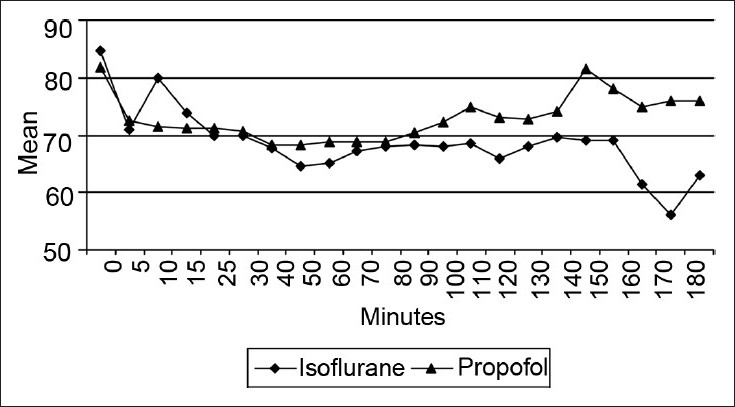
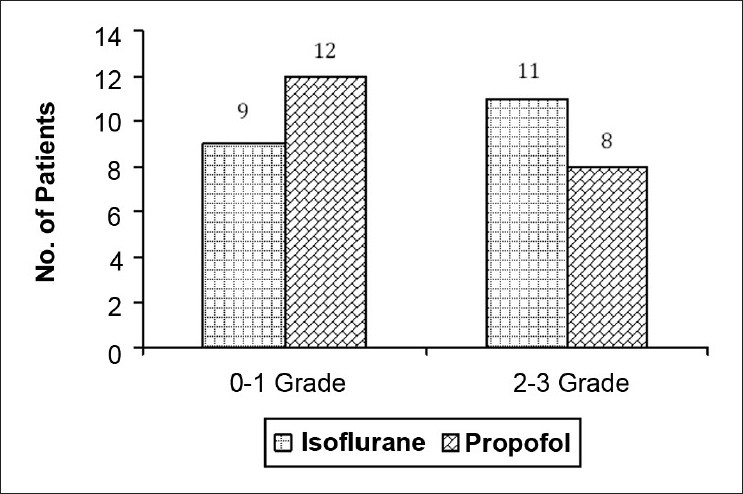
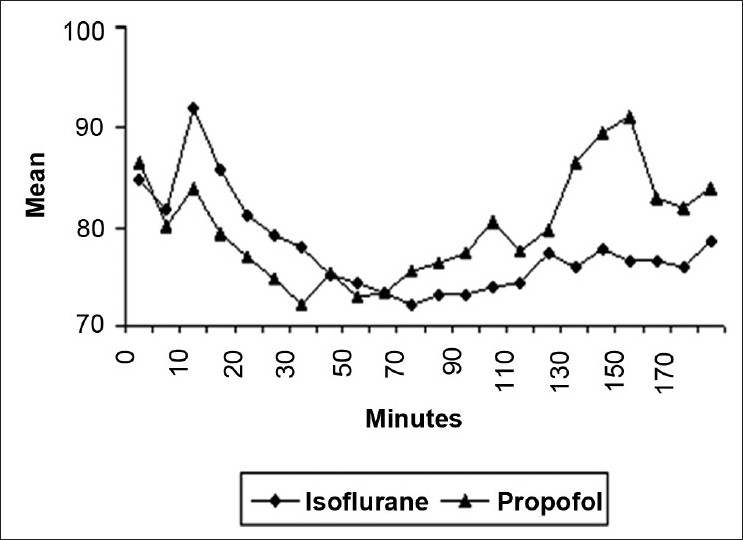
The mean (±SD) time to achieve the target mean blood pressure was 18 (±8) minutes in the isoflurane group and 16 (±7) minutes in the propofol group (P = 0.66). There was no statistically significant difference (P = 0.402) between these two groups in terms of intraoperative blood loss and operative field conditions (P = 0.34).
Controlled hypotension can be achieved equally and effectively with both propofol and isoflurane. Total intravenous anesthesia using propofol offers no significant advantage over isoflurane-based anesthetic technique in terms of operative conditions and blood loss.
功能性鼻内镜鼻窦手术中的一项重要要求是保持术野清晰,以改善手术过程中的视野并将并发症降至最低。
我们比较了在功能性鼻内镜鼻窦手术中使用丙泊酚的全静脉麻醉与使用异氟烷的吸入麻醉用于控制性低血压的情况。这是在印度一家三级医院进行的一项前瞻性研究。40例美国麻醉医师协会(ASA)身体状况为I级和II级的成年患者(16 - 60岁)被随机分配到两个平行组之一(异氟烷组,n = 20;丙泊酚组,n = 20)。主要结局是了解使用丙泊酚的全静脉麻醉在控制性低血压方面是否优于使用异氟烷的吸入麻醉。测量的次要结局包括术中失血量、手术持续时间、外科医生对术野的评价以及并发症发生率。
异氟烷组达到目标平均血压的平均(±标准差)时间为18(±8)分钟,丙泊酚组为16(±7)分钟(P = 0.66)。两组在术中失血量和术野情况方面无统计学显著差异(P = 0.402)(P = 0.34)。
丙泊酚和异氟烷均可同等有效地实现控制性低血压。在手术条件和失血量方面,使用丙泊酚的全静脉麻醉相较于基于异氟烷的麻醉技术并无显著优势。