Experimental Genetics Group - LEGTEGG, Department Human Genetics KULeuven, Leuven, Belgium.
Front Mol Neurosci. 2011 Aug 26;4:17. doi: 10.3389/fnmol.2011.00017. eCollection 2011.
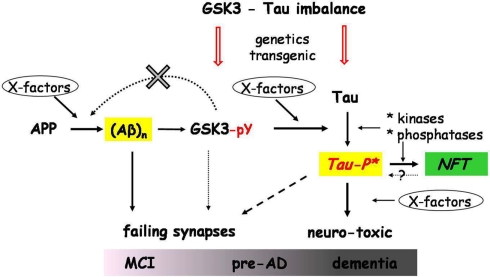
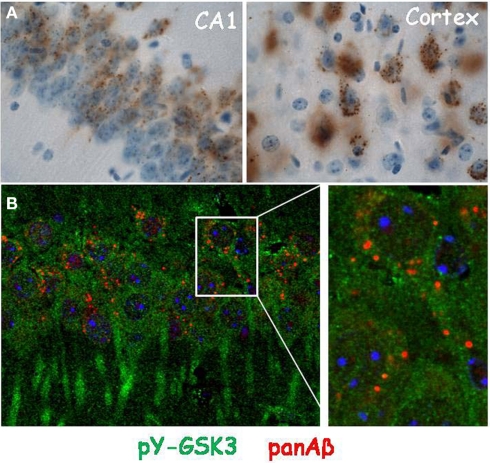
The physiological functions and pathological roles of the Glycogen synthase kinase-type 3 (GSK3) kinases in peripheral and central systems are diverse and complex, and therefore hard to unravel in molecular detail in vivo. Our assignment to review and discuss available data to clarify the actual position of these kinases in the pathology of Alzheimer's dementia (AD) was both ambitious and easy. On the one hand, numerous studies are available in isolated, recombinant, or cell-based systems, which have resulted in very diverse data-sets that are hardly informative for the brain in vivo. At the other extreme, reliable, and relevant models for the role of GSK3 in CNS are rare, if not lacking. Moreover, (too) many in vivo studies used Li(+) as "specific" inhibitor of GSK3, which is factually not valid because lithium ions are neither specific nor potent inhibitors of GSK3 in vivo. More specific pharmacological inhibitors of GSK3 have met with considerable problems, and are reviewed by others in this issue or elsewhere. We concentrate here on AD-related aspects of GSK3 in brain in vivo, mainly studied in transgenic mice and highlight some of the more important issues, among many remaining: activation of GSK3 by amyloid, phosphorylation of protein tau, effects on or interference with synaptic activity, differentiation between both GSK3 isoforms. These relate directly to brain function, and brain dysfunction in AD, and are to be resolved if we want to understand the molecular pathology of this dreadful disease.
糖原合酶激酶-3(GSK3)激酶在周围和中枢系统中的生理功能和病理作用是多种多样且复杂的,因此很难在体内从分子细节上揭示出来。我们的任务是审查和讨论现有的数据,以阐明这些激酶在阿尔茨海默病(AD)病理中的实际位置,这既具有挑战性,又很简单。一方面,有许多关于分离的、重组的或基于细胞的系统的研究,这些研究产生了非常多样化的数据集,对于体内的大脑几乎没有信息。另一方面,GSK3 在中枢神经系统中的作用的可靠和相关模型很少,如果不是缺乏的话。此外,(太多)许多体内研究使用 Li(+)作为 GSK3 的“特异性”抑制剂,这实际上是无效的,因为锂离子在体内既不是 GSK3 的特异性抑制剂,也不是有效的抑制剂。更特异性的 GSK3 药理学抑制剂遇到了相当多的问题,并在本期或其他地方由其他人进行了综述。我们在这里集中讨论 GSK3 在体内大脑中的与 AD 相关的方面,主要在转基因小鼠中进行研究,并强调了许多仍然存在的重要问题之一:淀粉样蛋白对 GSK3 的激活、蛋白 tau 的磷酸化、对突触活动的影响或干扰、两种 GSK3 同工型的区分。这些与大脑功能和 AD 中的大脑功能障碍直接相关,如果我们想要理解这种可怕疾病的分子病理学,就需要解决这些问题。