School of Humanities and Social Sciences, Jacobs University, Bremen, Germany.
PLoS One. 2011;6(8):e23930. doi: 10.1371/journal.pone.0023930. Epub 2011 Aug 31.
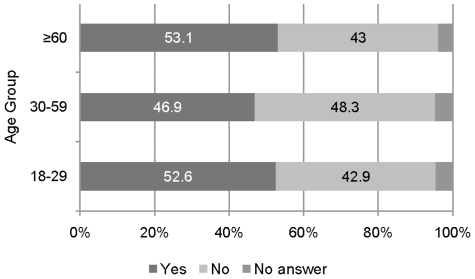
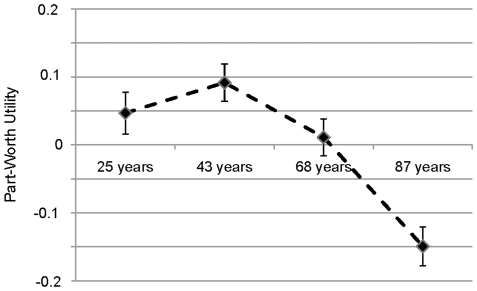
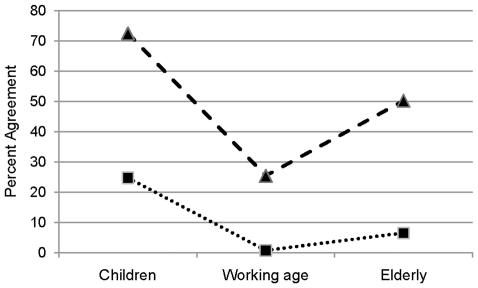
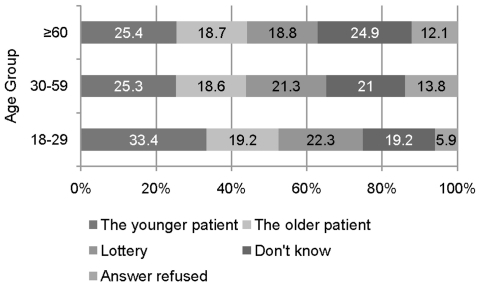
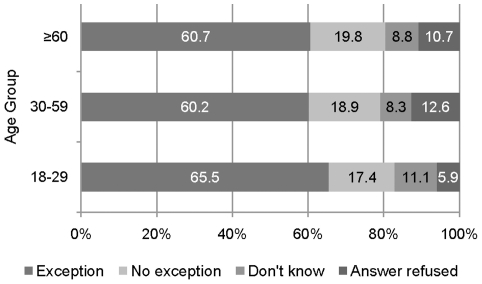
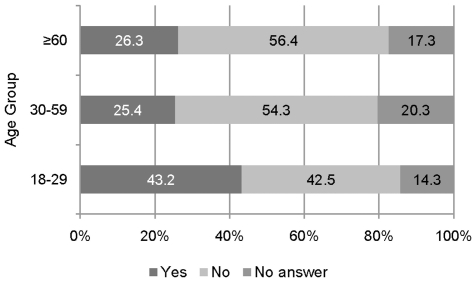
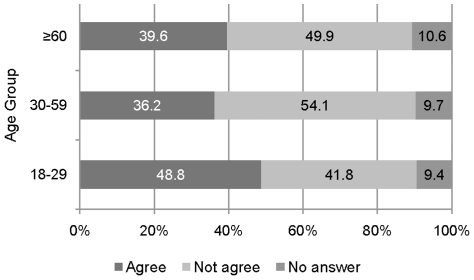
Although the German health care system has budget constraints similar to many other countries worldwide, a discussion on prioritization has not gained the attention of the public yet. To probe the acceptance of priority setting in medicine, a quantitative survey representative for the German public (n = 2031) was conducted. Here we focus on the results for age, a highly disputed criterion for prioritizing medical services. This criterion was investigated using different types of questionnaire items, from abstract age-related questions to health care scenarios, and discrete choice settings, all performed within the same sample. Several explanatory variables were included to account for differences in preference; in particular, interviewee's own age but also his or her sex, socioeconomic status, and health status. There is little evidence that the German public accepts age as a criterion to prioritize health care services.
尽管德国的医疗保健系统与全球许多其他国家一样存在预算限制,但优先级排序的讨论尚未引起公众的关注。为了探究公众对医学中优先排序的接受程度,我们对具有代表性的德国公众(n=2031)进行了一项定量调查。在这里,我们重点关注年龄的结果,这是优先考虑医疗服务的一个极具争议的标准。该标准使用不同类型的问卷项目进行了调查,从抽象的与年龄相关的问题到医疗保健场景,以及离散选择设置,所有这些都在同一个样本中进行。还包括了几个解释变量,以说明偏好的差异;特别是受访者自身的年龄,但也包括他或她的性别、社会经济地位和健康状况。几乎没有证据表明德国公众接受年龄作为优先考虑医疗服务的标准。