Division of Pharmacology and Toxicology, Faculty of Pharmaceutical Sciences, The University of British Columbia, Vancouver, British Columbia, Canada.
PLoS One. 2011;6(9):e24467. doi: 10.1371/journal.pone.0024467. Epub 2011 Sep 2.
Selective degeneration of medium spiny neurons and preservation of medium sized aspiny interneurons in striatum has been implicated in excitotoxicity and pathophysiology of Huntington's disease (HD). However, the molecular mechanism for the selective sparing of medium sized aspiny neurons and vulnerability of projection neurons is still elusive. The pathological characteristic of HD is an extensive reduction of the striatal mass, affecting caudate putamen. Somatostatin (SST) positive neurons are selectively spared in HD and Quinolinic acid/N-methyl-D-aspartic acid induced excitotoxicity, mimic the model of HD. SST plays neuroprotective role in excitotoxicity and the biological effects of SST are mediated by five somatostatin receptor subtypes (SSTR1-5).
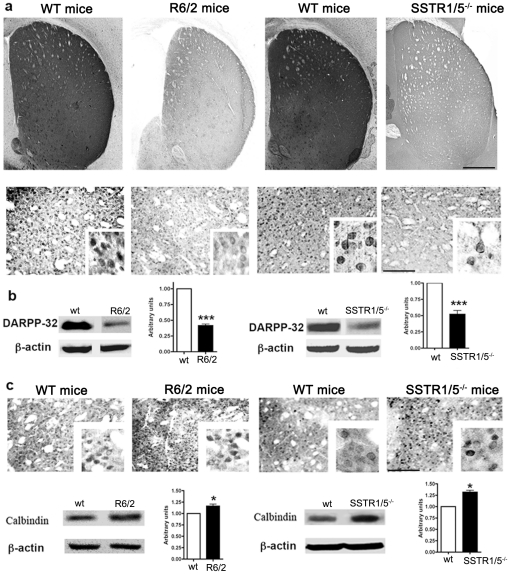
To delineate subtype selective biological responses we have here investigated changes in SSTR1 and 5 double knockout mice brain and compared with HD transgenic mouse model (R6/2). Our study revealed significant loss of dopamine and cAMP regulated phosphoprotein of 32 kDa (DARPP-32) and comparable changes in SST, N-methyl-D-aspartic acid receptors subtypes, calbindin and brain nitric oxide synthase expression as well as in key signaling proteins including calpain, phospho-extracellular-signal-regulated kinases1/2, synapsin-IIa, protein kinase C-α and calcineurin in SSTR1/5(-/-) and R6/2 mice. Conversely, the expression of somatostatin receptor subtypes, enkephalin and phosphatidylinositol 3-kinases were strain specific. SSTR1/5 appears to be important in regulating NMDARs, DARPP-32 and signaling molecules in similar fashion as seen in HD transgenic mice.
This is the first comprehensive description of disease related changes upon ablation of G- protein coupled receptor gene. Our results indicate that SST and SSTRs might play an important role in regulation of neurodegeneration and targeting this pathway can provide a novel insight in understanding the pathophysiology of Huntington's disease.
纹状体中型棘神经元的选择性退化和中型无棘间神经元的保留与亨廷顿病(HD)的兴奋性毒性和病理生理学有关。然而,中型无棘神经元选择性保留和投射神经元易感性的分子机制仍不清楚。HD 的病理特征是纹状体质量广泛减少,影响尾壳核。生长抑素(SST)阳性神经元在 HD 和喹啉酸/N-甲基-D-天冬氨酸诱导的兴奋性毒性中选择性保留,模拟 HD 模型。SST 在兴奋性毒性中发挥神经保护作用,SST 的生物学效应由五种生长抑素受体亚型(SSTR1-5)介导。
为了描绘亚型选择性的生物学反应,我们在此研究了 SSTR1 和 5 双重敲除小鼠大脑的变化,并将其与 HD 转基因小鼠模型(R6/2)进行了比较。我们的研究表明,多巴胺和 cAMP 调节的 32kDa 磷酸蛋白(DARPP-32)明显丢失,SST、N-甲基-D-天冬氨酸受体亚型、钙结合蛋白和脑一氧化氮合酶表达以及关键信号蛋白(包括钙蛋白酶、磷酸细胞外信号调节激酶 1/2、突触素-IIa、蛋白激酶 C-α 和钙调神经磷酸酶)的变化在 SSTR1/5(-/-)和 R6/2 小鼠中相似。相反,生长抑素受体亚型、脑啡肽和磷脂酰肌醇 3-激酶的表达具有菌株特异性。SSTR1/5 似乎在调节 NMDAR、DARPP-32 和信号分子方面具有重要作用,其方式与 HD 转基因小鼠相似。
这是首次全面描述 G 蛋白偶联受体基因缺失后的疾病相关变化。我们的结果表明,SST 和 SSTR 可能在调节神经退行性变中发挥重要作用,靶向该途径可以为理解亨廷顿病的病理生理学提供新的见解。