Department of Cancer Biology, Roswell Park Cancer Institute, Buffalo, New York 14263, United States.
Biochemistry. 2011 Nov 8;50(44):9475-87. doi: 10.1021/bi200301w. Epub 2011 Oct 13.
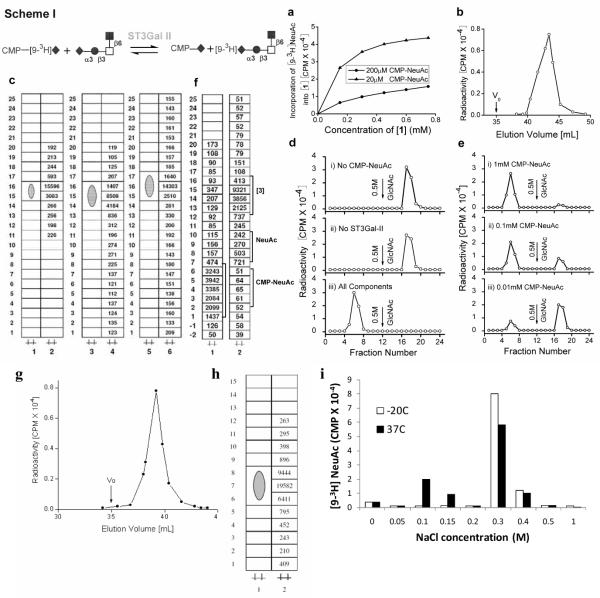
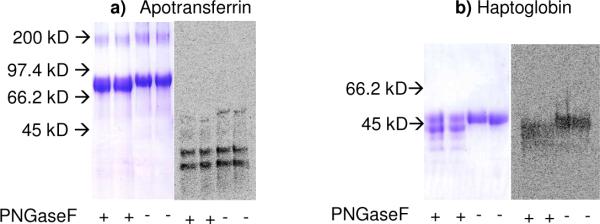
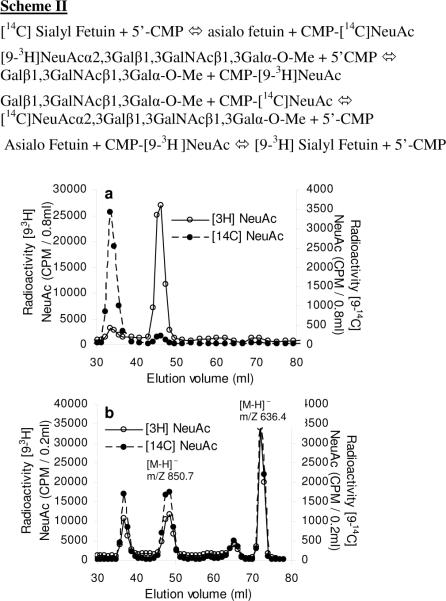
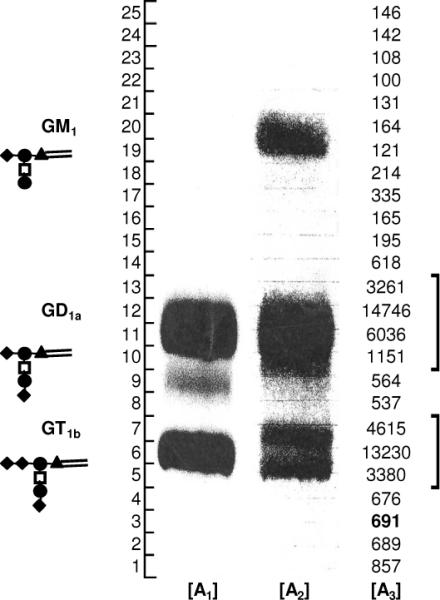
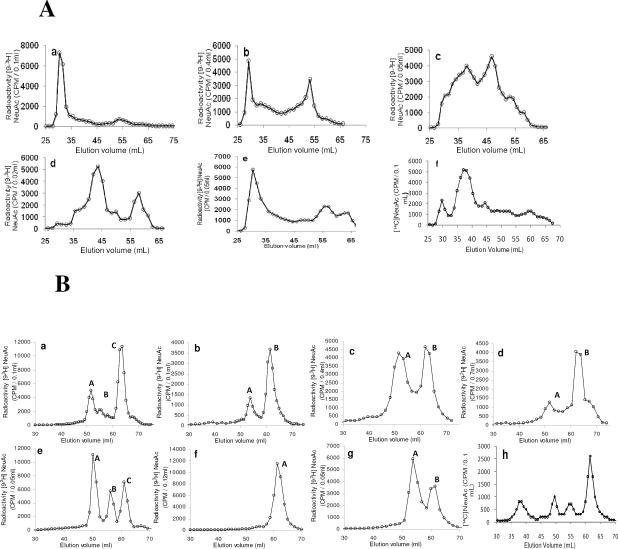
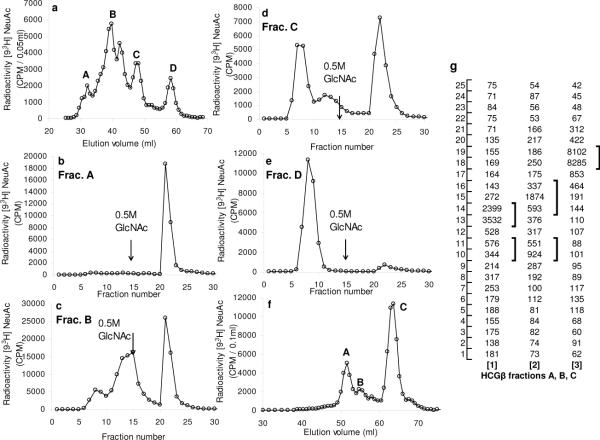
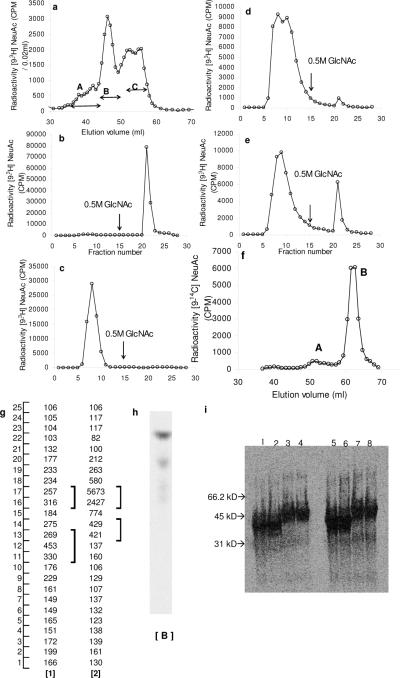
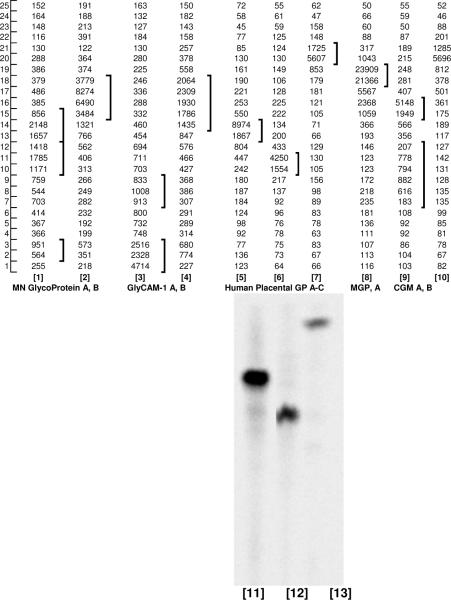
While glycosyltransferases are known to display unidirectional enzymatic activity, recent studies suggest that some can also catalyze readily reversible reactions. Recently, we found that mammalian sialyltransferase ST3Gal-II can catalyze the formation of CMP-NeuAc from 5'-CMP in the presence of a donor containing the NeuAcα2,3Galβ1,3GalNAc unit [Chandrasekaran, E. V., et al. (2008) Biochemistry 47, 320-330]. This study shows by using [9-(3)H]- or [(14)C]sialyl mucin core 2 compounds that ST3Gal-II exchanges sialyl residues between CMP-NeuAc and the NeuAcα2,3Galβ1,3GalNAc unit and also radiolabels sialyl residues in gangliosides GD1a and GT1b, but not GM1. Exchange sialylation proceeds with relative ease, which is evident from the following. (a) Radiolabeleling of fetuin was ~2-fold stronger than that of asialo fetuin when CMP- [9-(3)H]NeuAc was generated in situ from 5'-CMP and [9-(3)H]NeuAcα2,3Galβ1,3GalNAcβ1,3Galα-O-Me by ST3Gal-II. (b) ST3Gal-II exchanged radiolabels between [(14)C]sialyl fetuin and [9-(3)H]NeuAcα2,3Galβ1,3GalNAcβ1,3Galα-O-Me by generating CMP-[(14)C]- and -[9-(3)H]NeuAc through 5'-CMP; only 20.3% (14)C and 28.0% (3)H remained with the parent compounds after the sialyl exchange. The [9-(3)H]sialyl-tagged MN glycophorin A, human chorionic gonadotropin β subunit, GlyCAM-1, CD43, fetuin, porcine Cowper's gland mucin, bovine casein macroglycopeptide, human placental glycoproteins, and haptoglobin were analyzed by using Pronase digestion, mild alkaline borohydride treatment, Biogel P6, lectin agarose, and silica gel thin layer chromatography. Sulfated and sialylated O-glycans were found in GlyCAM-1 and human placental glycoproteins. This technique has the potential to serve as an important tool as it provides a natural tag for the chemical and functional characterization of O-glycan-bearing glycoproteins.
虽然糖基转移酶被认为具有单向酶活性,但最近的研究表明,有些酶也可以催化易于逆转的反应。最近,我们发现哺乳动物唾液酸转移酶 ST3Gal-II 可以在含有 NeuAcα2,3Galβ1,3GalNAc 单元的供体存在下,将 5'-CMP 转化为 CMP-NeuAc [Chandrasekaran, E. V., 等人(2008)生物化学 47,320-330]。这项研究使用 [9-(3)H]-或 [(14)C]唾液酸粘蛋白核心 2 化合物表明,ST3Gal-II 在 CMP-NeuAc 和 NeuAcα2,3Galβ1,3GalNAc 单元之间交换唾液酸残基,还标记神经节苷脂 GD1a 和 GT1b 中的唾液酸残基,但不标记 GM1。交换唾液酸化进行得相当容易,这从以下几点可以明显看出。(a)当 ST3Gal-II 从 5'-CMP 和 [9-(3)H]NeuAcα2,3Galβ1,3GalNAcβ1,3Galα-O-Me 原位生成 CMP-[9-(3)H]NeuAc 时,用 CMP-[9-(3)H]NeuAc 标记的胎球蛋白的放射性标记比无唾液酸胎球蛋白强 2 倍。(b)ST3Gal-II 通过 5'-CMP 将放射性标记物在 [(14)C]唾液酸胎球蛋白和 CMP-[(14)C]-和 -[9-(3)H]NeuAcα2,3Galβ1,3GalNAcβ1,3Galα-O-Me 之间交换,仅在唾液酸交换后,与母体化合物一起保留 20.3%(14)C 和 28.0%(3)H。[9-(3)H]唾液酸化标记的 MN 糖蛋白 A、人绒毛膜促性腺激素β亚基、GlyCAM-1、CD43、胎球蛋白、猪 Cowper 氏腺粘蛋白、牛酪蛋白大糖肽、人胎盘糖蛋白和触珠蛋白通过蛋白酶消化、温和碱性硼氢化钠处理、Biogel P6、凝集素琼脂糖和硅胶薄层层析进行分析。在 GlyCAM-1 和人胎盘糖蛋白中发现了硫酸化和唾液酸化的 O-聚糖。该技术具有作为重要工具的潜力,因为它为 O-聚糖结合糖蛋白的化学和功能特征提供了天然标记。