
遗传毒性应激诱导的NF-κB信号转导的逻辑网络预测了治疗干预策略的假定靶标结构。
Logical network of genotoxic stress-induced NF-κB signal transduction predicts putative target structures for therapeutic intervention strategies.
作者信息
Poltz Rainer, Franke Raimo, Schweitzer Katrin, Klamt Steffen, Gilles Ernst-Dieter, Naumann Michael
机构信息
Institute of Experimental Internal Medicine, Otto von Guericke University, Magdeburg, Germany.
出版信息
Adv Appl Bioinform Chem. 2009;2:125-38. doi: 10.2147/aabc.s8211. Epub 2009 Dec 3.
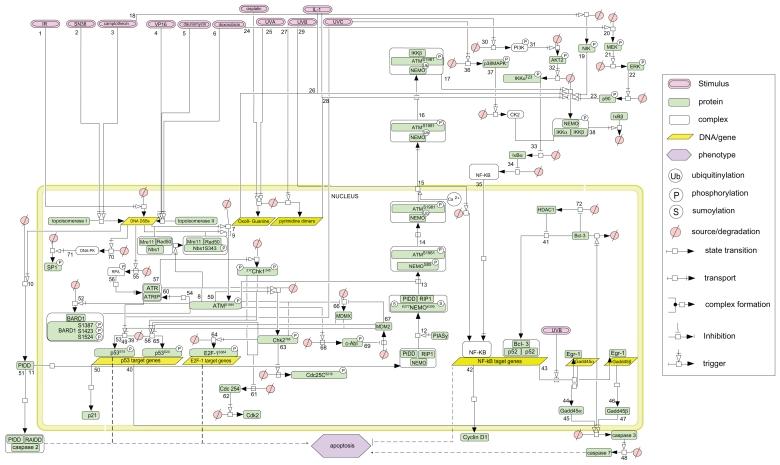
Genotoxic stress is induced by a broad range of DNA-damaging agents and could lead to a variety of human diseases including cancer. DNA damage is also therapeutically induced for cancer treatment with the aim to eliminate tumor cells. However, the effectiveness of radio- and chemotherapy is strongly hampered by tumor cell resistance. A major reason for radio- and chemotherapeutic resistances is the simultaneous activation of cell survival pathways resulting in the activation of the transcription factor nuclear factor-kappa B (NF-κB). Here, we present a Boolean network model of the NF-κB signal transduction induced by genotoxic stress in epithelial cells. For the representation and analysis of the model, we used the formalism of logical interaction hypergraphs. Model reconstruction was based on a careful meta-analysis of published data. By calculating minimal intervention sets, we identified p53-induced protein with a death domain (PIDD), receptor-interacting protein 1 (RIP1), and protein inhibitor of activated STAT y (PIASy) as putative therapeutic targets to abrogate NF-κB activation resulting in apoptosis. Targeting these structures therapeutically may potentiate the effectiveness of radio-and chemotherapy. Thus, the presented model allows a better understanding of the signal transduction in tumor cells and provides candidates as new therapeutic target structures.
基因毒性应激由多种DNA损伤剂诱导,可导致包括癌症在内的多种人类疾病。为了消除肿瘤细胞,癌症治疗中也会通过治疗手段诱导DNA损伤。然而,放疗和化疗的有效性受到肿瘤细胞耐药性的严重阻碍。放疗和化疗耐药的一个主要原因是细胞存活通路的同时激活,导致转录因子核因子κB(NF-κB)的激活。在此,我们提出了一个上皮细胞中基因毒性应激诱导的NF-κB信号转导的布尔网络模型。为了表示和分析该模型,我们使用了逻辑相互作用超图的形式主义。模型重建基于对已发表数据的仔细荟萃分析。通过计算最小干预集,我们确定了含死亡结构域的p53诱导蛋白(PIDD)、受体相互作用蛋白1(RIP1)和活化STATγ蛋白抑制剂(PIASy)作为消除NF-κB激活导致细胞凋亡的假定治疗靶点。对这些结构进行治疗靶向可能会增强放疗和化疗的有效性。因此,所提出的模型有助于更好地理解肿瘤细胞中的信号转导,并提供作为新治疗靶点结构的候选物。



 Zotero 插件