Department of Ultrasound, Tangdu Hospital of the Fourth Military Medicine University, Xi an 710038, China.
Korean J Radiol. 2011 Sep-Oct;12(5):541-6. doi: 10.3348/kjr.2011.12.5.541. Epub 2011 Aug 24.
We wanted to evaluate the clinical value of intraoperative ultrasonography for real-time guidance when performing microneurosurgical resection of small subcortical lesions.
Fifty-two patients with small subcortical lesions were involved in this study. The pathological diagnoses were cavernous hemangioma in 25 cases, cerebral glioma in eight cases, abscess in eight cases, small inflammatory lesion in five cases, brain parasite infection in four cases and the presence of an intracranial foreign body in two cases. An ultrasonic probe was sterilized and lightly placed on the surface of the brain during the operation. The location, extent, characteristics and adjacent tissue of the lesion were observed by high frequency ultrasonography during the operation.
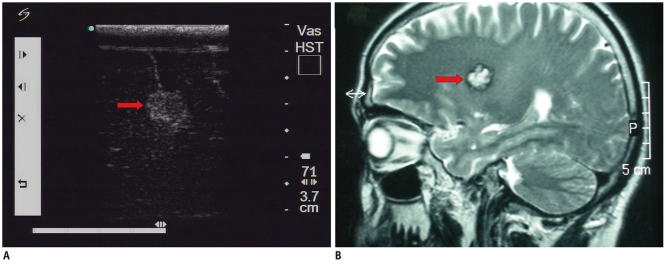
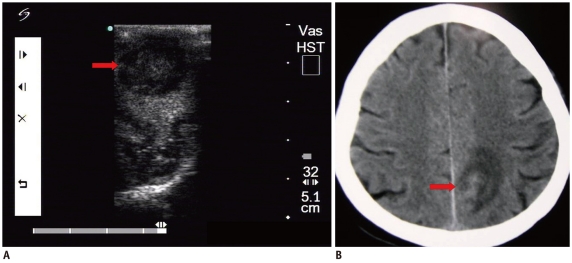
All the lesions were located in the cortex and their mean size was 1.3 ± 0.2 cm. Intraoperative ultrasonography accurately located all the small subcortical lesions, and so the neurosurgeon could provide appropriate treatment. Different lesion pathologies presented with different ultrasonic appearances. Cavernous hemangioma exhibited irregular shapes with distinct margins and it was mildly hyperechoic or hyperechoic. The majority of the cerebral gliomas displayed irregular shapes with indistinct margins, and they often showed cystic and solid mixed echoes. Postoperative imaging identified that the lesions had completely disappeared, and the original symptoms of all the patients were significantly alleviated.
Intraoperative ultrasonography can help accurately locate small subcortical lesions and it is helpful for selecting the proper approach and guiding thorough resection of these lesions.
我们旨在评估术中超声实时引导在施行显微神经外科切除小皮质下病变中的临床价值。
本研究纳入 52 例小皮质下病变患者。病理诊断为海绵状血管瘤 25 例,脑胶质瘤 8 例,脓肿 8 例,小炎性病变 5 例,脑寄生虫感染 4 例,颅内异物 2 例。手术过程中,对超声探头进行消毒后,轻轻放置在脑表面。术中高频超声观察病变的位置、范围、特征及毗邻组织。
所有病变均位于皮质,平均大小为 1.3 ± 0.2cm。术中超声准确定位所有小皮质下病变,使神经外科医生能够提供适当的治疗。不同的病变病理表现出不同的超声表现。海绵状血管瘤呈不规则形状,边界清楚,呈轻度高回声或高回声。大多数脑胶质瘤呈不规则形状,边界不清,常呈囊实性混合回声。术后影像学检查显示病变完全消失,所有患者的原有症状均明显缓解。
术中超声有助于准确定位小皮质下病变,有助于选择合适的手术入路,并指导病变的彻底切除。