Wu Wu-Hsiung, Wang Feng-Sheng, Chang Maw-Shang
Department of Chemical Engineering, National Chung Cheng University, Chiayi, Taiwan.
BMC Syst Biol. 2011 Sep 19;5:145. doi: 10.1186/1752-0509-5-145.
Improving the synthesis rate of desired metabolites in metabolic systems is one of the main tasks in metabolic engineering. In the last decade, metabolic engineering approaches based on the mathematical optimization have been used extensively for the analysis and manipulation of metabolic networks. Experimental evidence shows that mutants reflect resilience phenomena against gene alterations. Although researchers have published many studies on the design of metabolic systems based on kinetic models and optimization strategies, almost no studies discuss the multi-objective optimization problem for enzyme manipulations in metabolic networks considering resilience phenomenon.
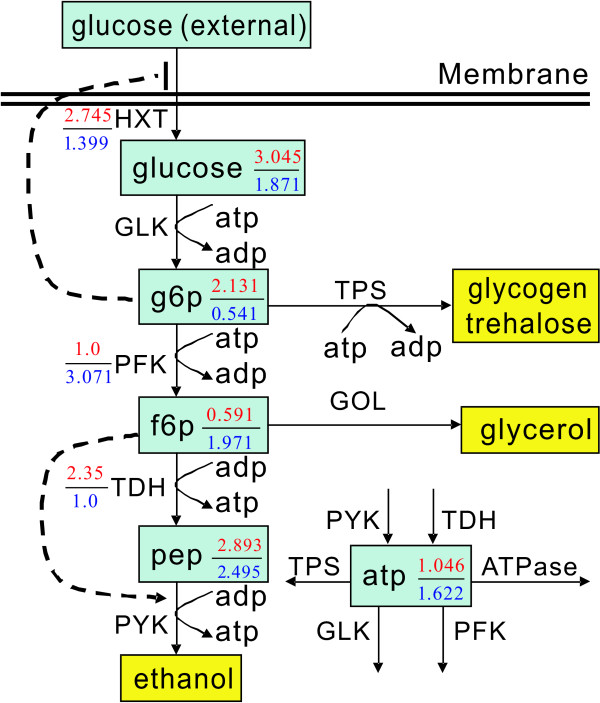
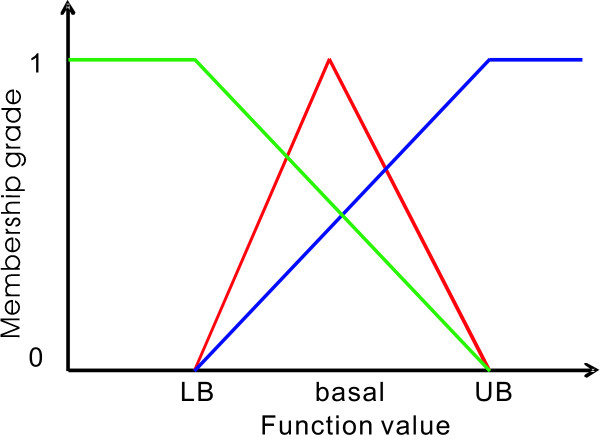
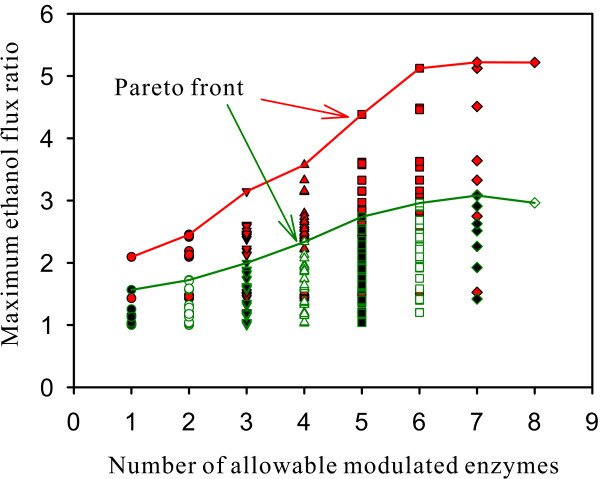
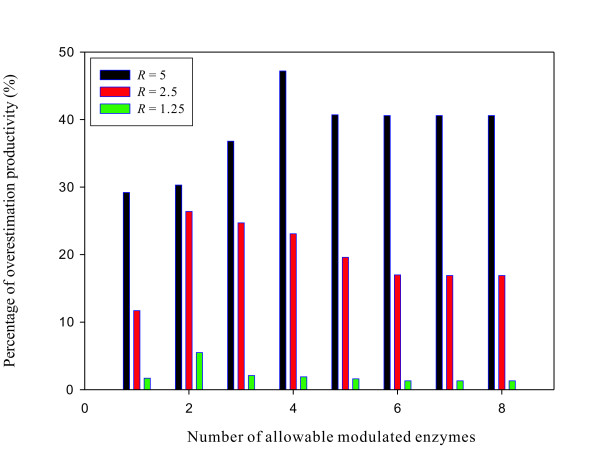
This study proposes a generalized fuzzy multi-objective optimization approach to formulate the enzyme intervention problem for metabolic networks considering resilience phenomena and cell viability. This approach is a general framework that can be applied to any metabolic networks to investigate the influence of resilience phenomena on gene intervention strategies and maximum target synthesis rates. This study evaluates the performance of the proposed approach by applying it to two metabolic systems: S. cerevisiae and E. coli. Results show that the maximum synthesis rates of target products by genetic interventions are always over-estimated in metabolic networks that do not consider the resilience effects.
Considering the resilience phenomena in metabolic networks can improve the predictions of gene intervention and maximum synthesis rates in metabolic engineering. The proposed generalized fuzzy multi-objective optimization approach has the potential to be a good and practical framework in the design of metabolic networks.
提高代谢系统中目标代谢物的合成速率是代谢工程的主要任务之一。在过去十年中,基于数学优化的代谢工程方法已被广泛用于代谢网络的分析和操纵。实验证据表明,突变体反映了对基因改变的弹性现象。尽管研究人员已经发表了许多关于基于动力学模型和优化策略的代谢系统设计的研究,但几乎没有研究讨论考虑弹性现象的代谢网络中酶操纵的多目标优化问题。
本研究提出了一种广义模糊多目标优化方法,以制定考虑弹性现象和细胞活力的代谢网络酶干预问题。该方法是一个通用框架,可应用于任何代谢网络,以研究弹性现象对基因干预策略和最大目标合成速率的影响。本研究通过将其应用于两个代谢系统:酿酒酵母和大肠杆菌,评估了所提出方法的性能。结果表明,在不考虑弹性效应的代谢网络中,通过基因干预实现的目标产物最大合成速率总是被高估。
考虑代谢网络中的弹性现象可以改善代谢工程中基因干预和最大合成速率的预测。所提出的广义模糊多目标优化方法有可能成为代谢网络设计中一个良好且实用的框架。