Department of Pharmacotherapy and Translational Research, University of Florida, Gainesville, FL, USA.
Neuropsychiatr Dis Treat. 2011;7:501-5. doi: 10.2147/NDT.S24153. Epub 2011 Aug 26.
With a US Food and Drug Administration-labeled indication to treat attention-deficit/hyperactivity disorder (ADHD), the nonstimulant guanfacine has become the preferred α(2)-agonist for ADHD treatment. However, significant interindividual variability has been observed in response to guanfacine. Consequently, hypotheses of a contributing interaction with the ubiquitously expressed drug transporter, P-glycoprotein (P-gp), have arisen. We performed an in vitro study to determine if guanfacine is indeed a substrate of P-gp.
Intracellular accumulation of guanfacine was compared between P-gp expressing LLC-PK1/MDR1 cells and P-gp-negative LLC-PK1 cells to evaluate the potential interaction between P-gp and guanfacine. Cellular retention of guanfacine was analyzed using a high-performance liquid chromatographic-ultraviolet method. Rhodamine6G, a known P-gp substrate, was included in the study as a positive control.
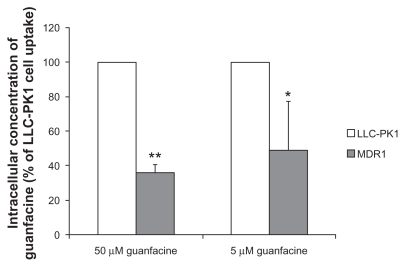
At guanfacine concentrations of 50 μM and 5 μM, intracellular accumulation of guanfacine in LLC-PK1/MDR1 cells was, 35.9% ± 4.8% and 49.0% ± 28.3% respectively, of that in LLC-PK1 cells. In comparison, the concentration of rhodamine6G, the positive P-gp substrate, in LLC-PK1/MDR1 cells was only 5% of that in LLC-PK1 cells.
The results of the intracellular accumulation study suggest that guanfacine is, at best, a weak P-gp substrate. Therefore, it is unlikely that P-gp, or any genetic variants thereof, are a determining factor in the interindividual variability of response observed with guanfacine therapy.
具有美国食品和药物管理局(FDA)批准的治疗注意缺陷/多动障碍(ADHD)的适应证,非兴奋剂胍法辛已成为治疗 ADHD 的首选α(2)-激动剂。然而,观察到个体对胍法辛的反应存在显著的个体间差异。因此,出现了与广泛表达的药物转运蛋白 P-糖蛋白(P-gp)相互作用的假设。我们进行了一项体外研究,以确定胍法辛是否确实是 P-gp 的底物。
通过比较表达 P-糖蛋白的 LLC-PK1/MDR1 细胞和 P-糖蛋白阴性的 LLC-PK1 细胞中胍法辛的细胞内积累,来评估 P-gp 与胍法辛之间的潜在相互作用。使用高效液相色谱-紫外法分析胍法辛的细胞保留。作为阳性对照,研究中还包括了已知的 P-gp 底物罗丹明 6G。
在 50 μM 和 5 μM 的胍法辛浓度下,LLC-PK1/MDR1 细胞中胍法辛的细胞内积累分别为 LLC-PK1 细胞的 35.9%±4.8%和 49.0%±28.3%。相比之下,阳性 P-gp 底物罗丹明 6G 在 LLC-PK1/MDR1 细胞中的浓度仅为 LLC-PK1 细胞的 5%。
细胞内积累研究的结果表明,胍法辛充其量只是一种弱的 P-gp 底物。因此,P-gp 或其任何遗传变异不太可能是胍法辛治疗中观察到的个体间反应差异的决定因素。