Department for Molecular Biomedical Research, VIB, Ghent, Belgium.
PLoS One. 2011;6(9):e22356. doi: 10.1371/journal.pone.0022356. Epub 2011 Sep 12.
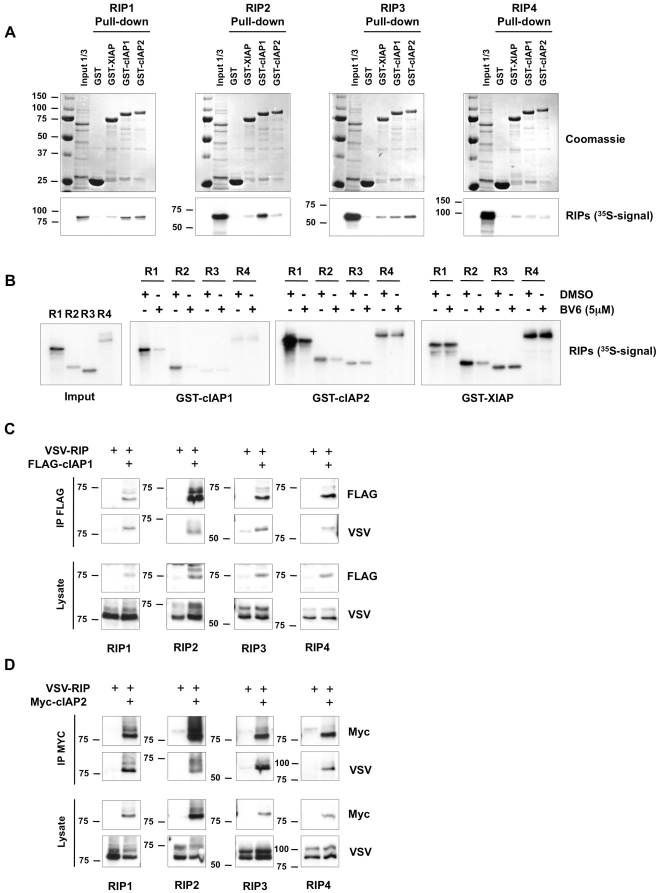
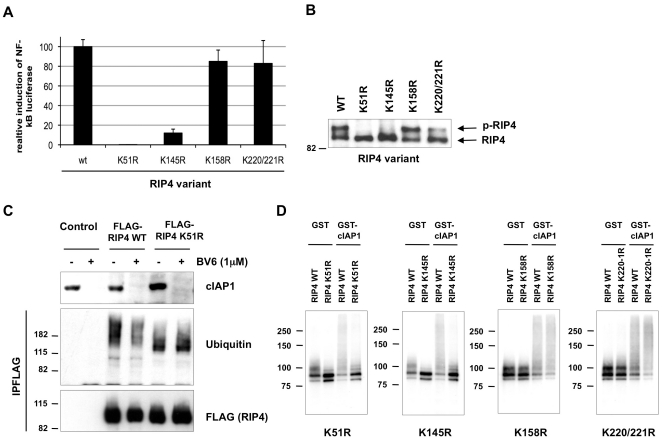
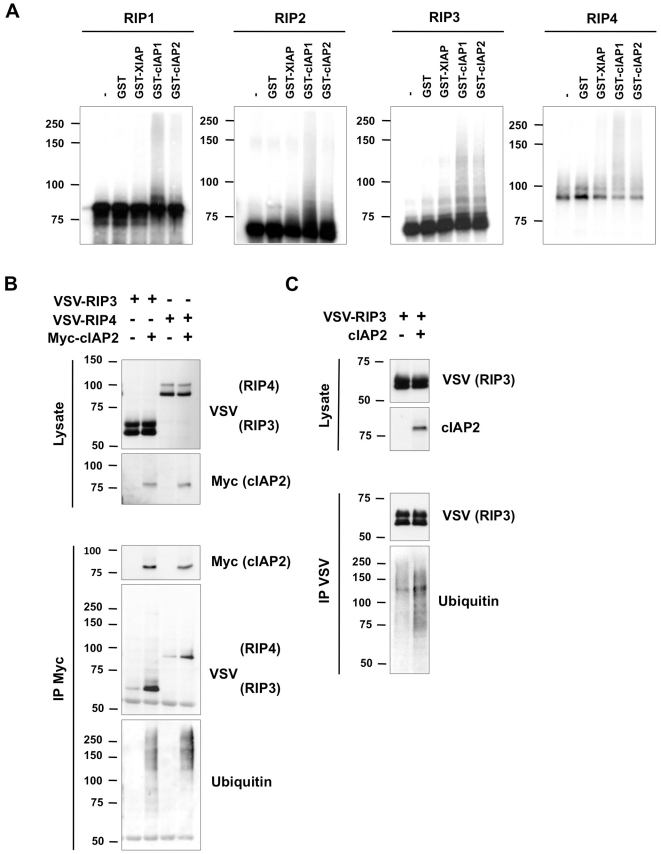
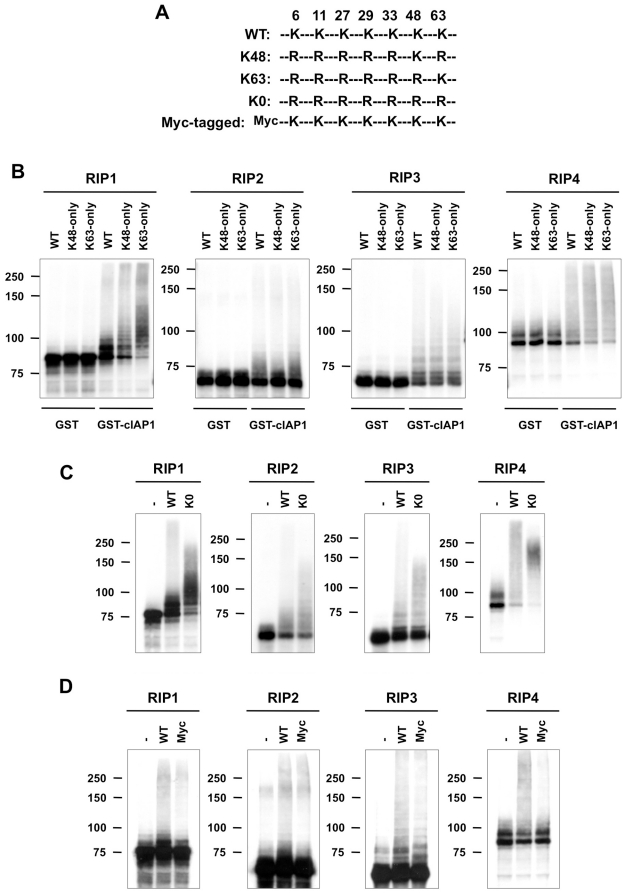
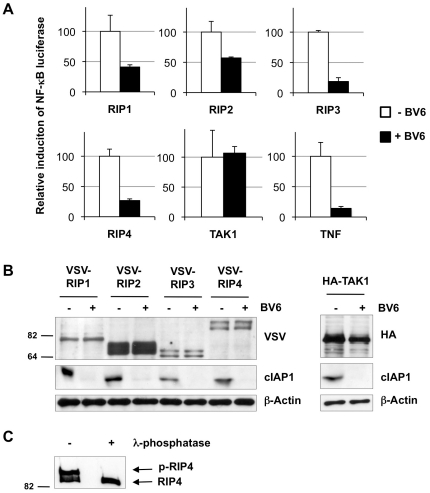
The RIP kinases have emerged as essential mediators of cellular stress that integrate both extracellular stimuli emanating from various cell-surface receptors and signals coming from intracellular pattern recognition receptors. The molecular mechanisms regulating the ability of the RIP proteins to transduce the stress signals remain poorly understood, but seem to rely only partially on their kinase activities. Recent studies on RIP1 and RIP2 have highlighted the importance of ubiquitination as a key process regulating their capacity to activate downstream signaling pathways. In this study, we found that XIAP, cIAP1 and cIAP2 not only directly bind to RIP1 and RIP2 but also to RIP3 and RIP4. We show that cIAP1 and cIAP2 are direct E3 ubiquitin ligases for all four RIP proteins and that cIAP1 is capable of conjugating the RIPs with diverse types of ubiquitin chains, including linear chains. Consistently, we show that repressing cIAP1/2 levels affects the activation of NF-κB that is dependent on RIP1, -2, -3 and -4. Finally, we identified Lys51 and Lys145 of RIP4 as two critical residues for cIAP1-mediated ubiquitination and NF-κB activation.
受体相互作用蛋白激酶已成为细胞应激的重要介质,整合了来自各种细胞表面受体的细胞外刺激和来自细胞内模式识别受体的信号。调节 RIP 蛋白传递应激信号的分子机制仍知之甚少,但似乎仅部分依赖于它们的激酶活性。最近对 RIP1 和 RIP2 的研究强调了泛素化作为调节其激活下游信号通路能力的关键过程的重要性。在这项研究中,我们发现 XIAP、cIAP1 和 cIAP2 不仅直接与 RIP1 和 RIP2 结合,还与 RIP3 和 RIP4 结合。我们表明 cIAP1 和 cIAP2 是所有四种 RIP 蛋白的直接 E3 泛素连接酶,并且 cIAP1 能够将 RIP 与多种类型的泛素链连接,包括线性链。一致地,我们表明抑制 cIAP1/2 水平会影响依赖于 RIP1、-2、-3 和 -4 的 NF-κB 的激活。最后,我们确定了 RIP4 的 Lys51 和 Lys145 两个关键残基,它们是 cIAP1 介导的泛素化和 NF-κB 激活所必需的。