Department of Neurosurgery, Leiden University Medical Center, Albinusdreef 2, PO Box 9600, 2300 RC, Leiden, The Netherlands.
Knee Surg Sports Traumatol Arthrosc. 2012 Aug;20(8):1450-5. doi: 10.1007/s00167-011-1684-9. Epub 2011 Sep 27.
The primary goal of this study was to assess the difference in active flexion between patients with a mobile versus a fixed bearing, cruciate retaining, and total knee arthroplasty. The study was designed as a randomised controlled multi-centre trial.
Participants were assigned to interventions by using block-stratified, random allocation. Outcome parameters were active flexion, passive flexion, and Knee Society Score (KSS). Outcome parameters were assessed preoperatively and at 3, 6, and 12 months postoperatively by an independent nurse.
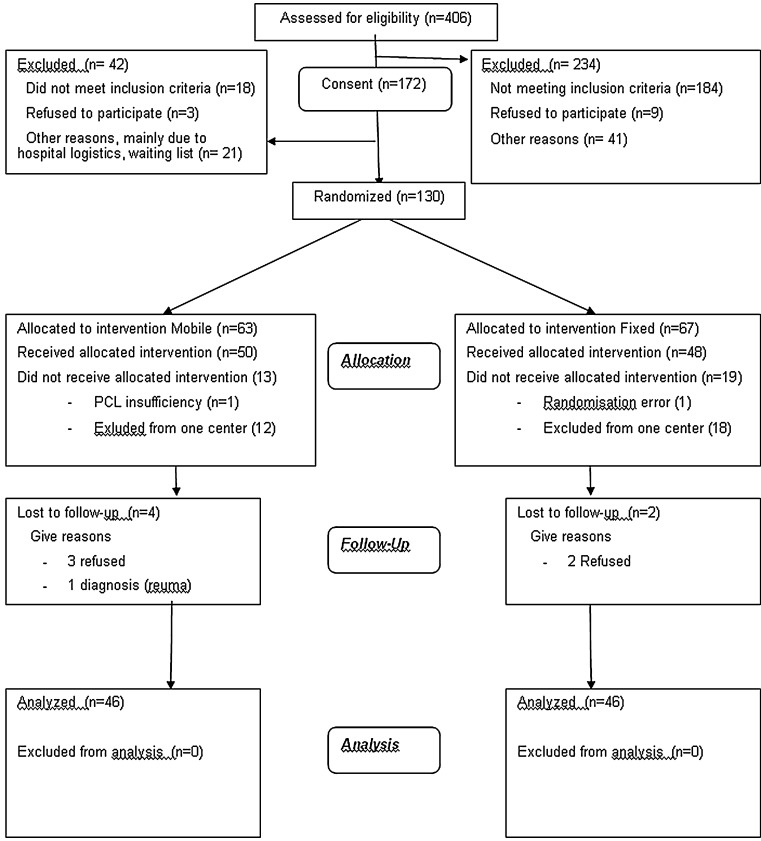
Ninety-two patients from one centre were included, 46 in each group. Active flexion was comparable for the two groups, 99.9° for the mobile bearing group and 101° for the fixed bearing group with a baseline controlled difference of 1.0 (95% CI -3.9 to 5.8, n.s.). The Clinical KSS was comparable between the two bearing groups (Mobile 90.0 vs. fixed 92.4, n.s.). The functional KSS showed a difference that was attributable to the stair climbing subscore, which showed a difference in favour of the fixed bearing design between preoperative and 3 months (7.3 point difference; 95% CI 2.3-12.5; P = 0.005) as well as 12 months (4.8 point difference; 95% CI 0.1-9.6; P = 0.045).
There were no short-term differences in active flexion between fixed bearing and mobile bearing total knee arthroplasty.
I.
本研究的主要目的是评估活动度在活动平台与固定平台、保留交叉韧带和全膝关节置换中的差异。该研究设计为随机对照多中心试验。
采用区组分层随机分配方法对参与者进行干预。主要结局指标为主动屈曲、被动屈曲和膝关节学会评分(KSS)。由独立护士在术前和术后 3、6 和 12 个月进行结局指标评估。
来自一个中心的 92 例患者纳入研究,每组 46 例。两组的主动屈曲相当,活动平台组为 99.9°,固定平台组为 101°,基线控制差异为 1.0(95%CI-3.9 至 5.8,无统计学意义)。两组的临床 KSS 相似(活动平台组 90.0 分,固定平台组 92.4 分,无统计学意义)。功能 KSS 显示出差异,主要归因于爬楼梯亚评分,该评分在固定平台设计中显示出术前与术后 3 个月(7.3 分差异;95%CI2.3-12.5;P=0.005)和术后 12 个月(4.8 分差异;95%CI0.1-9.6;P=0.045)时存在优势。
固定平台与活动平台全膝关节置换在主动屈曲方面没有短期差异。
I 级。