Dil Nyla, Banerjee Abhijit G
Departments of Oral Biology, University of Manitoba, Health Sciences Center, Winnipeg, Canada.
Head Neck Oncol. 2011 Sep 29;3:44. doi: 10.1186/1758-3284-3-44.
Oral cancer is the sixth most common malignancy worldwide with a mortality rate that is higher than many other cancers. Death usually occurs as a result of local invasion and regional lymph node metastases. Decorin is a multifunctional proteoglycan of the extracellular matrix that affects the biology of various types of cancer. Previously; we have shown that decorin is aberrantly expressed in the nucleus in human dysplastic oral keratinocytes (DOK) and malignant squamous cells carcinoma (SCC-25) and human biopsy tissues. In this study, we examined the role of nuclear decorin in oral cancer progression.
We have used a post-transcriptional gene silencing (RNA interference) approach to stably knockdown nuclear decorin gene expression in DOK and SCC-25 cells using a specific shRNA plasmid and a combination of immunological and molecular techniques to study nuclear decorin function in these oral epithelial cell lines.
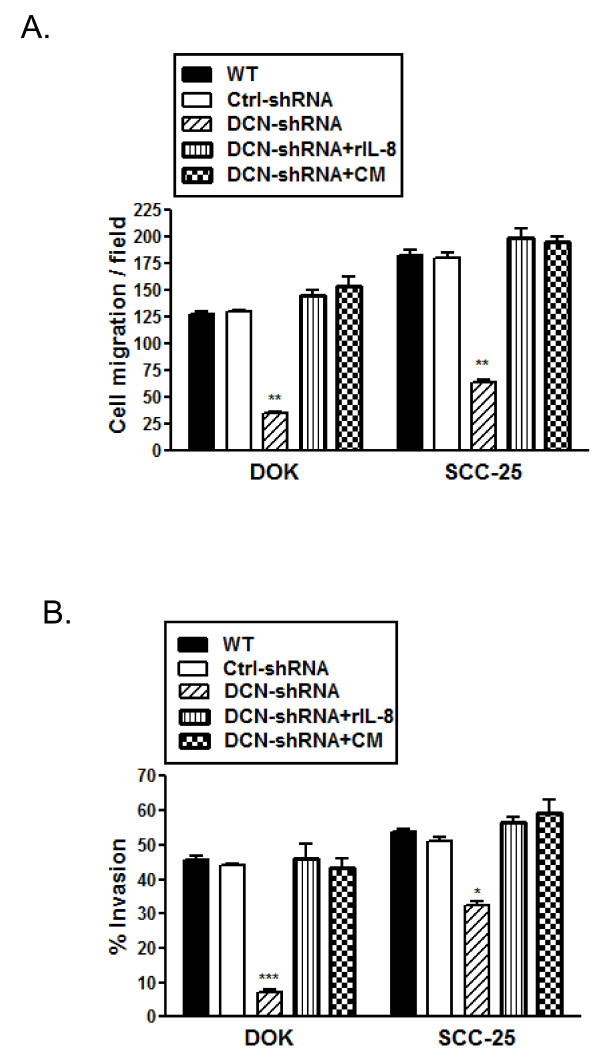
More than 80% decorin silencing/knockdown was achieved as confirmed by real time PCR and western blot analysis in both DOK and SCC-25 cells. This RNA interference-mediated knockdown of nuclear decorin expression resulted in significantly reduced invasion and migration in these cell lines as measured by Matrigel™ coated and uncoated Trans well chamber assays respectively. Decorin silencing also resulted in reduced IL-8 mRNA and proteins levels in these cell lines. Culturing decorin silenced DOK and SCC-25 cells, with recombinant human IL-8 or IL-8 containing conditioned medium from respective un-transfected cells for 24 h prior to migration and invasion experiments, resulted in the salvation of reduced migration and invasion phenotype. Furthermore, we found that nuclear localized decorin interacts with EGFR in the nuclear fractions of both DOK and SCC-25 cells. Interestingly, EGFR (trans) activation has previously been shown to be involved in IL-8 production in various epithelia.
Taken together, our results indicate that nuclear localized decorin plays an important role in migration and invasion of oral cancer cells and thus may present as a novel potential target for the treatment of oral cancer.
口腔癌是全球第六大常见恶性肿瘤,其死亡率高于许多其他癌症。死亡通常是局部侵袭和区域淋巴结转移的结果。核心蛋白聚糖是细胞外基质的一种多功能蛋白聚糖,影响多种类型癌症的生物学行为。此前,我们已经表明,核心蛋白聚糖在人发育异常的口腔角质形成细胞(DOK)、恶性鳞状细胞癌(SCC - 25)以及人活检组织的细胞核中异常表达。在本研究中,我们研究了细胞核核心蛋白聚糖在口腔癌进展中的作用。
我们采用转录后基因沉默(RNA干扰)方法,使用特异性shRNA质粒稳定敲低DOK和SCC - 25细胞中细胞核核心蛋白聚糖基因的表达,并结合免疫和分子技术研究这些口腔上皮细胞系中细胞核核心蛋白聚糖的功能。
实时PCR和蛋白质印迹分析证实,DOK和SCC - 25细胞中核心蛋白聚糖沉默/敲低率均超过80%。这种RNA干扰介导的细胞核核心蛋白聚糖表达敲低导致这些细胞系的侵袭和迁移能力显著降低,分别通过基质胶包被和未包被的Trans well小室试验进行测定。核心蛋白聚糖沉默还导致这些细胞系中IL - 8 mRNA和蛋白质水平降低。在迁移和侵袭实验前24小时,用重组人IL - 8或来自各自未转染细胞的含IL - 8条件培养基培养核心蛋白聚糖沉默的DOK和SCC - 25细胞,可挽救降低的迁移和侵袭表型。此外,我们发现细胞核定位的核心蛋白聚糖在DOK和SCC - 25细胞的细胞核组分中与表皮生长因子受体(EGFR)相互作用。有趣的是,EGFR(转)激活先前已被证明参与各种上皮细胞中IL - 8的产生。
综上所述,我们的结果表明,细胞核定位的核心蛋白聚糖在口腔癌细胞的迁移和侵袭中起重要作用,因此可能是口腔癌治疗的一个新的潜在靶点。