Department of Microbiology & Immunology, Institute of Biomedicine, Mucosal Immunology and Vaccine Center, University of Gothenburg, Gothenburg, Sweden.
PLoS One. 2011;6(9):e25073. doi: 10.1371/journal.pone.0025073. Epub 2011 Sep 22.
Mice deficient in the inhibitory G protein subunit Gαi2 spontaneously develop a T helper 1 dominated colitis. We examined whether a defect in CD4(+)FoxP3(+) regulatory T cells (Treg) underpins the pathogenesis of colitis in the Gαi2(-/-) (Gαi2-deficient) colitis model.
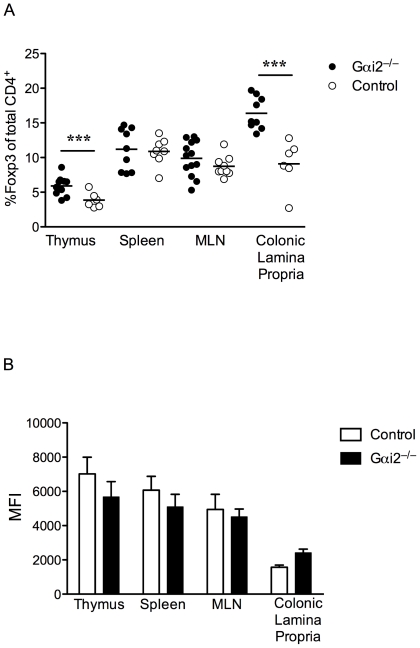
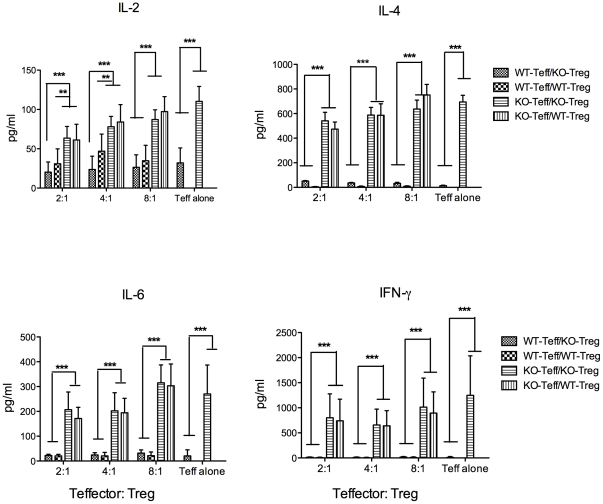
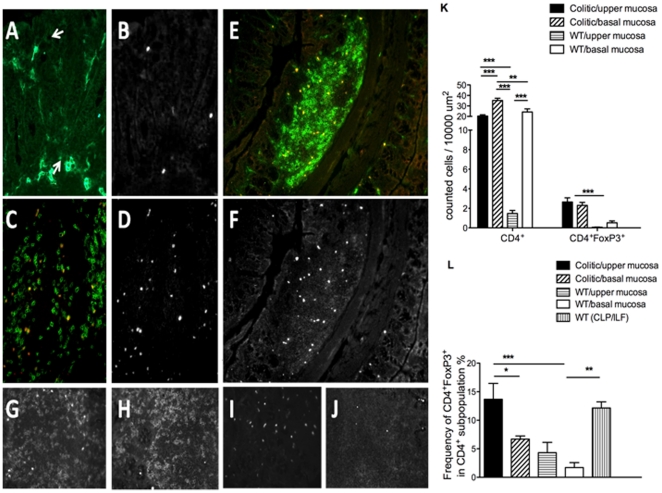
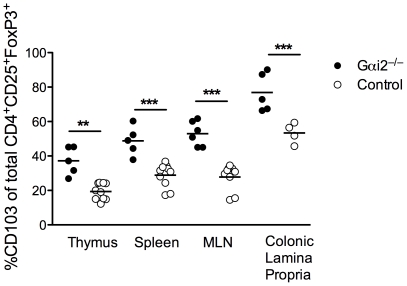
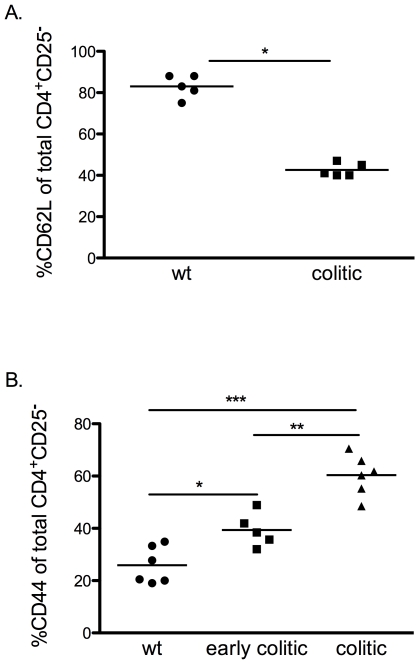
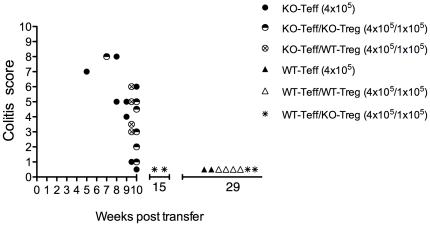
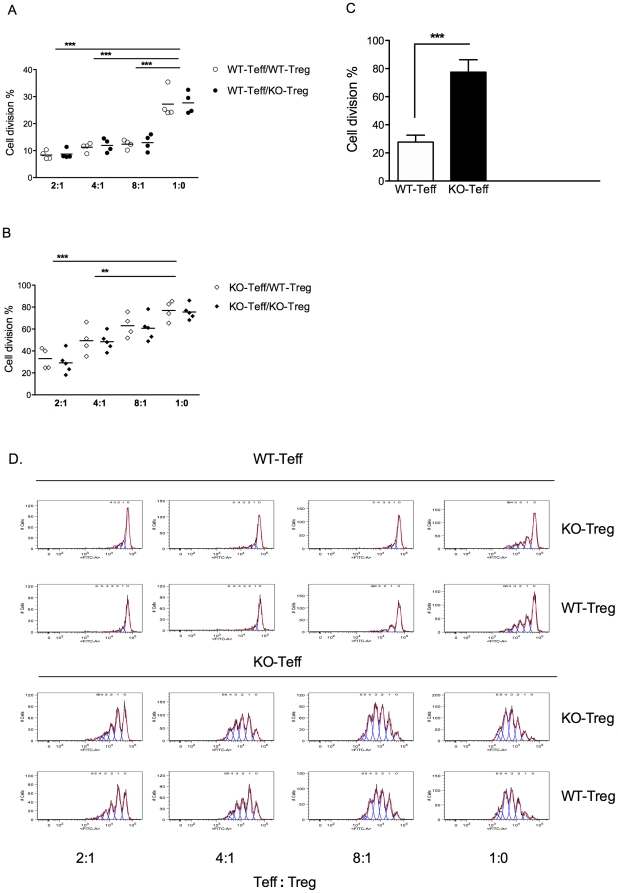
METHODOLOGY/PRINCIPAL FINDINGS: Using flow cytometry, we found that thymus and colonic lamina propria, but not spleen and mesenteric lymph nodes, of colitic Gαi2(-/-) mice contained increased frequencies of Treg, whereas FoxP3 expression intensity was similar in Gαi2(-/-) compared to Gαi2(+/-) or Gαi2(+/+) wild type (WT) mice. The frequency of CD4(+)FoxP3(+) T cells expressing CD103 was significantly increased in Gαi2(-/-) compared to WT mice. Treg in colons from WT mice clustered in the T cell areas of colonic lymphoid patches (CLP), with relatively few Treg in the lamina propria, as demonstrated by immunohistochemistry. In Gαi2(-/-) mice, CLP were not observed but lamina propria Treg were increased in number and frequency within the CD4(+) infiltrate, compared to WT mice. Using an in vitro co-culture system and flow cytometric analysis of cell division we could demonstrate that the in vitro suppressive function of WT and Gαi2(-/-) CD4(+)FoxP3(+) regulatory T cells (WT-Treg and KO-Treg) was indistinguishable, but that T effector cells (CD4(+)25(-) T cells) from Gαi2(-/-) mice were less readily suppressed than WT effectors (WT-Teff) by Treg from either source. However, neither WT nor Gαi2(-/-) Treg was able to suppress colitis induced by adoptive transfer of Gαi2(-/-) effector T cells (KO-Teff) to RAG2(-/-) recipients. The enhanced inflammatory activity of Gαi2(-/-) effectors was accompanied by increased expression of an effector/memory T cell phenotype and increased cytokine secretion, especially IL-4, IL-6 and IFN-γ.
There is an increased frequency of Gαi2(-/-) Treg in the colon, and they demonstrate no endogenous functional defect. However, Gαi2(-/-) T effector cells are dramatically less susceptible to suppression in vitro, and in vivo, despite increased effective numbers of Treg, they cannot prevent disease.
缺乏抑制性 G 蛋白亚单位 Gαi2 的小鼠会自发地发生 T 辅助 1 型主导的结肠炎。我们研究了 CD4(+)FoxP3(+)调节性 T 细胞(Treg)的缺陷是否是 Gαi2(-/-)(Gαi2 缺陷)结肠炎模型中结肠炎发病机制的基础。
方法/主要发现:通过流式细胞术,我们发现结肠炎 Gαi2(-/-) 小鼠的胸腺和结肠固有层中 Treg 的频率增加,而脾和肠系膜淋巴结中则没有,而 Gαi2(-/-) 与 Gαi2(+/-) 或 Gαi2(+/+) 野生型(WT)小鼠相比,FoxP3 表达强度相似。与 WT 小鼠相比,Gαi2(-/-) 小鼠中表达 CD103 的 CD4(+)FoxP3(+)T 细胞的频率显著增加。WT 小鼠的结肠中,Treg 聚集在结肠淋巴样斑块(CLP)的 T 细胞区,固有层中 Treg 相对较少,免疫组织化学显示。在 Gαi2(-/-) 小鼠中,未观察到 CLP,但与 WT 小鼠相比,固有层中的 Treg 数量和频率均增加。通过体外共培养系统和细胞分裂的流式细胞分析,我们可以证明 WT 和 Gαi2(-/-) CD4(+)FoxP3(+)调节性 T 细胞(WT-Treg 和 KO-Treg)的体外抑制功能无法区分,但来自 Gαi2(-/-) 小鼠的 T 效应细胞(CD4(+)25(-)T 细胞)比 WT 效应物(WT-Teff)更不容易被来自任何来源的 Treg 抑制。然而,WT 或 Gαi2(-/-) Treg 均无法抑制通过过继转移 Gαi2(-/-)效应 T 细胞(KO-Teff)至 RAG2(-/-)受体而诱导的结肠炎。Gαi2(-/-)效应物的增强炎症活性伴随着效应记忆 T 细胞表型的增加和细胞因子的增加分泌,尤其是 IL-4、IL-6 和 IFN-γ。
结肠中 Gαi2(-/-)Treg 的频率增加,并且它们没有表现出内在的功能缺陷。然而,Gαi2(-/-)T 效应细胞在体外和体内对抑制的敏感性明显降低,尽管增加了有效数量的 Treg,但它们不能预防疾病。