Department of Anatomy, Juntendo University School of Medicine, Tokyo, Japan.
PLoS One. 2011;6(9):e25303. doi: 10.1371/journal.pone.0025303. Epub 2011 Sep 23.
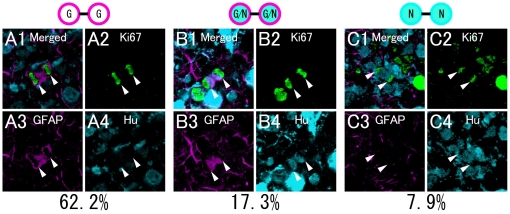
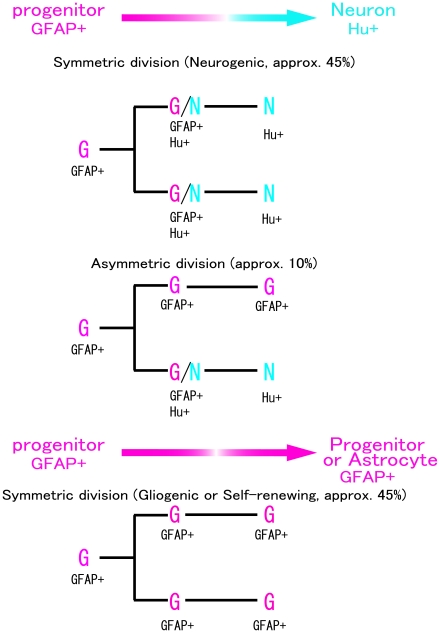
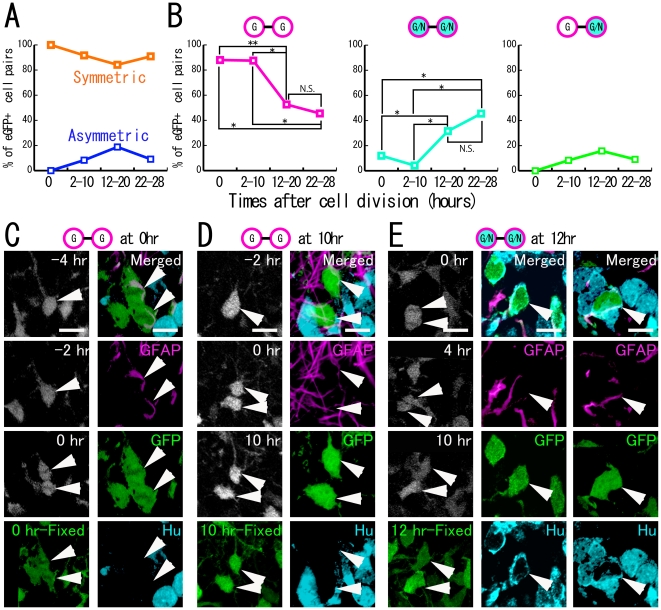
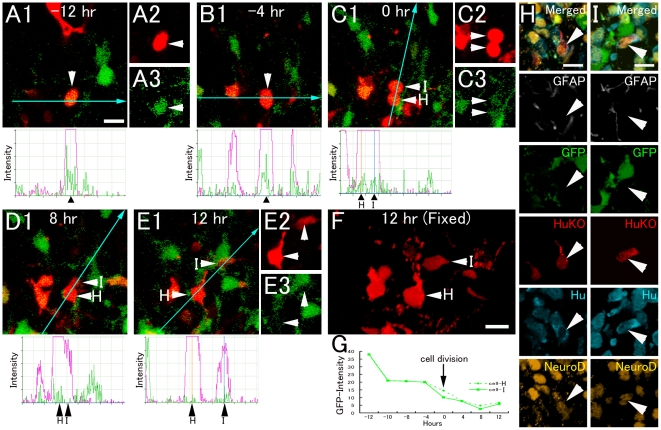
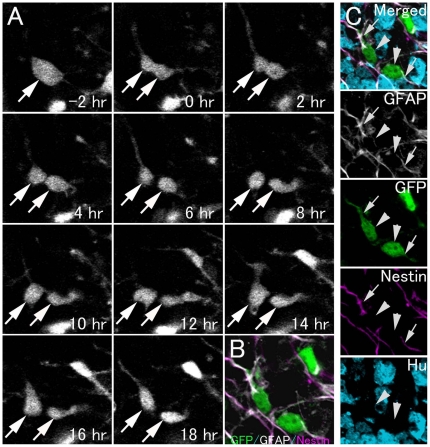
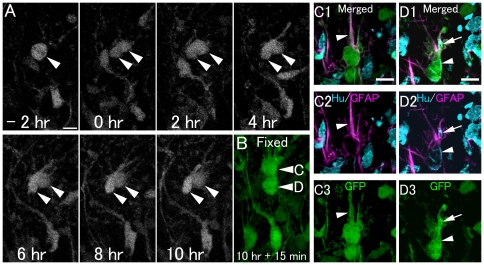
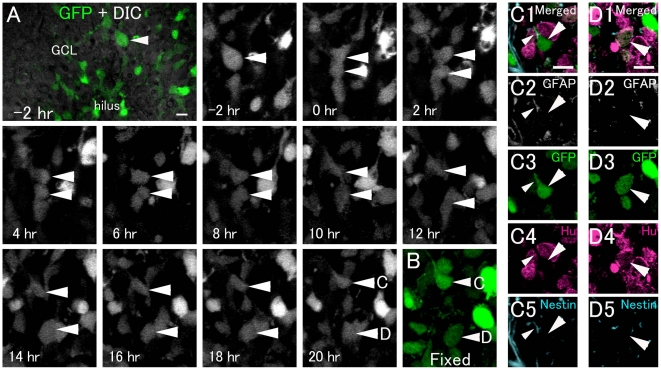
Granule cells in the hippocampus, a region critical for memory and learning, are generated mainly during the early postnatal period but neurogenesis continues in adulthood. Postnatal neuronal production is carried out by primary progenitors that express glial fibrillary acidic protein (GFAP) and they are assumed to function as stem cells. A central question regarding postnatal dentate neurogenesis is how astrocyte-like progenitors produce neurons. To reveal cell division patterns and the process of neuronal differentiation of astrocyte-like neural progenitors, we performed time-lapse imaging in cultured hippocampal slices from early postnatal transgenic mice with mouse GFAP promoter-controlled enhanced green fluorescent protein (mGFAP-eGFP Tg mice) in combination with a retrovirus carrying a red fluorescent protein gene. Our results showed that the majority of GFAP-eGFP+ progenitor cells that express GFAP, Sox2 and nestin divided symmetrically to produce pairs of GFAP+ cells (45%) or pairs of neuron-committed cells (45%), whereas a minority divided asymmetrically to generate GFAP+ cells and neuron-committed cells (10%). The present results suggest that a substantial number of GFAP-expressing progenitors functions as transient amplifying progenitors, at least in an early postnatal dentate gyrus, although a small population appears to be stem cell-like progenitors. From the present data, we discuss possible cell division patterns of adult GFAP+ progenitors.
海马中的颗粒细胞对于记忆和学习至关重要,其主要在出生后早期产生,但神经发生在成年期仍在继续。出生后神经元的产生是由表达神经胶质纤维酸性蛋白 (GFAP) 的主要祖细胞进行的,它们被认为是干细胞。关于出生后齿状回神经发生的一个核心问题是星形细胞样祖细胞如何产生神经元。为了揭示星形细胞样神经祖细胞的细胞分裂模式和神经元分化过程,我们在早期出生后具有小鼠 GFAP 启动子控制的增强型绿色荧光蛋白 (mGFAP-eGFP Tg 小鼠) 的培养海马切片中进行了延时成像,同时使用携带红色荧光蛋白基因的逆转录病毒。我们的结果表明,大多数表达 GFAP、Sox2 和巢蛋白的 GFAP-eGFP+祖细胞通过对称分裂产生一对 GFAP+细胞 (45%) 或一对神经元祖细胞 (45%),而少数细胞通过不对称分裂产生 GFAP+细胞和神经元祖细胞 (10%)。目前的结果表明,大量表达 GFAP 的祖细胞作为短暂扩增祖细胞发挥作用,至少在出生后早期的齿状回是这样,尽管一小部分祖细胞似乎具有干细胞样特性。根据目前的数据,我们讨论了成年 GFAP+祖细胞的可能细胞分裂模式。