Leitzinger M, Odert P, Kulikov Yu N, Lammer H, Wuchterl G, Penz T, Guarcello M G, Micela G, Khodachenko M L, Weingrill J, Hanslmeier A, Biernat H K, Schneider J
Institute for Physics, IGAM, University of Graz, Universitätsplatz 5, A-8010 Graz, Austria.
Planet Space Sci. 2011 Oct;59(13):1472-1481. doi: 10.1016/j.pss.2011.06.003.
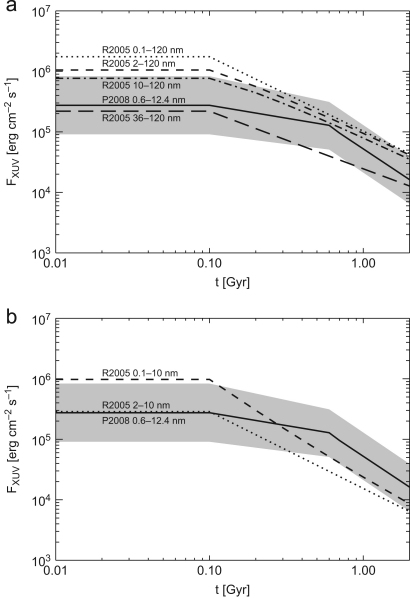
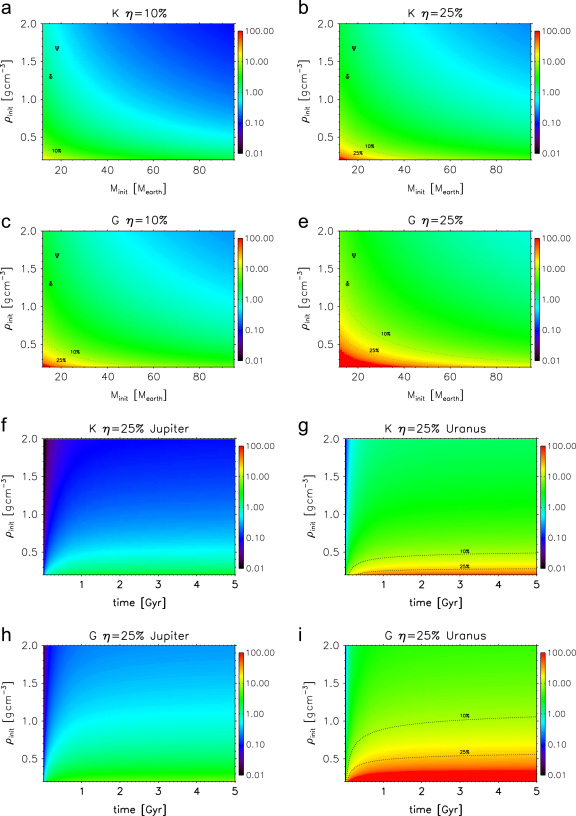
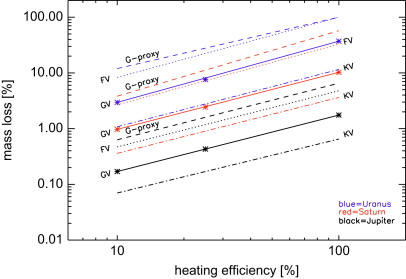
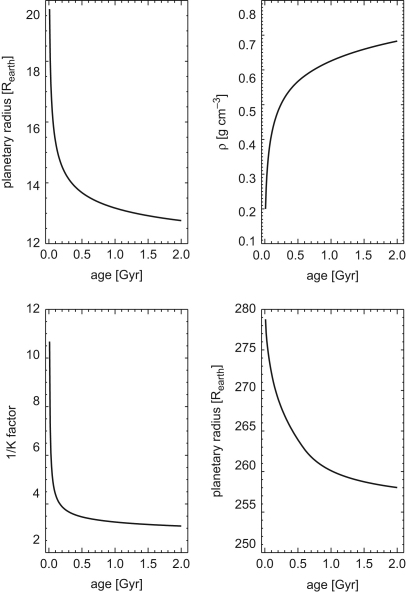
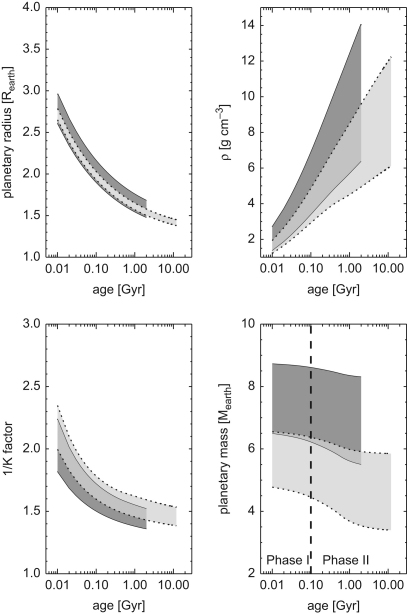
We present thermal mass loss calculations over evolutionary time scales for the investigation if the smallest transiting rocky exoplanets CoRoT-7b (∼1.68REarth) and Kepler-10b (∼1.416REarth) could be remnants of an initially more massive hydrogen-rich gas giant or a hot Neptune-class exoplanet. We apply a thermal mass loss formula which yields results that are comparable to hydrodynamic loss models. Our approach considers the effect of the Roche lobe, realistic heating efficiencies and a radius scaling law derived from observations of hot Jupiters. We study the influence of the mean planetary density on the thermal mass loss by placing hypothetical exoplanets with the characteristics of Jupiter, Saturn, Neptune, and Uranus to the orbital location of CoRoT-7b at 0.017 AU and Kepler-10b at 0.01684 AU and assuming that these planets orbit a K- or G-type host star. Our findings indicate that hydrogen-rich gas giants within the mass domain of Saturn or Jupiter cannot thermally lose such an amount of mass that CoRoT-7b and Kepler-10b would result in a rocky residue. Moreover, our calculations show that the present time mass of both rocky exoplanets can be neither a result of evaporation of a hydrogen envelope of a "Hot Neptune" nor a "Hot Uranus"-class object. Depending on the initial density and mass, these planets most likely were always rocky planets which could lose a thin hydrogen envelope, but not cores of thermally evaporated initially much more massive and larger objects.
我们给出了在演化时间尺度上的热质量损失计算结果,以研究最小的凌日系岩石系外行星CoRoT - 7b(约1.68地球半径)和开普勒 - 10b(约1.416地球半径)是否可能是最初质量更大的富氢气体巨星或热海王星类系外行星的残余。我们应用了一个热质量损失公式,其得出的结果与流体动力学损失模型相当。我们的方法考虑了洛希瓣的影响、实际的加热效率以及从热木星观测中得出的半径缩放定律。我们通过将具有木星、土星、海王星和天王星特征的假设系外行星放置在CoRoT - 7b位于0.017天文单位的轨道位置和开普勒 - 10b位于0.01684天文单位的轨道位置,并假设这些行星围绕K型或G型宿主恒星运行,来研究平均行星密度对热质量损失的影响。我们的研究结果表明,处于土星或木星质量范围内的富氢气体巨星不会因热作用而损失如此多的质量,以至于CoRoT - 7b和开普勒 - 10b会形成岩石残余。此外,我们的计算表明,这两颗岩石系外行星目前的质量既不是“热海王星”氢包层蒸发的结果,也不是“热天王星”类天体蒸发的结果。根据初始密度和质量,这些行星很可能一直都是岩石行星,它们可能会失去一层稀薄的氢包层,但不会是最初质量大得多、体积大得多的天体热蒸发后的核心。