Department of Neuroscience and Physiology, SUNY Upstate Medical University, Syracuse, NY 13210, USA.
Neurosci Lett. 2011 Nov 7;505(1):19-24. doi: 10.1016/j.neulet.2011.09.040. Epub 2011 Sep 29.
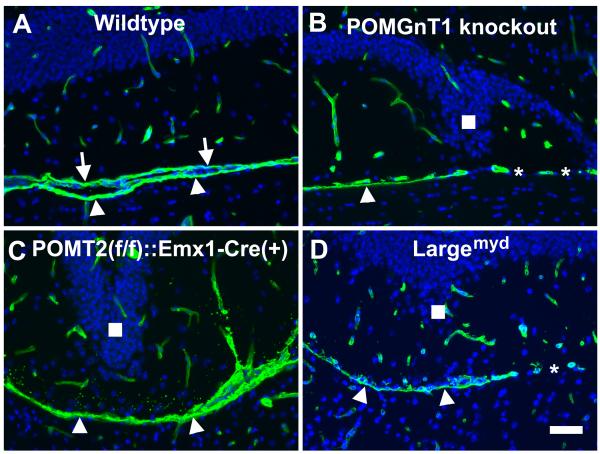
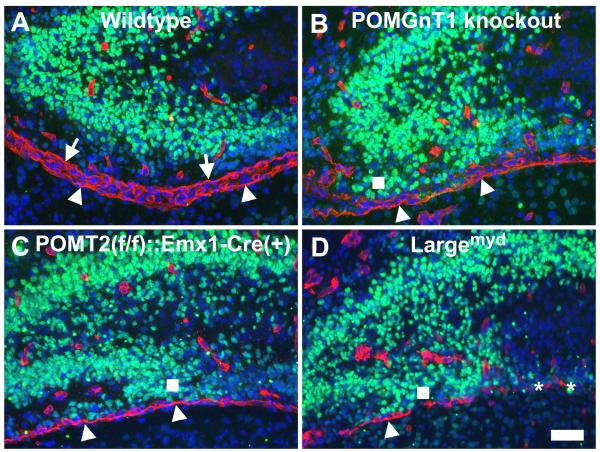
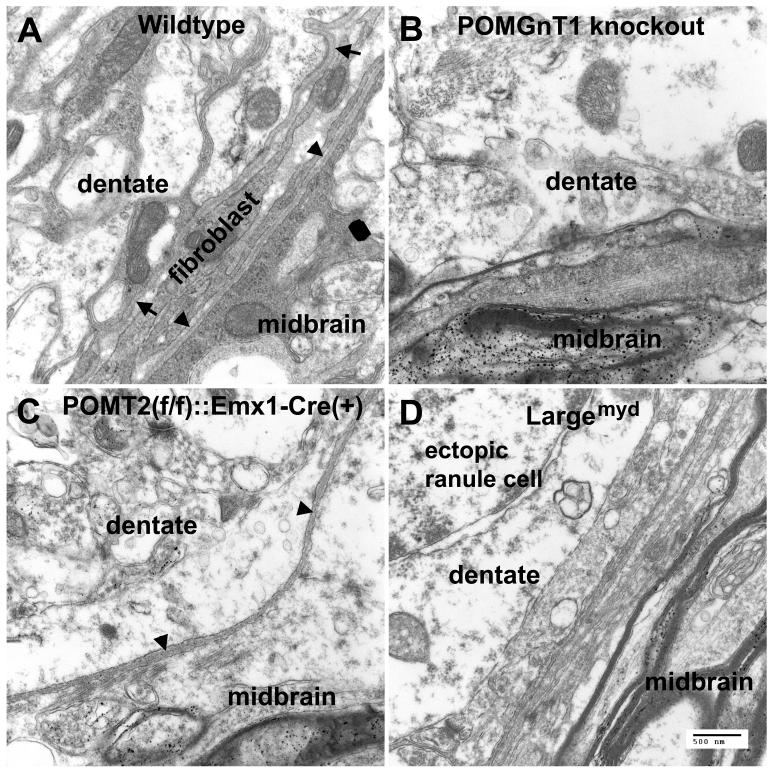
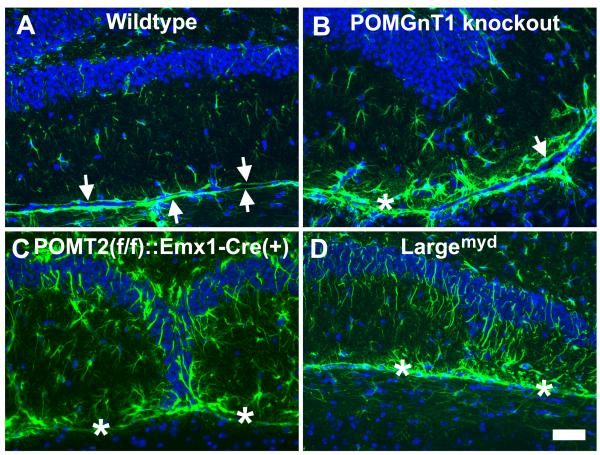
A subset of congenital muscular dystrophies (CMDs) has central nervous system manifestations. There are good mouse models for these CMDs that include POMGnT1 knockout, POMT2 knockout and Large(myd) mice with all exhibiting defects in dentate gyrus. It is not known how the abnormal dentate gyrus is formed during the development. In this study, we conducted a detailed morphological examination of the dentate gyrus in adult and newborn POMGnT1 knockout, POMT2 knockout, and Large(myd) mice by immunofluorescence staining and electron microscopic analyses. We observed that the pial basement membrane overlying the dentate gyrus was disrupted and there was ectopia of granule cell precursors through the breached pial basement membrane. Besides these, the knockout dentate gyrus exhibited reactive gliosis in these mouse models. Thus, breaches in the pial basement membrane are associated with defective dentate gyrus development in mouse models of congenital muscular dystrophies.
一部分先天性肌营养不良症(CMD)有中枢神经系统表现。这些 CMD 有很好的小鼠模型,包括 POMGnT1 敲除、POMT2 敲除和 Large(myd) 小鼠,它们的齿状回均有缺陷。目前尚不清楚在发育过程中异常的齿状回是如何形成的。在这项研究中,我们通过免疫荧光染色和电子显微镜分析,对成年和新生 POMGnT1 敲除、POMT2 敲除和 Large(myd) 小鼠的齿状回进行了详细的形态学检查。我们观察到,覆盖齿状回的软脑膜基底层被破坏,颗粒细胞前体细胞通过破裂的软脑膜基底层异位。除此之外,这些小鼠模型的齿状回还表现出反应性神经胶质增生。因此,软脑膜基底层的破裂与先天性肌营养不良症小鼠模型中齿状回发育缺陷有关。