Cardiovascular Research Group, University of Manchester, Manchester, UK.
J Cell Mol Med. 2012 Aug;16(8):1720-30. doi: 10.1111/j.1582-4934.2011.01457.x.
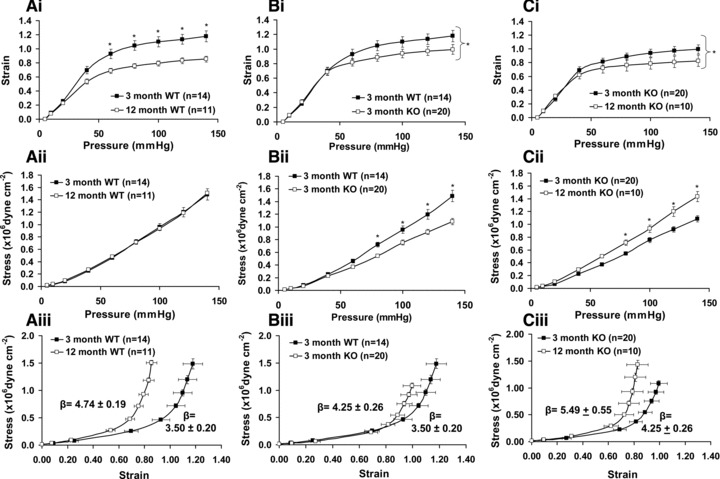
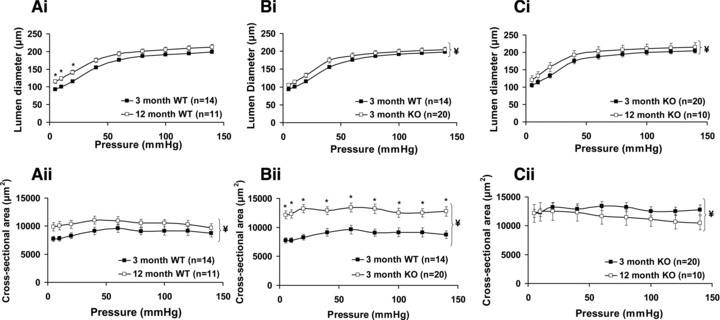
Caveolin-1, an integral protein of caveolae, is associated with multiple cardiovascular signalling pathways. Caveolin-1 knockout (KO) mice have a reduced lifespan. As changes in artery structure and function are associated with ageing we have investigated the role of caveolin-1 ablation on age-related changes of small artery contractility and passive mechanical properties. Mesenteric small arteries isolated from 3 and 12-month wild-type (WT) and caveolin-1 KO mice were mounted on a pressure myograph and changes in passive and functional arterial properties were continuously monitored. In WT mice ageing was associated with a reduction in arterial contractility to noradrenaline which was reversed by inhibition of nitric oxide synthase with L-NNA. Similarly, in 3-month-old mice, caveolin-1 KO reduced contractility to noradrenaline by an L-NNA-sensitive mechanism. However, ageing in caveolin-1 KO mice was not associated with any further change in contractility. In WT mice ageing was associated with an increased passive arterial diameter and cross-sectional area (CSA), consistent with outward remodelling of the arterial wall, and a reduced arterial distensibility. Caveolin-1 ablation at 3 months of age resulted in similar changes in passive arterial properties to those observed with ageing in WT animals. However, ageing in caveolin-1 KO mice resulted in a reduced arterial CSA indicating different effects on passive structural characteristics from that observed in WT mice. Thus, caveolin-1 mice show abnormalities of small mesenteric artery function and passive mechanical characteristics indicative of premature vascular ageing. Moreover, caveolin-1 ablation modulates the age-related changes usually observed in mesenteric arteries of WT mice.
窖蛋白-1 是小窝蛋白的一种完整蛋白,与多种心血管信号通路有关。窖蛋白-1 敲除(KO)小鼠的寿命缩短。由于动脉结构和功能的变化与衰老有关,我们研究了窖蛋白-1 缺失对小动脉收缩性和被动机械特性与年龄相关变化的作用。从小鼠 3 个月和 12 个月龄的野生型(WT)和窖蛋白-1 KO 中分离出肠系膜小动脉,并将其安装在压力肌动描记器上,连续监测被动和功能动脉特性的变化。在 WT 小鼠中,随着年龄的增长,去甲肾上腺素引起的动脉收缩性降低,这种降低可被一氧化氮合酶抑制剂 L-NNA 逆转。同样,在 3 个月大的小鼠中,窖蛋白-1 KO 通过 L-NNA 敏感机制降低了去甲肾上腺素的收缩性。然而,在窖蛋白-1 KO 小鼠中,衰老并没有导致收缩性进一步变化。在 WT 小鼠中,随着年龄的增长,动脉的被动直径和横截面积(CSA)增加,这与动脉壁的外向重塑一致,动脉可扩展性降低。在 3 个月龄时,窖蛋白-1 缺失导致的被动动脉特性变化与 WT 动物衰老时观察到的变化相似。然而,在窖蛋白-1 KO 小鼠中,随着年龄的增长,动脉 CSA 减少,表明其对被动结构特征的影响与 WT 小鼠不同。因此,窖蛋白-1 敲除小鼠表现出小肠系膜动脉功能和被动机械特性异常,表明其血管衰老提前。此外,窖蛋白-1 缺失改变了 WT 小鼠肠系膜动脉中通常观察到的与年龄相关的变化。