Metastasis Research Laboratory, GIGA Cancer, University of Liege, Bat. B23, CHU Sart Tilman Liège, B-4000 Liège, Belgium.
Laboratory of Mass Spectrometry, Department of Chemistry, University of Liege, Bat. B6c, B-4000 Liège, Belgium.
Proteome Sci. 2011 Oct 5;9(1):63. doi: 10.1186/1477-5956-9-63.
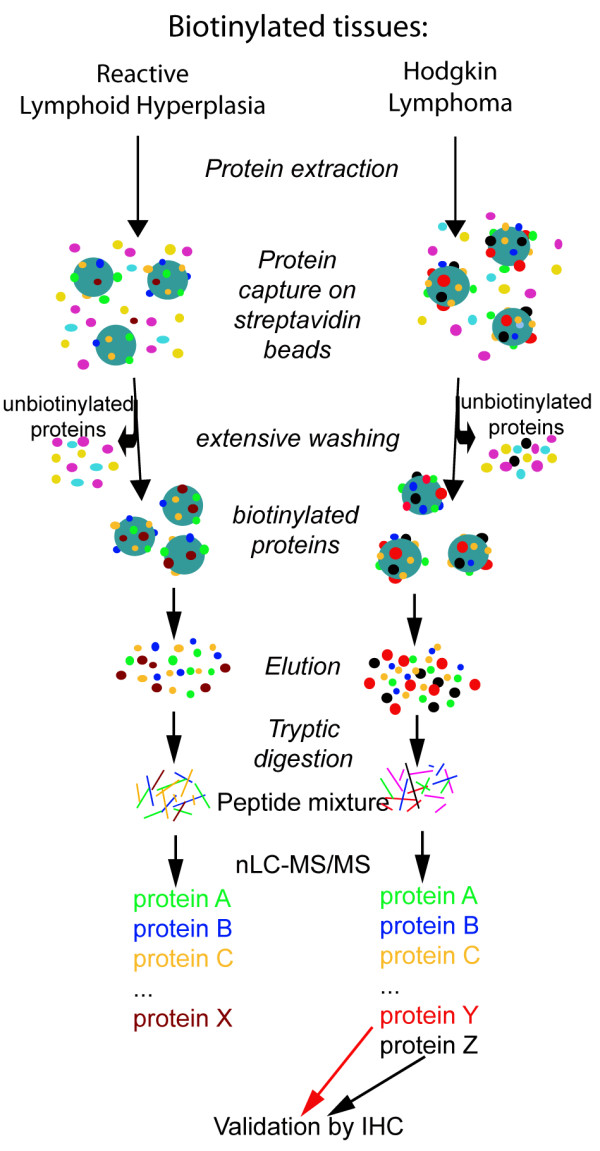
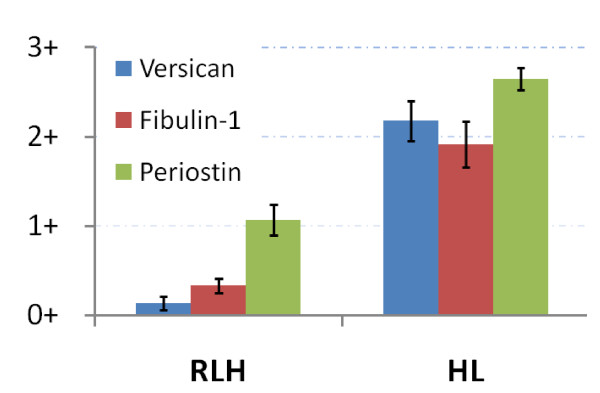
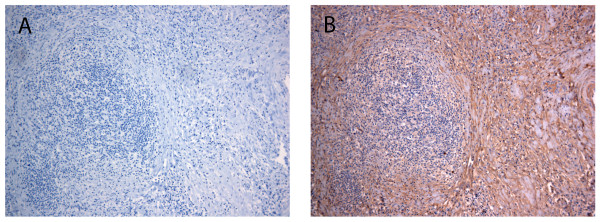
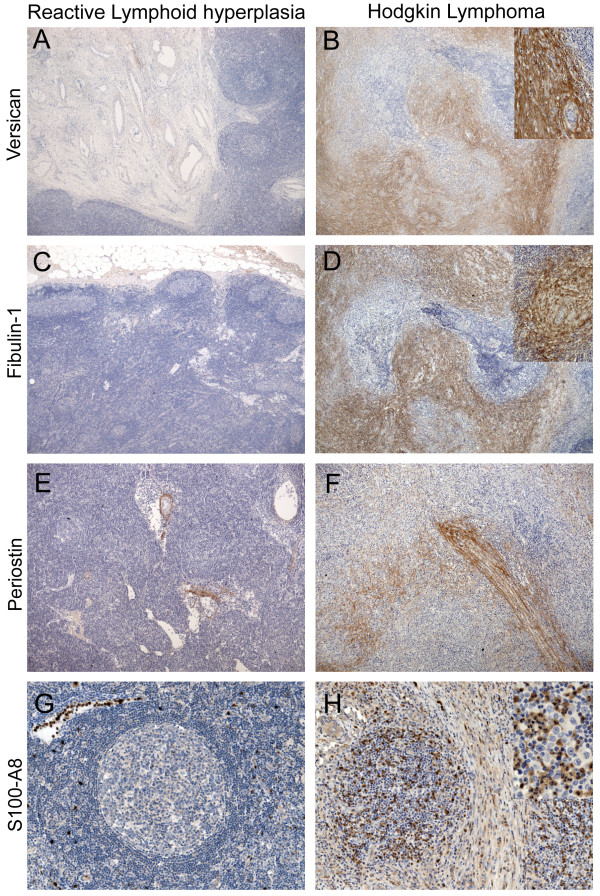
Hodgkin lymphoma (HL) represents a category of lymphoid neoplasms with unique features, notably the usual scarcity of tumour cells in involved tissues. The most common subtype of classical HL, nodular sclerosis HL, characteristically comprises abundant fibrous tissue stroma. Little information is available about the protein composition of the stromal environment from HL. Moreover, the identification of valid protein targets, specifically and abundantly expressed in HL, would be of utmost importance for targeted therapies and imaging, yet the biomarkers must necessarily be accessible from the bloodstream. To characterize HL stroma and to identify potentially accessible proteins, we used a chemical proteomic approach, consisting in the labelling of accessible proteins and their subsequent purification and identification by mass spectrometry. We performed an analysis of potentially accessible proteins in lymph node biopsies from HL and reactive lymphoid tissues, and in total, more than 1400 proteins were identified in 7 samples. We have identified several extracellular matrix proteins overexpressed in HL, such as versican, fibulin-1, periostin, and other proteins such as S100-A8. These proteins were validated by immunohistochemistry on a larger series of biopsy samples, and bear the potential to become targets for antibody-based anti-cancer therapies.
霍奇金淋巴瘤(HL)是一类具有独特特征的淋巴肿瘤,其特征为受累组织中肿瘤细胞通常稀少。经典 HL 的最常见亚型结节性硬化型 HL 通常包含丰富的纤维组织基质。关于 HL 基质环境的蛋白质组成,人们知之甚少。此外,鉴定在 HL 中特异性且丰富表达的有效蛋白靶标对于靶向治疗和成像非常重要,但生物标志物必须可从血液中获得。为了描述 HL 基质并鉴定潜在可及的蛋白,我们使用了一种化学蛋白质组学方法,包括标记可及蛋白,然后通过质谱进行后续的纯化和鉴定。我们对来自 HL 和反应性淋巴组织的淋巴结活检进行了潜在可及蛋白的分析,在 7 个样本中共鉴定出 1400 多种蛋白。我们鉴定了几种在 HL 中过表达的细胞外基质蛋白,如 versican、fibulin-1、periostin 以及 S100-A8 等其他蛋白。我们通过对更大系列的活检样本进行免疫组织化学验证了这些蛋白,并有可能成为基于抗体的抗癌治疗的靶标。