Department of Animal Science, Georg August University, Albrecht-Thaer-Weg 3, 37075 Göttingen, Germany.
Parasitol Res. 2012 Apr;110(4):1453-9. doi: 10.1007/s00436-011-2648-1. Epub 2011 Oct 7.
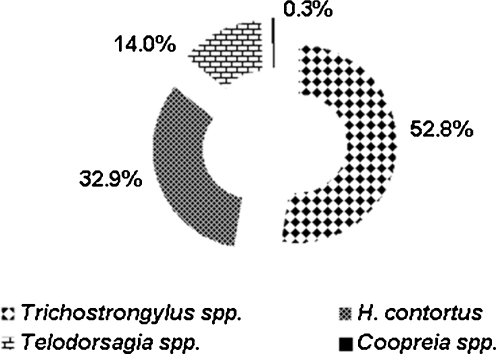
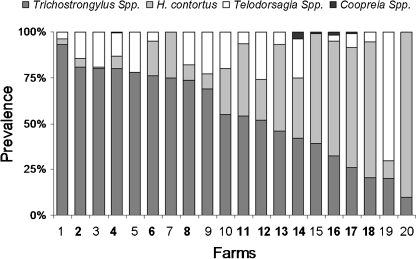
The objective of the present study was to determine the prevalence and variation of natural gastrointestinal nematode (GIN) infections in lambs according to birth type, gender and breed based on individual faecal egg counts (FEC) from various regions in Germany. A total of 3,924 lambs (3 to 15 months old) with different genetic backgrounds (Merinoland, German Blackhead Mutton, Rhoen, Texel and Merino long-wool) were individually sampled during the grazing period between 2006 and 2008. Furthermore, pooled faecal samples from each of the farms were cultured in order to differentiate the third-stage larvae of the nematode spp. Sixty-three percent of the lambs were infected with GIN. The infections were mostly low to moderate and involved several nematode species. The Trichostrongylus spp. was the predominant species based on the percentage of larvae in faecal cultures. Only 11.4% of the lambs were free of Eimeria oocysts. Tapeworm eggs were encountered in 13.2% of all samples. The prevalence of GIN infections varied significantly (P < 0.001) among farms. A significantly higher FEC (P < 0.05) was observed in multiple-born lambs when compared with singletons. Moreover, male lambs were more susceptible to infection than females (P < 0.001). No significant differences (P > 0.05) were observed between breeds regarding FEC. Inter-individual variations were higher than inter-breed differences, which may indicate the possibility of selection within these breeds for parasites resistance as described in earlier studies.
本研究旨在根据德国不同地区的个体粪便卵计数(FEC),确定按出生类型、性别和品种分类的羔羊自然胃肠道线虫(GIN)感染的流行率和变化。2006 年至 2008 年放牧期间,对来自不同遗传背景(美利奴兰、德国黑头羊肉、Rhoen、特克塞尔和美利奴长毛)的 3924 只 3 至 15 月龄的羔羊进行了个体采样。此外,对每个农场的混合粪便样本进行培养,以区分线虫 spp 的第三期幼虫。63%的羔羊受到 GIN 感染。感染多为低至中度,涉及多种线虫物种。根据粪便培养中幼虫的百分比,Trichostrongylus spp.是主要物种。仅有 11.4%的羔羊无艾美尔球虫卵囊。所有样本中,绦虫卵的检出率为 13.2%。GIN 感染的流行率在农场之间差异显著(P<0.001)。与单胎羔羊相比,多胎羔羊的 FEC 显著更高(P<0.05)。此外,雄性羔羊比雌性羔羊更容易感染(P<0.001)。不同品种之间的 FEC 无显著差异(P>0.05)。个体间的变异高于品种间的差异,这可能表明在这些品种中存在对寄生虫抗性的选择,正如早期研究所述。