Department of Anesthesiology, Perioperative and Pain Medicine, Brigham and Women's Hospital, Harvard Medical School, Boston, Massachusetts, United States of America.
PLoS One. 2011;6(9):e24593. doi: 10.1371/journal.pone.0024593. Epub 2011 Sep 30.
Postoperative ventricular dysfunction (VnD) occurs in 9-20% of coronary artery bypass graft (CABG) surgical patients and is associated with increased postoperative morbidity and mortality. Understanding genetic causes of postoperative VnD should enhance patient risk stratification and improve treatment and prevention strategies. We aimed to determine if genetic variants associate with occurrence of in-hospital VnD after CABG surgery.
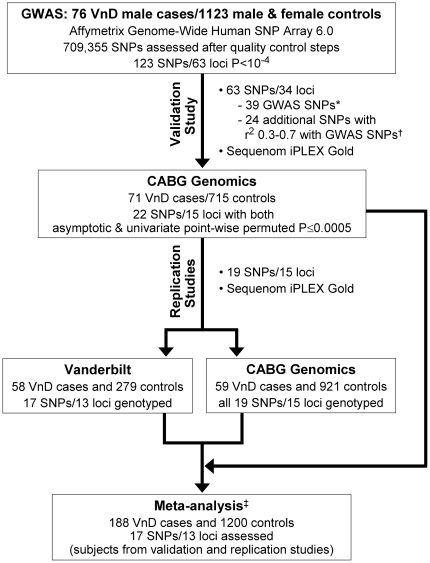
A genome-wide association study identified single nucleotide polymorphisms (SNPs) associated with postoperative VnD in male subjects of European ancestry undergoing isolated primary CABG surgery with cardiopulmonary bypass. VnD was defined as the need for ≥2 inotropes or mechanical ventricular support after CABG surgery. Validated SNPs were assessed further in two replication CABG cohorts and meta-analysis was performed.
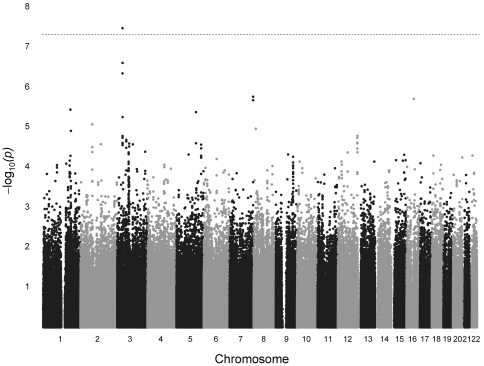
Over 100 SNPs were associated with VnD (P<10(-4)), with one SNP (rs17691914) encoded at 3p22.3 reaching genome-wide significance (P(additive model) = 2.14×10(-8)). Meta-analysis of validation and replication study data for 17 SNPs identified three SNPs associated with increased risk for developing postoperative VnD after adjusting for clinical risk factors. These SNPs are located at 3p22.3 (rs17691914, OR(additive model) = 2.01, P = 0.0002), 3p14.2 (rs17061085, OR(additive model) = 1.70, P = 0.0001) and 11q23.2 (rs12279572, OR(recessive model) = 2.19, P = 0.001).
No SNPs were consistently associated with strong risk (OR(additive model)>2.1) of developing in-hospital VnD after CABG surgery. However, three genetic loci identified by meta-analysis were more modestly associated with development of postoperative VnD. Studies of larger cohorts to assess these loci as well as to define other genetic mechanisms and related biology that link genetic variants to postoperative ventricular dysfunction are warranted.
术后心室功能障碍(VnD)发生在 9-20%的冠状动脉旁路移植(CABG)手术患者中,与术后发病率和死亡率增加有关。了解术后 VnD 的遗传原因应增强患者风险分层,并改善治疗和预防策略。我们旨在确定遗传变异是否与 CABG 手术后院内 VnD 的发生有关。
全基因组关联研究确定了与接受体外循环下孤立性原发性 CABG 手术的欧洲血统男性患者术后 VnD 相关的单核苷酸多态性(SNP)。VnD 定义为 CABG 手术后需要使用≥2 种正性肌力药或机械心室支持。进一步评估了两个复制 CABG 队列中的验证 SNP,并进行了荟萃分析。
超过 100 个 SNP 与 VnD 相关(P<10(-4)),其中一个 SNP(rs17691914)位于 3p22.3,达到全基因组显著性水平(P(additive model) = 2.14×10(-8))。对 17 个 SNP 的验证和复制研究数据进行荟萃分析,确定了三个 SNP 在调整临床危险因素后与术后 VnD 风险增加相关。这些 SNP 位于 3p22.3(rs17691914,OR(additive model) = 2.01,P = 0.0002)、3p14.2(rs17061085,OR(additive model) = 1.70,P = 0.0001)和 11q23.2(rs12279572,OR(recessive model) = 2.19,P = 0.001)。
没有 SNP 与 CABG 手术后院内 VnD 发生的强风险(OR(additive model)>2.1)一致相关。然而,荟萃分析确定的三个遗传位点与术后 VnD 的发生呈中度相关。需要更大的队列研究来评估这些位点以及确定将遗传变异与术后心室功能障碍联系起来的其他遗传机制和相关生物学。