Epidemiology Service, Public Health Agency of Barcelona, Barcelona, Spain.
PLoS One. 2011;6(9):e25315. doi: 10.1371/journal.pone.0025315. Epub 2011 Sep 28.
Mortality among patients who complete tuberculosis (TB) treatment is still high among vulnerable populations. The objective of the study was to identify the probability of death and its predictive factors in a cohort of successfully treated TB patients.
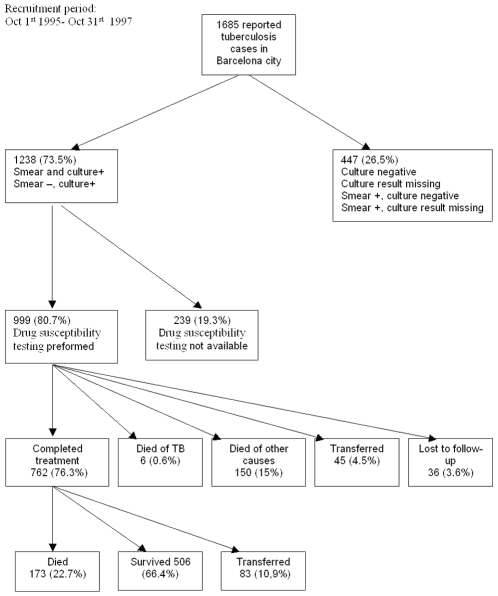
A population-based retrospective longitudinal study was performed in Barcelona, Spain. All patients who successfully completed TB treatment with culture-confirmation and available drug susceptibility testing between 1995-1997 were retrospectively followed-up until December 31, 2005 by the Barcelona TB Control Program. Socio-demographic, clinical, microbiological and treatment variables were examined. Mortality, TB Program and AIDS registries were reviewed. Kaplan-Meier and a Cox regression methods with time-dependent covariates were used for the survival analysis, calculating the hazard ratio (HR) with 95% confidence intervals (CI).
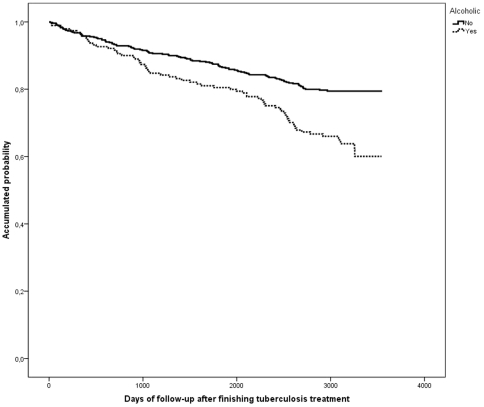
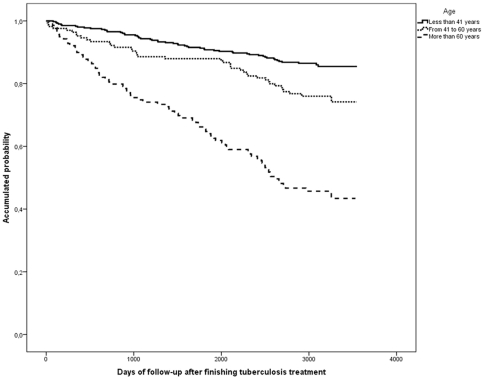
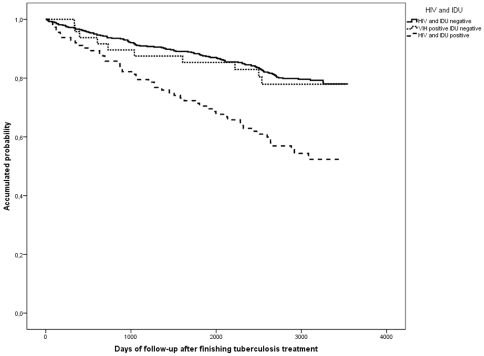
Among the 762 included patients, the median age was 36 years, 520 (68.2%) were male, 178 (23.4%) HIV-infected, and 208 (27.3%) were alcohol abusers. Of the 134 (17.6%) injecting drug users (IDU), 123 (91.8%) were HIV-infected. A total of 30 (3.9%) recurrences and 173 deaths (22.7%) occurred (mortality rate: 3.4/100 person-years of follow-up). The predictors of death were: age between 41-60 years old (HR: 3.5; CI:2.1-5.7), age greater than 60 years (HR: 14.6; CI:8.9-24), alcohol abuse (HR: 1.7; CI:1.2-2.4) and HIV-infected IDU (HR: 7.9; CI:4.7-13.3).
The mortality rate among TB patients who completed treatment is associated with vulnerable populations such as the elderly, alcohol abusers, and HIV-infected IDU. We therefore need to fight against poverty, and promote and develop interventions and social policies directed towards these populations to improve their survival.
在弱势群体中,完成结核病(TB)治疗的患者的死亡率仍然很高。本研究的目的是确定成功治疗的 TB 患者队列中死亡的概率及其预测因素。
在西班牙巴塞罗那进行了一项基于人群的回顾性纵向研究。1995-1997 年间,所有成功完成培养确诊和可获得药敏试验的 TB 治疗的患者均通过巴塞罗那结核病控制项目进行了回顾性随访,直至 2005 年 12 月 31 日。检查了社会人口统计学、临床、微生物学和治疗变量。审查了死亡率、TB 计划和艾滋病登记处。使用 Kaplan-Meier 和 Cox 回归方法进行时间依赖性协变量的生存分析,计算危险比(HR)及其 95%置信区间(CI)。
在纳入的 762 名患者中,中位年龄为 36 岁,520 名(68.2%)为男性,178 名(23.4%)为 HIV 感染者,208 名(27.3%)为酗酒者。在 134 名(17.6%)注射吸毒者(IDU)中,123 名(91.8%)为 HIV 感染者。共发生 30 例(3.9%)复发和 173 例死亡(22.7%)(死亡率:3.4/100 人年随访)。死亡的预测因素是:41-60 岁年龄组(HR:3.5;CI:2.1-5.7)、60 岁以上年龄组(HR:14.6;CI:8.9-24)、酗酒(HR:1.7;CI:1.2-2.4)和 HIV 感染的 IDU(HR:7.9;CI:4.7-13.3)。
完成治疗的 TB 患者的死亡率与弱势群体有关,如老年人、酗酒者和 HIV 感染的 IDU。因此,我们需要与贫困作斗争,并促进和制定针对这些人群的干预措施和社会政策,以提高他们的生存率。