Department of Parasitology, Faculty of Medicine, University of Kelaniya, Ragama, Sri Lanka.
PLoS Negl Trop Dis. 2011 Sep;5(9):e1341. doi: 10.1371/journal.pntd.0001341. Epub 2011 Sep 27.
The plantation sector in Sri Lanka lags behind the rest of the country in terms of living conditions and health. In 1992, a sector-wide survey of children aged 3-12 years and women of reproductive age showed >90% prevalence of soil-transmitted helminth infections. Biannual mass de-worming targeting children aged 3-18 years started in 1994 and was continued until 2005. The present study was carried out to assess the status of infection four years after cessation of mass de-worming.
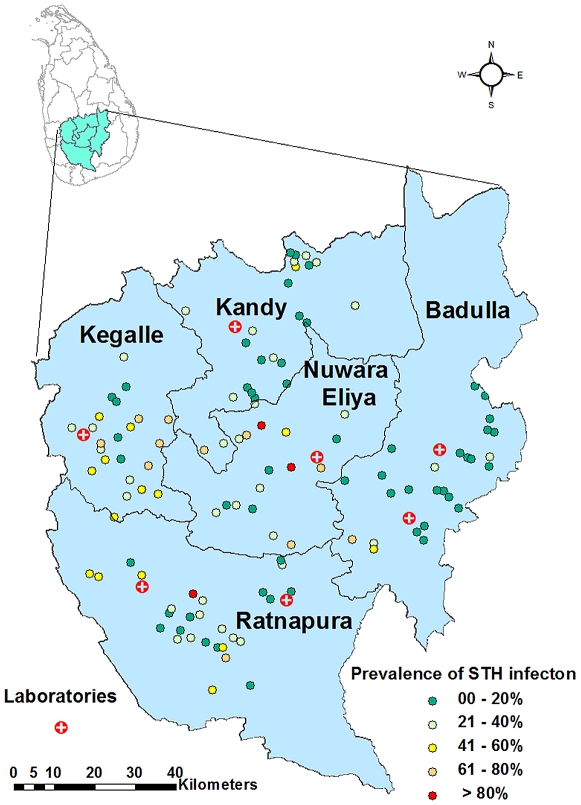
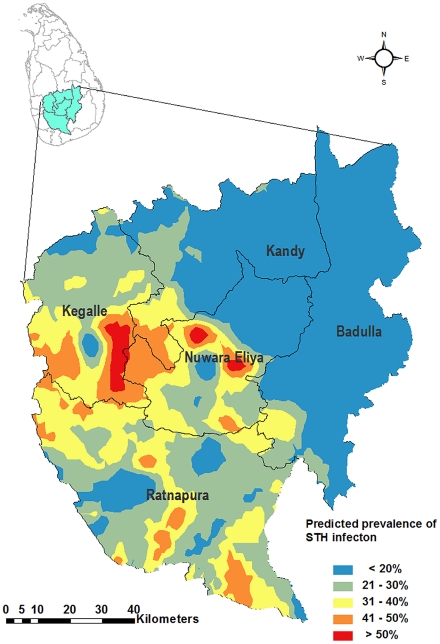
METHODS/FINDINGS: A school-based cross-sectional survey was carried out. Faecal samples from approximately 20 children from each of 114 schools in five districts were examined using the modified Kato-Katz technique. Data regarding the school, the child's family and household sanitation were recorded after inspection of schools and households. Multivariate analysis was carried out using logistic regression, to identify risk factors for infection. Faecal samples were obtained from 1890 children. In 4/5 districts, >20% were infected with one or more helminth species. Overall combined prevalence was 29.0%; 11.6% had infections of moderate-heavy intensity. The commonest infection was Ascaris lumbricoides, present in all five districts, as was Trichuris trichiura. Hookworm was not detected in two districts. Multivariate analysis identified low altitude and maternal under-education as risk factors for all three infections. Poor household sanitation was identified as a risk factor for A. lumbricoides and hookworm, but not T. trichiura infections.
CONCLUSIONS/SIGNIFICANCE: The results indicate that regular mass de-worming of plantation sector children should be resumed along with more emphasis on better sanitation and health education. They show that even after 10 years of mass chemotherapy, prevalence can bounce back after cessation of preventive chemotherapy, if the initial force of transmission is strong and other long-term control measures are not concomitantly implemented.
斯里兰卡种植园部门的生活条件和健康状况落后于该国其他地区。1992 年,对 3-12 岁儿童和育龄妇女进行了全部门调查,结果显示土壤传播性蠕虫感染率超过 90%。1994 年开始对 3-18 岁儿童进行两年一次的大规模驱虫,一直持续到 2005 年。本研究旨在评估大规模驱虫停止四年后的感染状况。
方法/发现:进行了一项基于学校的横断面调查。从五个地区的 114 所学校的每所学校抽取约 20 名儿童的粪便样本,使用改良加藤氏技术进行检查。在检查学校和家庭后,记录有关学校、儿童家庭和家庭卫生的数据。使用逻辑回归进行多变量分析,以确定感染的危险因素。共获得 1890 名儿童的粪便样本。在 5 个地区中的 4 个地区,超过 20%的儿童感染了一种或多种蠕虫。总体合并患病率为 29.0%;11.6%的儿童感染强度为中度至重度。最常见的感染是所有五个地区都存在的蛔虫,以及鞭虫。两个地区未发现钩虫。多变量分析确定低海拔和母亲受教育程度低是所有三种感染的危险因素。家庭卫生条件差是感染蛔虫和钩虫的危险因素,但不是感染鞭虫的危险因素。
结论/意义:结果表明,应恢复对种植园部门儿童的定期大规模驱虫,并更加重视改善卫生和健康教育。它们表明,即使在大规模化疗 10 年后,如果初始传播力度强且未同时实施其他长期控制措施,预防化疗停止后患病率也会反弹。