Department of Pathology and Laboratory Medicine, Children's Hospital of Philadelphia, Philadelphia, PA, USA.
Am J Surg Pathol. 2012 Jan;36(1):73-80. doi: 10.1097/PAS.0b013e31822cfa7e.
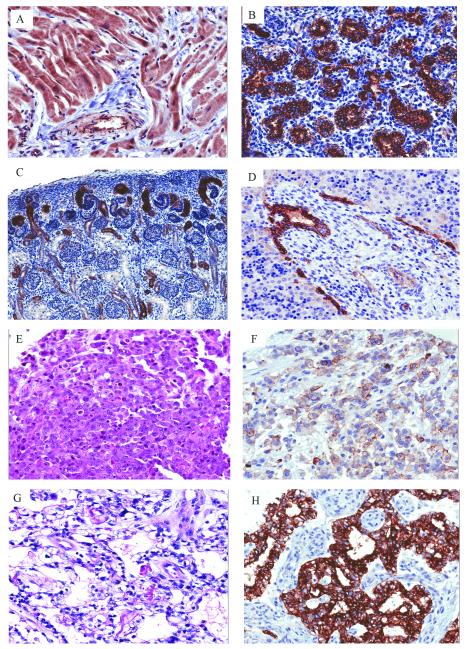
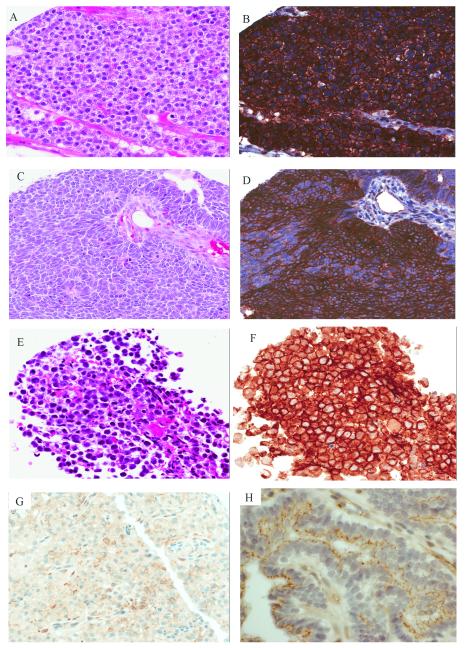
Claudins are tight junction proteins with claudin-6 (CLDN6) expression mostly restricted to embryonic and fetal life. Previously reported gene expression microarray analysis showed an increased level of CLDN6 in atypical teratoid rhabdoid tumors (AT/RT) compared with other central nervous system (CNS) tumors and sarcomas. However, there exist conflicting data on expression of CLDN6 as assessed by immunohistochemistry in CNS tumors. We established membranous staining as a specific and reproducible method for evaluating CLDN6 expression based on fetal and adolescent controls. We then evaluated a large group (257) of pediatric tumors using tissue microarrays, including: 47 malignant rhabdoid tumors (MRTs), (31 AT/RTs and 16 non-CNS MRTs); 67 small, round, blue cell tumors (10 Wilms tumors, 10 embryonal rhabdomyosarcomas, 10 neuroblastomas (NBs), 10 synovial sarcomas (SSs), 9 hepatoblastomas (HBs), 9 alveolar rhabdomyosarcomas, and 9 Ewings sarcomas); and 143 CNS tumors (24 medulloblastomas, 21 pilocytic astrocytomas, 14 astrocytomas grade II/III, 13 gangliogliomas, 12 glioblastomas, 12 ependymal tumors, 11 choroid plexus tumors, 10 meningiomas, 8 dysembryoplastic neuroepithelial tumors, 8 oligodendrogliomas, 4 craniopharyngiomas, 2 germinomas, 2 primitive neuroectodermal tumors (PNET), and 2 central neurocytomas). CLDN6 expression was seen in 12 of 31 (39%) AT/RTs, 7 of 16 (44%) non-CNS MRTs, 5 of 10 (50%) Wilms tumors, 1 of 9 (11%) HBs, 2 of 2 (100%) germinomas, 1 of 2 (50%) CNS PNETs, 1 of 24 (4%) medulloblastomas, and 1 of 10 (10%) meningiomas. Ten of 11 (91%) choroid plexus tumors showed apical staining but no concentric membranous staining. Although CLDN6 is expressed in both AT/RTs and MRTs, it is not a specific biomarker as it is expressed in a variety of other pediatric CNS and soft tissue tumors.
紧密连接蛋白 Claudin-6(CLDN6)的表达主要局限于胚胎和胎儿期。先前的基因表达微阵列分析显示,非典型畸胎样/横纹肌样肿瘤(AT/RT)与其他中枢神经系统(CNS)肿瘤和肉瘤相比,CLDN6 水平升高。然而,在 CNS 肿瘤的免疫组织化学评估中,CLDN6 的表达存在相互矛盾的数据。我们建立了膜染色作为评估 CLDN6 表达的特异性和可重复方法,基于胎儿和青少年对照。然后,我们使用组织微阵列评估了一大组(257)儿科肿瘤,包括:47 例恶性横纹肌样肿瘤(MRT),(31 例 AT/RT 和 16 例非 CNS MRT);67 例小圆细胞蓝色肿瘤(10 例肾母细胞瘤、10 例胚胎性横纹肌肉瘤、10 例神经母细胞瘤(NB)、10 例滑膜肉瘤(SS)、9 例肝母细胞瘤、9 例肺泡横纹肌肉瘤和 9 例尤文肉瘤);和 143 例 CNS 肿瘤(24 例髓母细胞瘤、21 例毛细胞星形细胞瘤、14 例星形细胞瘤 II/III 级、13 例神经节细胞瘤、12 例胶质母细胞瘤、12 例室管膜瘤、11 例脉络丛肿瘤、10 例脑膜瘤、8 例发育不良性神经上皮肿瘤、8 例少突胶质细胞瘤、4 例颅咽管瘤、2 例生殖细胞瘤、2 例原始神经外胚层肿瘤(PNET)和 2 例中枢神经细胞瘤)。CLDN6 的表达在 31 例 AT/RT 中的 12 例(39%)、16 例非 CNS MRT 中的 7 例(44%)、10 例肾母细胞瘤中的 5 例(50%)、9 例肝母细胞瘤中的 1 例(11%)、2 例生殖细胞瘤中的 2 例(100%)、2 例 CNS PNET 中的 1 例(50%)、24 例髓母细胞瘤中的 1 例(4%)和 10 例脑膜瘤中的 1 例。11 例脉络丛肿瘤中的 10 例显示顶膜染色,但没有同心膜染色。尽管 CLDN6 在 AT/RT 和 MRT 中均有表达,但由于它在多种其他儿科 CNS 和软组织肿瘤中表达,因此不是一种特异性生物标志物。