Children's Cancer Research Group, University of Otago, Christchurch, Christchurch, New Zealand.
J Exp Clin Cancer Res. 2011 Oct 12;30(1):96. doi: 10.1186/1756-9966-30-96.
Activation of beta-catenin is a hallmark of hepatoblastoma (HB) and appears to play a crucial role in its pathogenesis. While aberrant accumulation of the beta-catenin is a common event in HB, mutations or deletions in CTNNB1 (beta-catenin gene) do not always account for the high frequency of protein expression. In this study we have investigated alternative activation of beta-catenin by HGF/c-Met signaling in a large cohort of 98 HB patients enrolled in the SIOPEL-3 clinical trial.
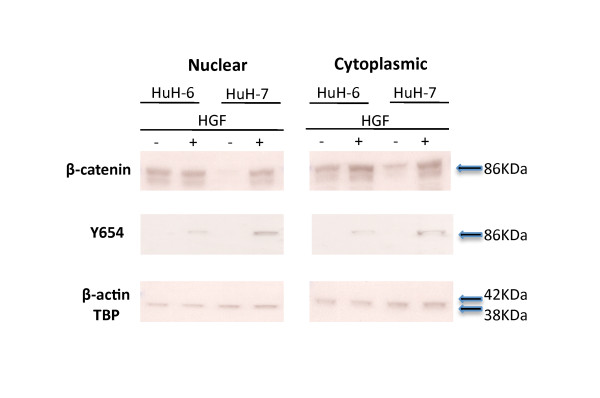
We performed immunohistochemistry, using antibodies to total beta-catenin and tyrosine654-phosphorylated beta-catenin, which is a good surrogate marker of HGF/c-Met activation. CTNNB1 mutation analysis was also carried out on all samples. We also investigated beta-catenin pathway activation in two liver cancer cell lines, HuH-6 and HuH-7.
Aberrant beta-catenin expression was seen in the cytoplasm and/or nucleus of 87% of tumour samples. Our results also revealed a large subset of HB, 83%, with cytoplasmic expression of tyrosine654-phosphorylated beta-catenin and 30% showing additional nuclear accumulation. Sequence analysis revealed mutations in 15% of our cohort. Statistical analysis showed an association between nuclear expression of c-Met-activated beta-catenin and wild type CTNNB1 (P-value = 0.015). Analysis of total beta-catenin and Y654-beta-catenin in response to HGF activation in the cell lines, mirrors that observed in our HB tumour cohort.
We identified a significant subset of hepatoblastoma patients for whom targeting of the c-Met pathway may be a treatment option and also demonstrate distinct mechanisms of beta-catenin activation in HB.
β-连环蛋白的激活是肝母细胞瘤(HB)的一个标志,似乎在其发病机制中起着关键作用。虽然β-连环蛋白的异常积累在 HB 中是常见事件,但 CTNNB1(β-连环蛋白基因)的突变或缺失并不总是解释其蛋白表达的高频。在这项研究中,我们调查了 HGF/c-Met 信号在 SIOPEL-3 临床试验中纳入的 98 例 HB 患者的大队列中对β-连环蛋白的替代激活。
我们使用针对总β-连环蛋白和酪氨酸 654 磷酸化β-连环蛋白的抗体进行免疫组织化学染色,这是 HGF/c-Met 激活的良好替代标志物。还对所有样本进行了 CTNNB1 突变分析。我们还研究了两种肝癌细胞系 HuH-6 和 HuH-7 中β-连环蛋白途径的激活。
87%的肿瘤样本中可见异常的β-连环蛋白表达,细胞质和/或核内。我们的结果还揭示了 HB 的一个大子集,83%具有细胞质中酪氨酸 654 磷酸化β-连环蛋白的表达,30%显示额外的核内积累。序列分析显示我们队列中有 15%的突变。统计分析显示核内表达 c-Met 激活的β-连环蛋白与野生型 CTNNB1 之间存在关联(P 值=0.015)。在细胞系中对 HGF 激活的总β-连环蛋白和 Y654-β-连环蛋白的分析,反映了我们在 HB 肿瘤队列中观察到的情况。
我们确定了一个显著的 HB 患者亚组,针对 c-Met 途径的靶向治疗可能是一种治疗选择,并且还证明了 HB 中β-连环蛋白激活的不同机制。